
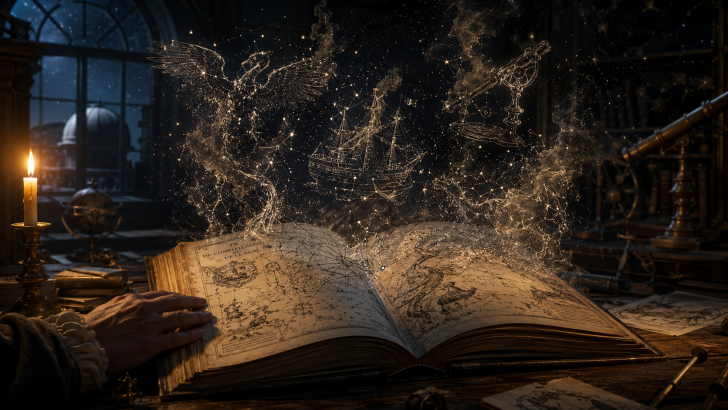
Old star maps reveal a sky you would hardly recognize today.
Between familiar figures like Hercules and Hydra, you’ll find a house cat, a royal tree, a scientific instrument, and the lost beloved of a Roman emperor.
The stars themselves haven’t moved. What has changed are the patterns we once drew between them.
Before today’s 88 official constellations were fixed, the night sky was far more varied and imaginative.
1. Antinous: The Emperor’s Lost Beloved
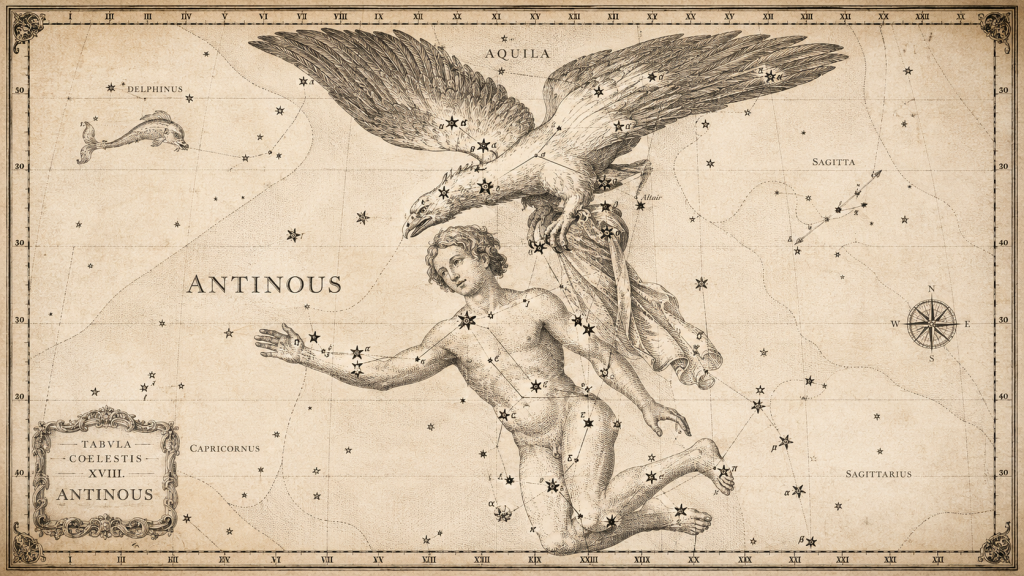
Look beneath Aquila in an old celestial atlas and you will find a young man standing among the stars.
His name was Antinous, the companion and lover of the Roman emperor Hadrian. In AD 130, while traveling with the emperor through Egypt, Antinous drowned in the Nile.
Some ancient accounts treated his death as an accident, while others suggested suicide or ritual sacrifice. Whatever the truth was, Hadrian was devastated.
The emperor founded a city in Antinous’s name, encouraged his worship, and filled the Roman world with statues of him.
He also found a place in the sky.
A small group of stars beneath Aquila became associated with him.
The astronomer Ptolemy included six stars linked to Antinous in the Almagest, though he still treated them as part of the Eagle rather than as a completely separate constellation.
Later mapmakers sometimes gave Antinous more independence. In old illustrations, Aquila appears to carry or hover over the young man.
The image echoed the Greek myth of Ganymede, another beautiful youth taken into the heavens.
But Antinous never gained a clear, permanent territory of his own. As astronomers began standardizing the constellations, his stars were absorbed fully into Aquila.
You can still see those stars today. What disappeared was the human figure drawn between them, along with one of the most personal stories ever placed in the night sky.
2. Cerberus: The Monster Hercules Couldn’t Keep
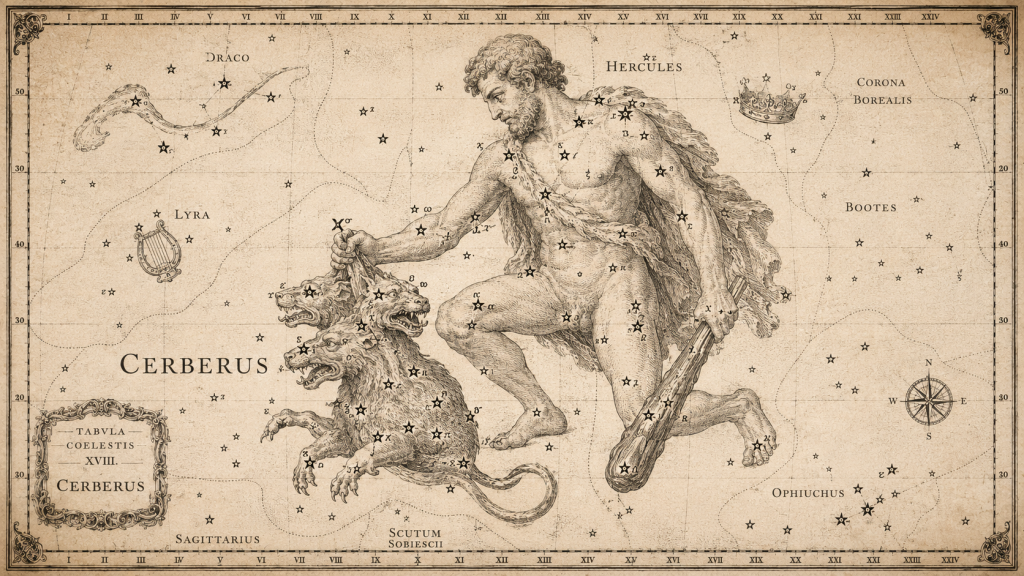
Hercules remains one of the largest constellations overhead. But the monster he once held in his hand is gone.
Cerberus was introduced by the Polish astronomer Johannes Hevelius during the late 1600s. He formed it from a small group of faint stars within the existing constellation of Hercules.
The name came from the guardian of the underworld in Greek mythology. Cerberus was the terrifying dog that watched the gates of Hades and prevented the dead from escaping.
His exact appearance changed from story to story, though he was usually described as having several heads, most famously three.
Capturing Cerberus was the final labor of Hercules. He entered the underworld, overpowered the creature, and dragged it into the world of the living.
That moment gave Hevelius his constellation.
Oddly, the creature on his chart didn’t look much like a dog. It resembled a three-headed serpent held tightly in Hercules’s hand.
It was visually memorable, but the constellation itself wasn’t convincing. Its stars were faint, and they already belonged naturally to Hercules.
So Cerberus gradually disappeared from celestial atlases. Modern charts leave Hercules with an empty hand where the monster once twisted between his fingers.
For a creature meant to stop souls from escaping, Cerberus proved surprisingly bad at remaining in the heavens.
3. Felis: The Cat That Finally Reached the Stars
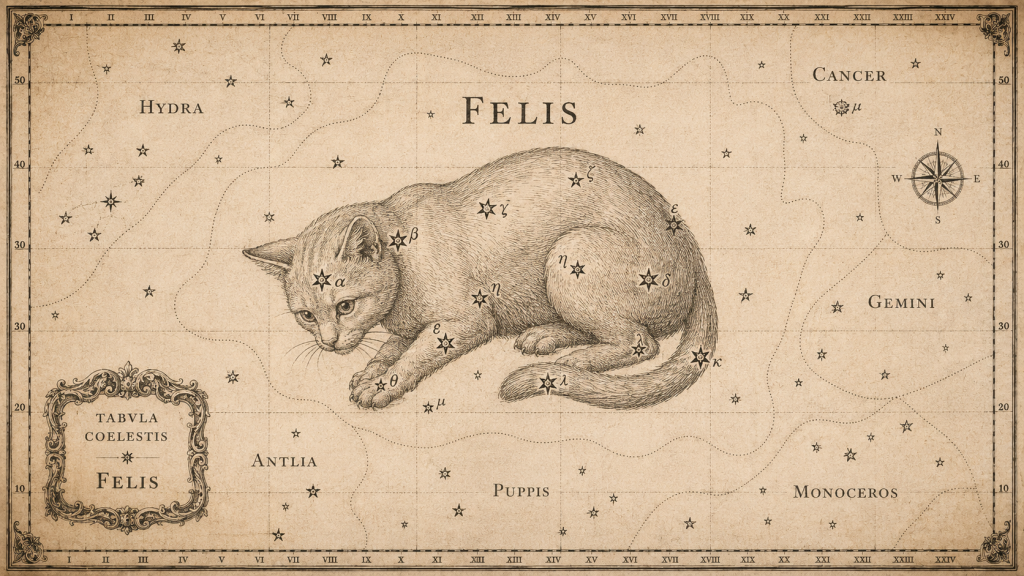
The sky already had bears, dogs, lions, fish, and birds. French astronomer Jérôme Lalande noticed one important animal was missing.
There was no ordinary house cat.
Lalande was famously fond of cats, so near the end of the eighteenth century he decided to correct the problem. He created Felis, a small constellation placed beside Hydra in a region of the southern sky.
He reportedly joked that he loved cats so much that he was willing to let one scratch across his star chart.
The constellation soon appeared in Johann Elert Bode’s influential 1801 atlas. There, Felis was shown as a small domestic cat beneath the enormous twisting body of Hydra.
It was a charming addition. But astronomers weren’t just after pretty pictures.
Felis had no bright stars and no especially memorable shape. You wouldn’t glance upward and naturally see a cat waiting there.
During the nineteenth century, mapmakers stopped including it. When the modern constellation boundaries were established, the stars of Felis officially became part of Hydra.
The cat didn’t disappear completely, though.
In 2018, the brightest star once associated with the constellation received the official name Felis. It was a tribute to the lost figure and to Lalande’s attempt to give the domestic cat a place in the heavens.
So the full animal no longer prowls across modern star maps, but one small point of light still carries its name.
4. Quadrans Muralis: The Constellation That Still Sends Meteors
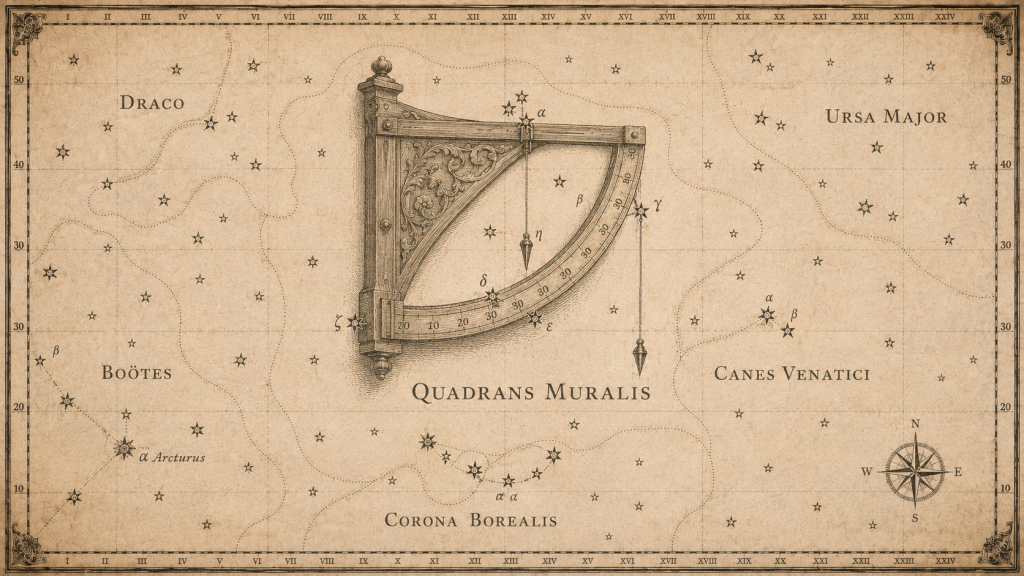
Every January, the Quadrantid meteor shower flashes across the northern sky.
The name sounds a little strange because there’s no constellation called Quadrans on modern maps. The meteors were named after something that no longer officially exists.
Quadrans Muralis means the Mural Quadrant. It referred to a large scientific instrument mounted against a wall and used by astronomers to measure the positions of stars.
Lalande introduced the constellation in 1795. He placed it in a patch of sky near Boötes, Draco, and Hercules, celebrating the tools of astronomy.
That was very common during the eighteenth century. Astronomers were filling parts of the southern and northern skies with telescopes, clocks, furnaces, and other instruments of science.
But Quadrans Muralis never became widely accepted. It had little mythology behind it, and its stars could be assigned easily to larger neighboring constellations.
When astronomers settled on the official 88 constellations in the early twentieth century, the Mural Quadrant was left out. Its territory was divided among the figures around it.
Yet its name survived through the meteor shower.
And for a few winter nights each year, a forgotten scientific instrument seems to scatter fire across the sky.
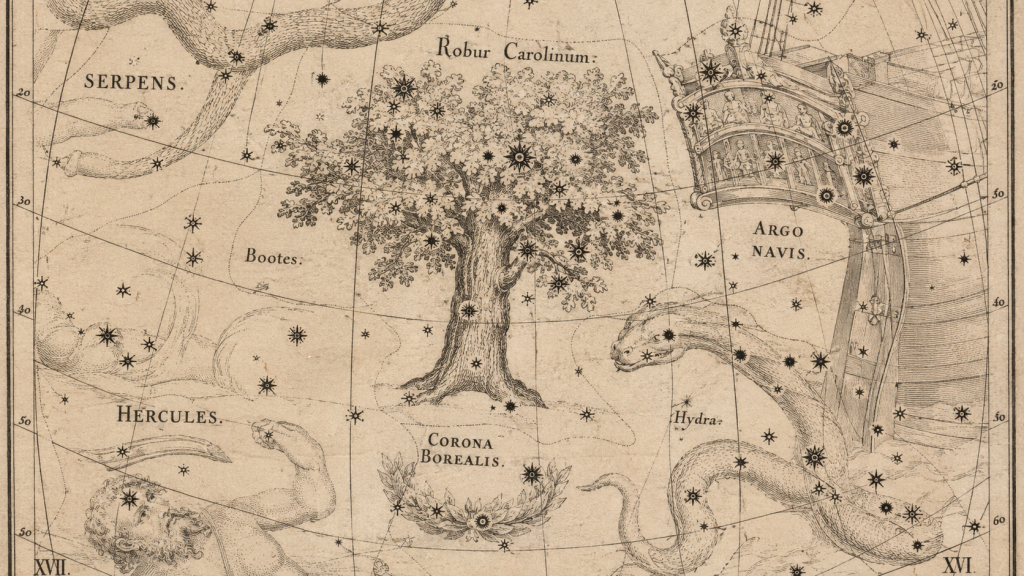
5. Robur Carolinum: The King’s Tree Among the Stars
Some constellations were created to preserve myths, while others were created to flatter powerful people.
Robur Carolinum belonged firmly to the second group.
The English astronomer Edmond Halley introduced it in the seventeenth century after studying the southern sky. Its name meant Charles’s Oak, and it honored King Charles II of England.
The tree referred to a famous episode from the king’s younger life.
After his defeat at the Battle of Worcester in 1651, Charles hid in an oak tree while soldiers searched the surrounding area.
The story later became an important symbol of his survival and eventual restoration to the throne.
Halley placed the royal oak among stars belonging to Argo Navis, the enormous ancient constellation representing the ship of Jason and the Argonauts.
Robur Carolinum wasn’t made from a forgotten patch of faint stars. It claimed several noticeable stars from an already established figure. That made it controversial from the beginning.
The French astronomer Nicolas-Louis de Lacaille later objected to the addition. He believed the oak had taken some of the finest stars from Argo Navis. So later atlases gradually removed it.
The stars of Charles’s Oak now sit mostly within Carina and Vela, with no royal tree surrounding them.
Robur Carolinum shows that old star maps weren’t neutral. They carried politics, fashion, loyalties, and the ambitions of the people who made them.
The stars remained untouched. But the king’s oak faded because the world beneath it changed.
