
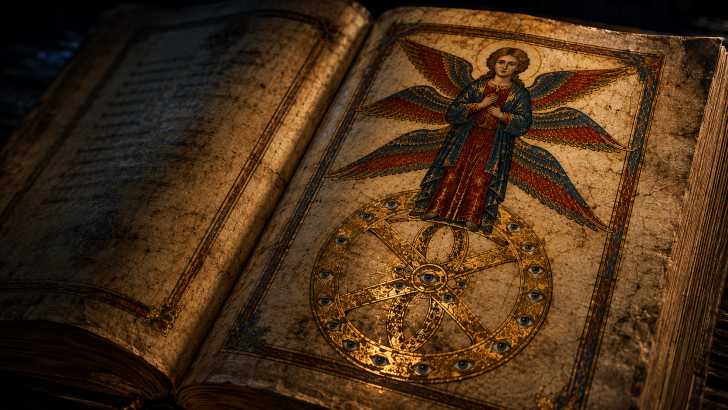
An angel balanced on a wheel, sometimes ringed with eyes, looks nothing like the gentle, feather-winged figure most people picture today.
Yet medieval artists weren’t simply trying to make heaven look peculiar.
They were working through one of the Bible’s most visually difficult passages, along with old traditions that tried to explain its moving, many-eyed wheels.
1. The Wheels Begin With Ezekiel’s Vision
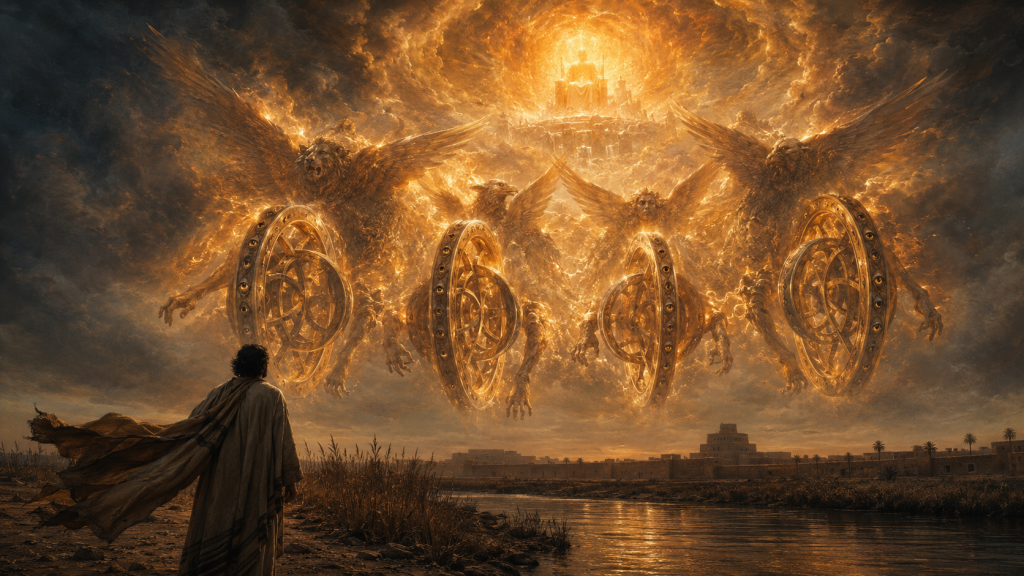
The trail leads back to the opening chapter of Ezekiel.
The prophet, living among Judean exiles in Babylonia, sees a fiery storm. Within it are four winged creatures, each facing several directions at once. Human hands appear beneath their wings, while their straight legs end in gleaming, calf-like feet.
Beside each creature is a wheel, sparkling like a precious stone and built like “a wheel intersecting a wheel.” The wheels can travel in any direction without turning, and their high rims are covered in eyes.
Above the creatures rises a shining platform with a throne and a humanlike form surrounded by fiery radiance.
The text calls this the appearance of the glory of God. It doesn’t simply introduce a species of wheel-shaped angel.
2. The Wheels Belonged to a Moving Throne
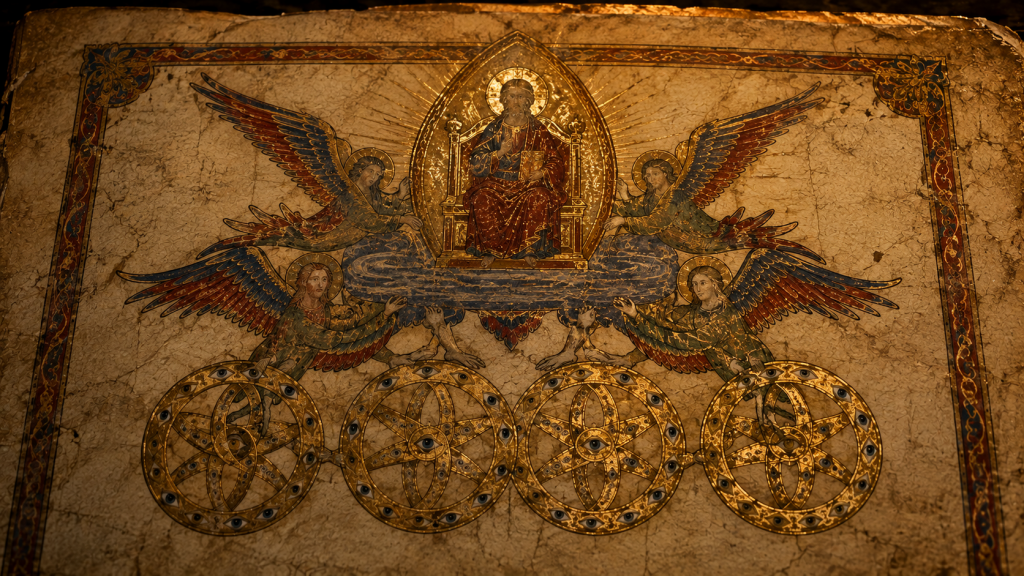
Ezekiel never neatly labels the whole structure a chariot. Later readers understood it as a divine throne-chariot, however, and the description makes that reading easy to see.
The wheels follow every movement of the creatures because “the spirit of the living creatures” is in them.
The vision gives God’s glory movement in every direction. Ezekiel 10 returns to the scene, identifies the living creatures as cherubim, and shows the divine glory leaving the Jerusalem Temple as the whole structure rises.
For a prophet among exiles, that was a powerful image.
The later Jewish tradition of the merkabah, or chariot, grew from this throne vision, though it developed far beyond Ezekiel’s chapter.
3. “Ophanim” Gradually Became the Name of Heavenly Beings
Ophanim is simply the Hebrew plural of ophan, meaning “wheel.” In Ezekiel, the word describes the wheels in the vision; it isn’t presented as the formal name of an angelic rank.
Later Jewish writings gave the wheels a more clearly animate identity. The ancient work known as 1 Enoch lists Ophanim alongside Cherubim and Seraphim among the heavenly host.
Jewish visionary and liturgical traditions also treated them as worshipping beings near God’s throne. But no single angelic chart was shared by every community.
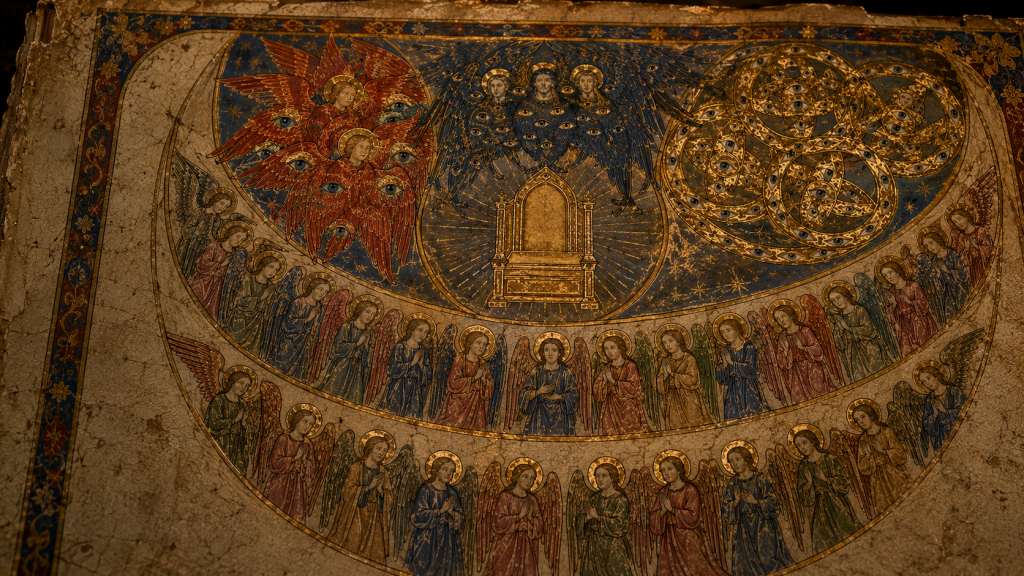
Christian angelology followed a related but different route. Around the late fifth or early sixth century, Pseudo-Dionysius arranged nine angelic choirs into three levels, placing the Thrones in the highest group.
His system became enormously influential. Artists sometimes connected the Thrones with Ezekiel’s wheels or with the fiery wheels beneath God’s throne in Daniel.
Still, “Ophanim” and “Thrones” weren’t simple synonyms in every source.
4. The Eyes Came Directly From the Biblical Text
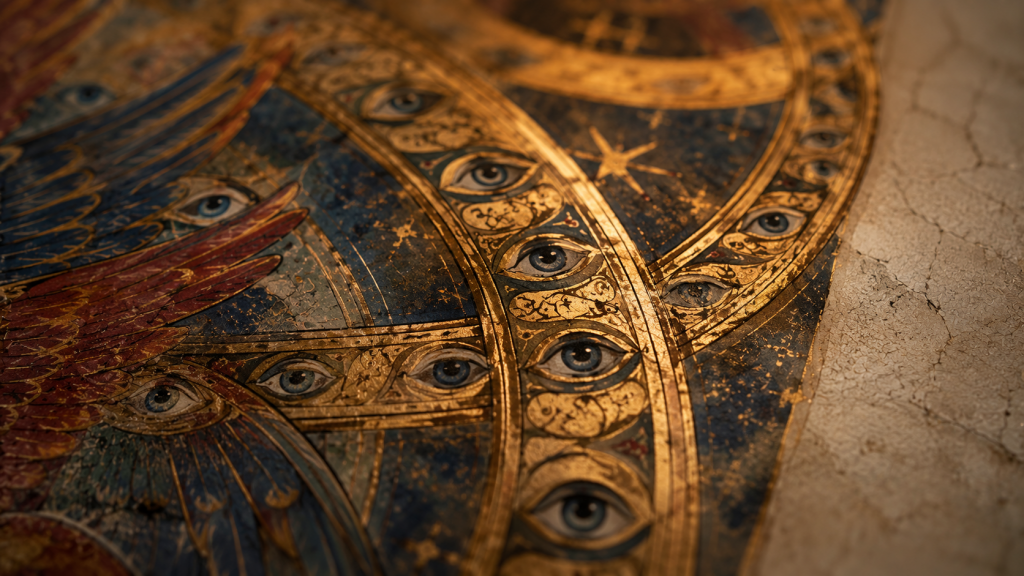
The eyes weren’t a modern embellishment.
Ezekiel 1 places them around the rims. Ezekiel 10 spreads them across the cherubim and wheels, while Revelation describes eye-covered creatures around God’s throne.
Artists sometimes folded these visions together.
Writers connected the eyes with wakefulness and knowledge, while Pseudo-Dionysius associated angelic eyes with the ability to receive divine illumination.
Still, Ezekiel never provides a tidy key assigning them one fixed meaning. A medieval image may suggest all-seeing awareness without being a code.
5. Medieval Artists Knew That Visions Weren’t Ordinary Bodies
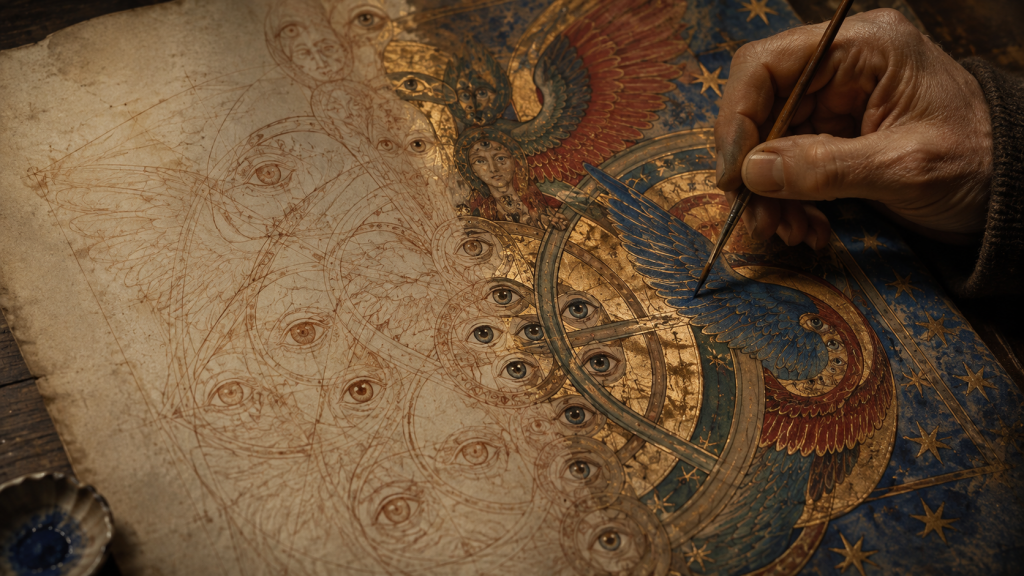
Taking the description seriously didn’t mean treating it as an anatomical report.
Pseudo-Dionysius warned readers not to imagine that heavenly intelligences were literally many-faced beasts or fiery wheels.
Scripture used visible forms, he argued, to lead the mind toward realities that couldn’t be pictured directly.
That gave artists an interesting problem.
Remove the impossible features and Ezekiel’s vision loses its identity. Render them as ordinary objects and the scene risks looking like a workshop machine.
Medieval illuminators embraced the tension, arranging impossible elements into clear patterns and using precious color to set heaven apart.
The result was a visual interpretation of language already understood as visionary.
6. The Wheel Could Become Part of the Angel
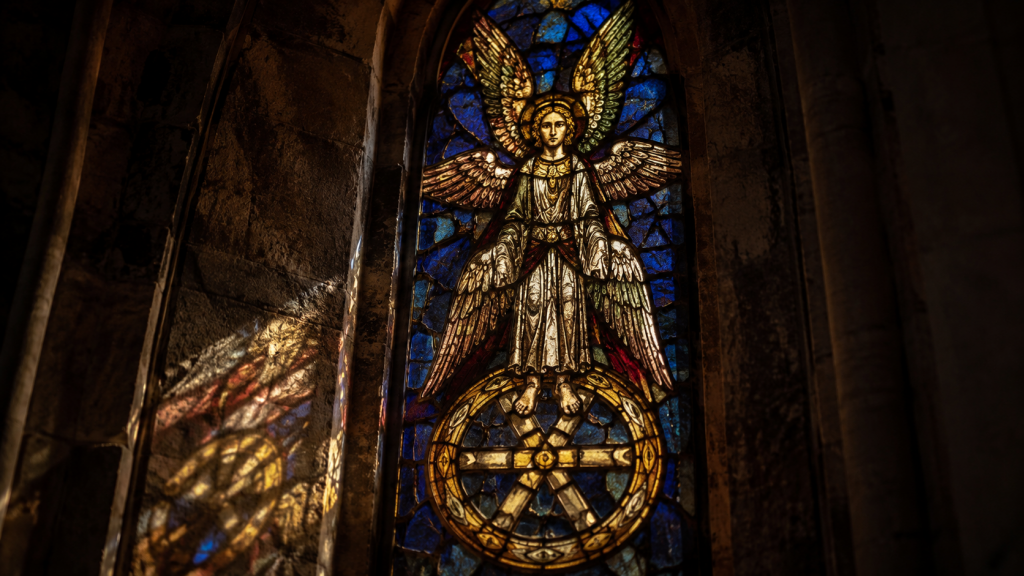
Ezekiel keeps the living creatures and wheels distinct, yet binds them closely. They move together and share one animating spirit.
On a small manuscript page or in narrow stained glass, that relationship could become one compact figure.
So an artist might place a humanlike angel directly upon a wheel, or make the wheel part of the being.
In diagrams of the choirs, it could work almost like a badge, identifying a high heavenly order without recreating the entire vision.
The combinations weren’t consistent.
The early fourteenth-century Queen Mary Psalter contains two six-winged figures standing on wheels; the British Library catalogue describes them as seraphim.
That’s a useful warning against calling every wheeled angel an Ophanim. Artists could merge biblical details with established angelic types while making a hierarchy fit the page.
7. Most Medieval Angels Still Looked Human
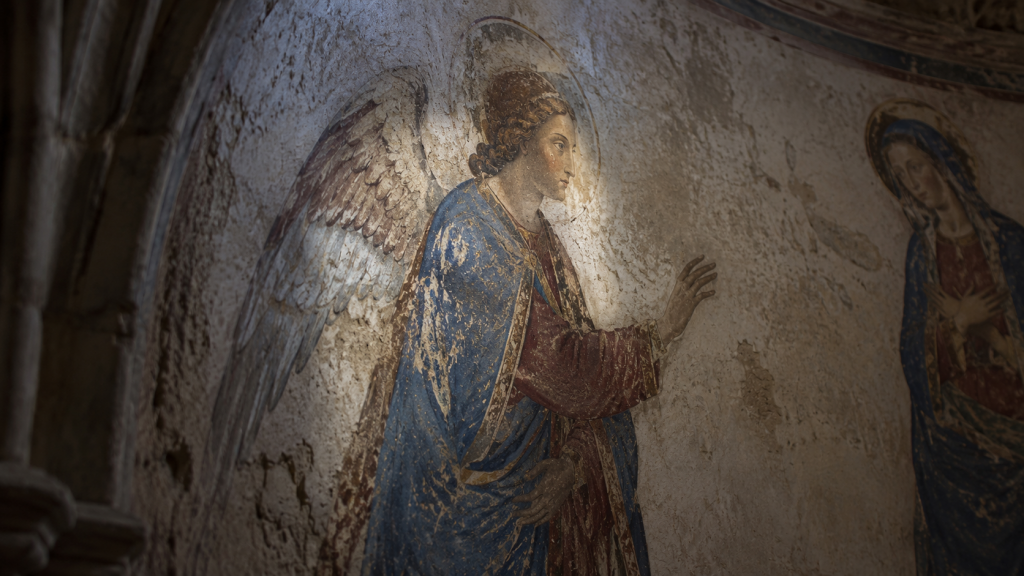
Wheel-bearing beings were never the standard form for every angel.
Biblical messengers often appear as men, and early Christian artists first pictured angels without wings. By the late fourth century, the winged human figure had emerged.
That form suited Gabriel approaching Mary or Michael fighting evil. A youthful face made the figure readable, and wings separated it from an ordinary person.
Context remains essential. A wheel might mark an angelic choir or belong to Ezekiel’s vision. In a different scene, it can be Saint Catherine’s instrument of martyrdom.
Proximity to an angel doesn’t settle the question by itself.
8. Later Art Made the Wheeled Angels Easier to Forget
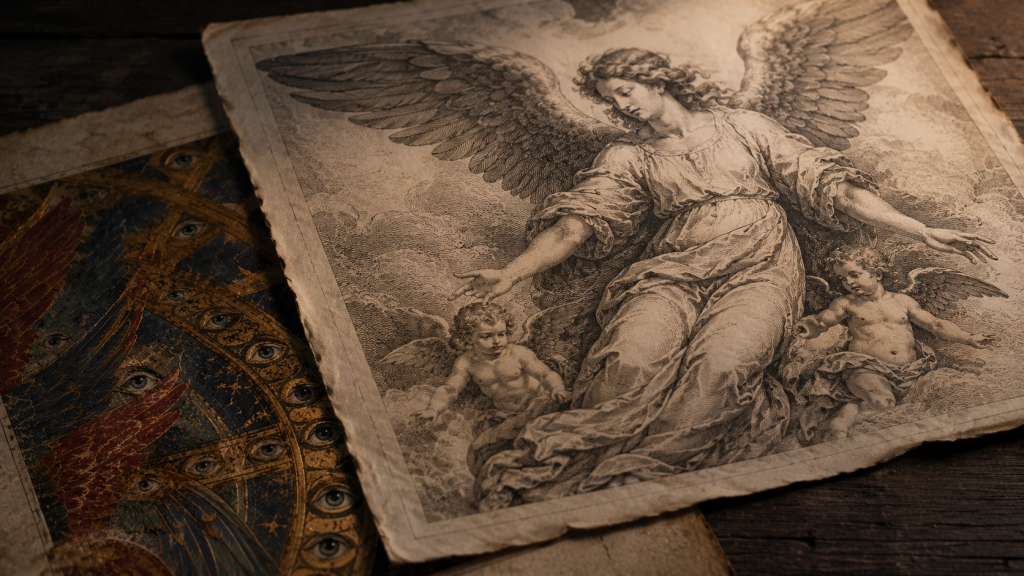
Renaissance artists didn’t invent the beautiful humanlike angel. Medieval art was already full of them. They did give that form an extraordinarily influential afterlife.
Graceful winged figures and childlike cherubs passed from major paintings into prints and popular decoration.
Wheeled figures remained in images of Ezekiel and diagrams of the celestial hierarchy. They also survived in church ornament, but occupied a narrower visual world.
Once the messenger angel became the version encountered everywhere, an eye-covered wheel began to feel almost alien.
For a medieval artist, the logic was less jarring. A being joined to a wheel wasn’t a failed attempt at a person with wings.
It was a way to preserve the motion and watchfulness of an ancient vision while admitting that heaven could not be made to look entirely familiar.
