

Hermeticism, at first, can feel like a locked door—something hidden, vast, and touched by alchemy.
This philosophically mystical tradition is rooted in spirituality, ancient texts, and a legendary teacher said to hold the very keys to the universe.
The first step into this strange world is understanding what truly belongs to the tradition—and what was added much later.
1. What Hermeticism Actually Is

Hermeticism isn’t quite religion, nor is it quite philosophy, and it is never merely magic. There’s no single founder, no single holy book, and no tidy list of rules.
At its core, Hermeticism is a broad tradition built around teachings attributed to Hermes Trismegistus.
It is a pursuit of higher knowledge, treating the universe almost like an open book and seeking answers through questions about God, the cosmos, and the soul. Some branches also explore astrology, alchemy, and magic.
These threads often meet and overlap, but they don’t all belong to one perfectly neat system.
Think of Hermeticism more like a library: a vast space where philosophy, mysticism, the human, and the divine are constantly in conversation.
The answers vary depending on who enters that library and what they’re searching for, but this ancient tradition of contemplation, transformation, and spiritual ascent is well worth exploring—and perhaps over more than just coffee.
2. Meet Hermes Trismegistus
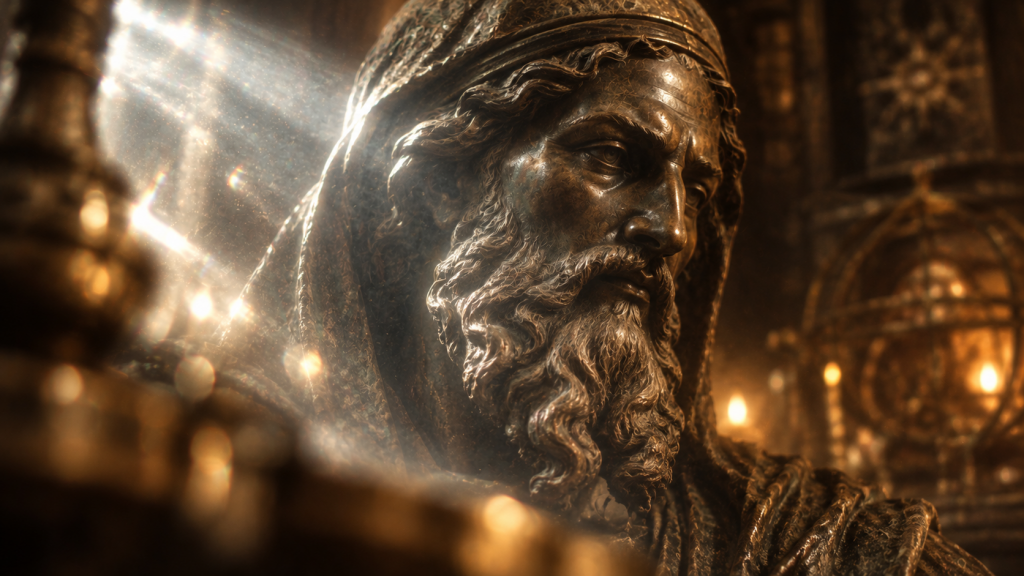
Hermes Trismegistus, the “Thrice-Great,” is a legendary, mercurial sage associated with both the Greek god Hermes and the Egyptian god Thoth.
He is the mysterious teacher standing at the very epicenter of the Hermetic tradition.
Hermes was a messenger and guide, while Thoth was associated with writing, wisdom, and cosmic order.
Hermes Trismegistus, therefore, becomes a sage assembled from two worlds, a figure standing at the threshold between human knowledge and divine mystery.
The Hermetic texts were not all written by one ancient master. They were composed by different people across time and often presented as dialogues or revelations involving Hermes and his students.
While Hermes represents a meeting point between two ancient gods and several intellectual worlds, Renaissance readers once believed this wisdom came from a far more ancient age.
Modern scholarship places the best-known Greek philosophical Hermetic texts in late antiquity. And while the history may seem slightly less mystical than the legend once we poke it with a stick, it remains endlessly fascinating.
The biography of Hermes matters less, in the end, than the extraordinary weight of the ideas placed in his name.
3. Begin With the Texts

The best-known collection is the Corpus Hermeticum, a group of seventeen Greek treatises.
It’s also the best place to begin this journey. Keep in mind, though, that this isn’t one continuous book making a single argument from beginning to end. Each treatise has its own voice, tone, and emphasis.
Poimandres, the opening text, begins with Hermes receiving a vision concerning the creation of the universe and the nature of humanity.
For a beginner, it’s worth starting with these old voices before muddying the waters with too many modern interpretations.
The Latin Asclepius is another major philosophical Hermetic text, presented largely as a conversation between Hermes and his student Asclepius.
Then there’s the Emerald Tablet, a brief alchemical text famously associated with the idea of “as above, so below.”
It belongs to a different textual tradition, though modern discussions frequently place it alongside the other Hermetic works.
Together, these texts offer several doors into Hermeticism—but they do not all open into quite the same room.
4. The Universe Is Alive With Mind

There is a central idea running through many philosophical Hermetic writings: the universe is alive rather than mechanically empty, and behind creation lies something like a thread of thought.
It is a living, breathing cosmos, connected to a divine source often described as Mind, or Nous.
But this Mind isn’t the same thing as your everyday thoughts, your anxieties, your to-do lists, or the overthinking that keeps you awake at night.
No, it points toward a greater intelligence woven through existence itself.
Today, Hermeticism is unfortunately often boiled down to positive thinking and manifesting your dream life, but the ancient texts reach toward something much, much larger.
They ask how the human mind can recognize divine intelligence and understand its place within the cosmos, no matter how small that place may seem.
The universe, in this view, is something to contemplate and revere, and it’s up to us to look both upward and inward, as though both directions ultimately lead toward the same source.
5. Self-Knowledge Is Spiritual Knowledge

Hermeticism teaches us to look inward as a way of approaching the divine.
We belong to the physical world, with all its needs and limitations, but we also possess the ability to reach toward higher knowledge.
We are earthly creatures with a sacred interior, our feet bound to the ground while our eyes remain turned toward something beyond it.
So, in Hermeticism, self-knowledge is not merely personality analysis. It is a doorway into the cosmos, an inward path toward a larger truth.
Your strengths, your bad habits, your little quirks, desires, temptations, and appetites matter far less than the older mystery reflected within.
And it is a mystery that, when the mind is awake enough to recognize it, reveals something extraordinary: we were already part of it all along.
6. Astrology, Alchemy, and the Hermetic Arts

Hermeticism is philosophical, but the broader Hermetic tradition also includes practical writings on astrology, alchemy, and magic.
While these may sound like separate interests, they all grow from the same underlying belief: that the star-filled cosmos is interconnected, and that nature contains patterns worth understanding.
Astrology was used to study the relationship between celestial and earthly life, as it had been in earlier ages.
Alchemy was both a material practice and a language of transformation, giving us even today a symbol-rich vocabulary for inner change and spiritual refinement.
And magic was where philosophical thought got its hands dirty, engaging more directly with the hidden forces believed to move through nature and the divine.
Today, many of us may read these ideas metaphorically. But in their own time, these ancient arts were treated as practical pursuits—and that practical side of the mystery is worth taking seriously.
7. “As Above, So Below”

“As above, so below” is probably the phrase most people associate with Hermeticism.
It’s commonly linked to the Emerald Tablet and points toward a correspondence between different levels of reality—the pattern above echoed in the pattern below, a kind of mirror between worlds.
It’s an elegant idea, but it doesn’t explain the entire tradition by itself.
You’ll also encounter the “seven Hermetic principles” almost everywhere: mentalism, correspondence, vibration, polarity, rhythm, cause and effect, and gender.
These come from The Kybalion, a book published in 1908 and strongly influenced by the New Thought movement.
It remains a popular modern interpretation of Hermetic ideas, but it is not a direct summary of the ancient Corpus Hermeticum. There may be value in it; just don’t mistake one much later framework for the whole ancient tradition.
8. A Good Place to Begin

If you want to explore Hermeticism, start with a modern translation of Poimandres. Read it slowly. Keep your mind open. A little ignorance can be excellent luggage.
This is a visionary dialogue, not a step-by-step guide, and some of its ideas are strange enough to deserve a second look.
Then move on to On Rebirth, another treatise in the Corpus Hermeticum, which explores spiritual renewal and the transformation of the self.
Keep a notebook nearby, too. You’ll want to write things down, return to certain passages, and let the ideas settle.
Hermeticism is a large, winding library, so take the long way into the mystery. Begin with one text, follow the questions that stay with you, and let the tradition open at its own pace.
