
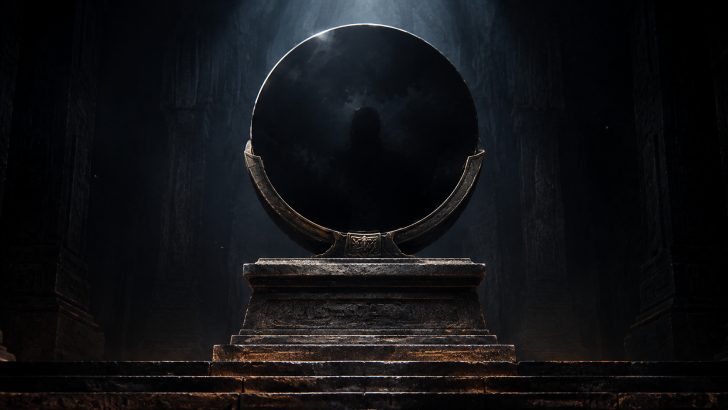
For centuries, people have looked into dark, reflective surfaces hoping to see something beyond an ordinary reflection.
Some searched for guidance, while others hoped to receive divine messages or catch glimpses of distant events.
These objects became known as black mirrors, and their history stretches from early obsidian craftsmanship to the spiritual experiments of one of Elizabethan England’s best-known scholars.
1. Black Mirrors Didn’t Reflect the World Clearly
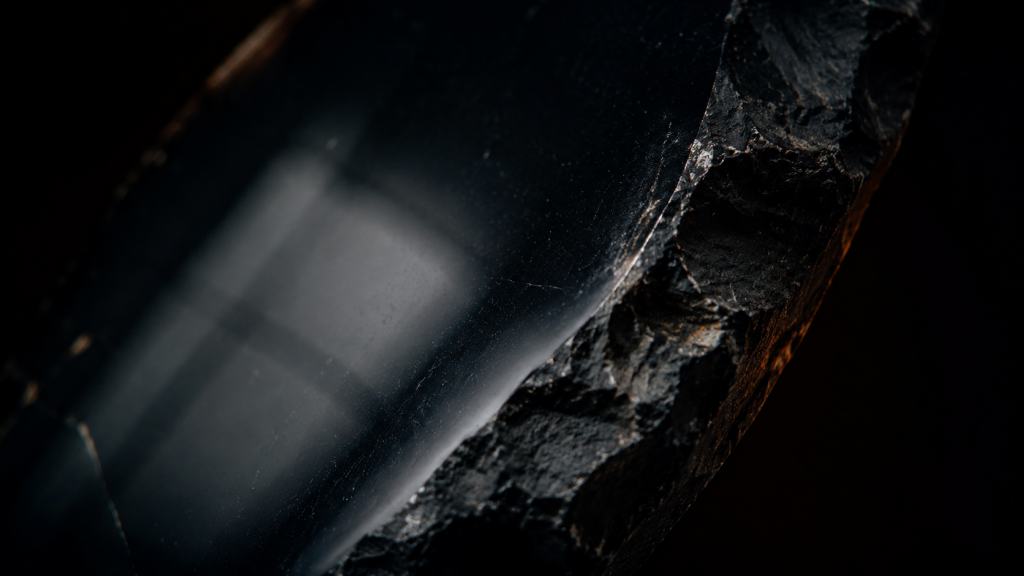
Many early black mirrors were made from obsidian, a dark volcanic glass formed when lava cools quickly.
Once cut and carefully polished, obsidian produces a reflection, though it’s much darker and less detailed than the image seen in a modern mirror.
That difference, however, was part of its magic. A person looking at polished obsidian could see a face or shape, but the image remained shadowy and slightly unclear.
Some people used these surfaces for scrying. This is the practice of looking into a reflective or translucent object while waiting for images, impressions, or messages to appear.
Water, crystals, polished metal, and ordinary mirrors have all been used for the same purpose.
Later black mirrors were sometimes made from glass with a dark backing. But an obsidian mirror is a solid piece of volcanic glass, shaped and polished by hand.
Of course, a dark mirror wasn’t always a spiritual object. Obsidian could be polished for decoration, display, or practical reflection.
The material alone doesn’t tell us how someone used it.
2. Obsidian Mirrors Are Thousands of Years Old

The history of obsidian mirrors began long before the well-known examples from Mexico. Some of the earliest were made in the ancient Near East during the seventh millennium BC.
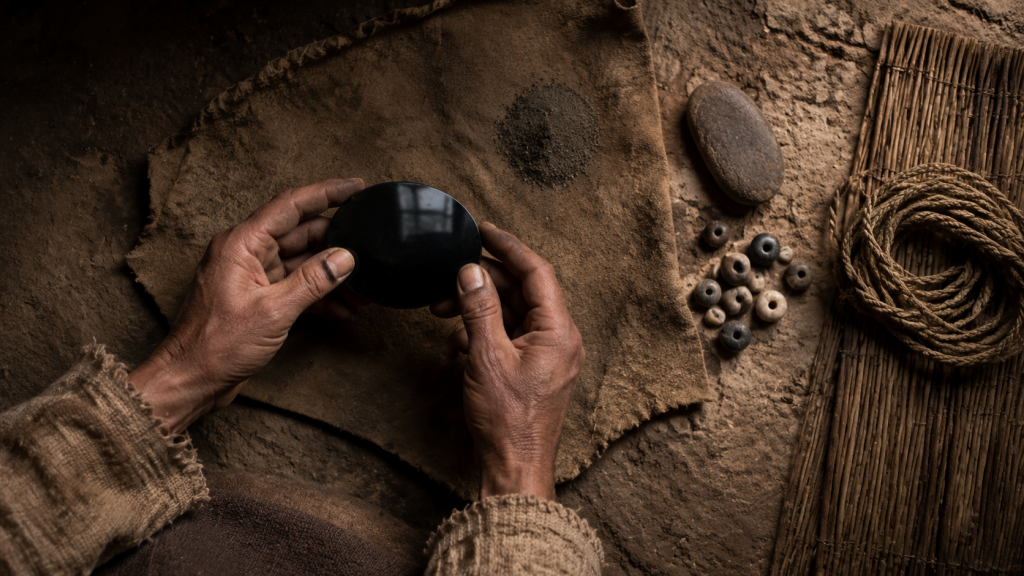
Producing one required a great deal of work. Obsidian had to be selected, shaped, ground, and polished until its surface reflected light.
This was happening thousands of years before the silvered glass mirrors familiar to us today.
Early examples have been found at archaeological sites in what is now Turkey and nearby regions. They show that people understood the reflective qualities of volcanic glass very early.
But their exact uses aren’t always clear.
Some may have been personal or ceremonial objects, while others may have carried social meaning because of the skill and labor needed to produce them.
Archaeologists have to rely on where a mirror was found, what was placed near it, and how it was made.
So there wasn’t one continuous black-mirror tradition stretching across the world. Different societies discovered obsidian’s reflective surface and understood it in their own unique ways.
3. Mirrors Had a Special Place in Ancient Mexico
Obsidian was especially important in ancient Mexico.
It was used for blades and tools, but it also appeared in ceremonial objects. Its dark shine gave it meanings that went far beyond its practical value.
Among the Mexica, often called the Aztecs, polished obsidian mirrors were connected with divination and sacred knowledge.
Ritual specialists could gaze into them while seeking information that ordinary sight couldn’t provide.
They believed the reflected images might reveal signs linked to fate, gods, ancestors, or events happening elsewhere.
Mirrors were closely associated with Tezcatlipoca, whose name is commonly translated as “Smoking Mirror.”
In surviving images, Tezcatlipoca is sometimes shown with a mirror on his chest, in his headdress, or in place of one foot.
The mirror suggested a form of sight that wasn’t limited to the visible surface of the world.
That didn’t make Tezcatlipoca a simple god of darkness or evil. Mexica deities could hold several roles at once, including roles that might seem contradictory from a modern point of view.
His mirror represented knowledge and power, but also uncertainty and change.
4. Mexican Mirrors Were Taken to Europe
After the Spanish conquest of the Mexica Empire in the early 1500s, many objects were removed from Mexico and sent to Europe.
Inventories from the period mention mirrors among the items crossing the Atlantic.
Some were presented to rulers, collectors, and religious figures. They entered royal collections and rooms filled with unusual objects from different parts of the world.
Europeans were interested in their material, craftsmanship, and unfamiliar appearance.
But these objects were no longer being viewed within their original religious setting. European collectors interpreted them through ideas they already understood.
A polished obsidian mirror could easily become associated with European traditions of divination, astrology, and ceremonial magic.
This doesn’t mean European scrying developed directly from Mexica practices. People in Europe had already used mirrors, crystals, and other reflective objects in attempts to receive visions.
The Mexican mirrors entered an existing set of European beliefs. As they moved between cultures, their meaning changed along with their owners.
5. One Mirror Became Connected With John Dee
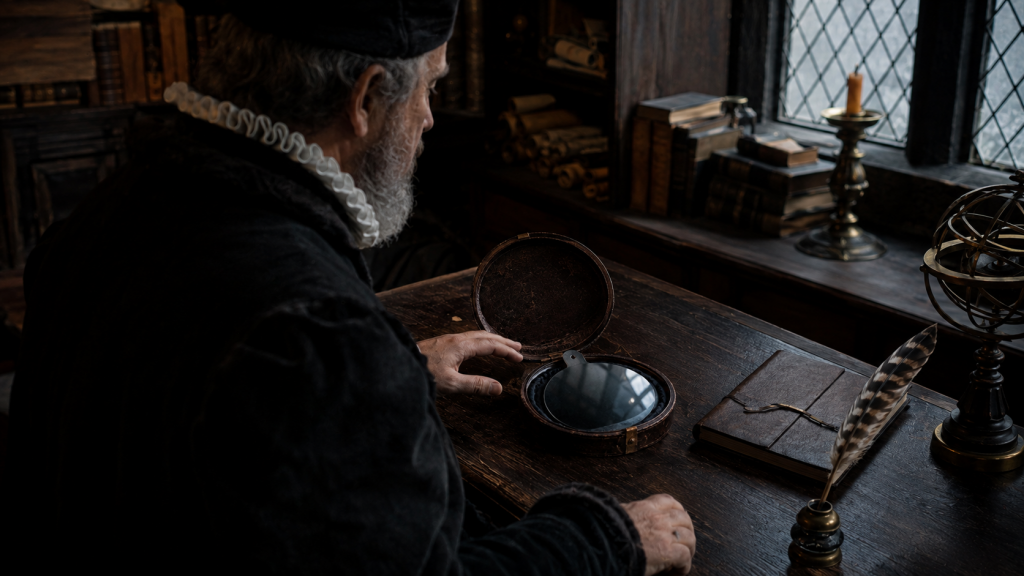
The most famous surviving example is a small obsidian mirror in the British Museum. It has long been associated with John Dee, a 16th-century mathematician, astronomer, astrologer, and adviser to Queen Elizabeth I.
Dee had a large library and studied subjects that we now tend to separate into science, religion, and magic.
During the 1580s, he became increasingly interested in communicating with angels. He hoped they could provide knowledge that couldn’t be reached through ordinary study.
Dee worked with several mediums, most famously Edward Kelley. Kelley acted as the scryer, looking into crystals or other objects and describing what he believed he could see and hear.
Dee recorded many of these sessions in detail.
These objects were known as show-stones. The term could refer to crystals, mirrors, or other polished surfaces used to receive visions.
The British Museum mirror may have belonged to Dee, but there are gaps in its history. Dee’s surviving writings don’t clearly describe him using this particular obsidian object.
Its connection to him was recorded by later owners, including the writer and collector Horace Walpole in the 18th century.
There is some early evidence supporting the connection. A legal statement from 1624 mentions a round, flat stone said to have belonged to Dee.
Still, no surviving document traces the museum’s mirror directly from Mexico into his hands.
6. Scientists Traced the Mirror Back to Mexico
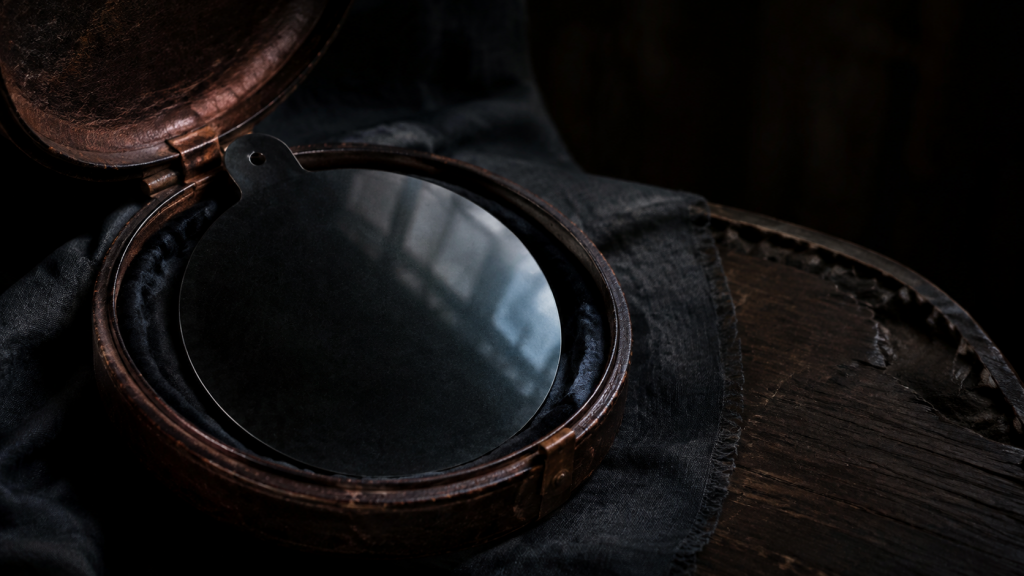
For a long time, researchers couldn’t be certain where the British Museum mirror had been made.
Obsidian occurs in several parts of the world, and some people wondered whether the object might be a European copy.
However, a scientific study published in 2021 provided a much clearer answer.
Researchers used portable X-ray fluorescence to examine the mirror’s chemical composition. Different obsidian sources contain slightly different combinations of elements, creating a kind of geological signature.
The results matched obsidian from the Pachuca region of central Mexico. This area was an important source of high-quality greenish obsidian during the Mexica period.
The analysis confirmed that the mirror wasn’t a later European imitation. It was made from Mexican stone and closely matched other mirrors associated with the late Mexica or early colonial period.
Science could identify the source of the material, but it couldn’t explain the mirror’s full journey. We still don’t know who made it, when it left Mexico, or how it became connected with Dee.
What the research does show is that an Indigenous Mexican object eventually became part of European occult history.
7. Why People Saw Things in Dark Mirrors
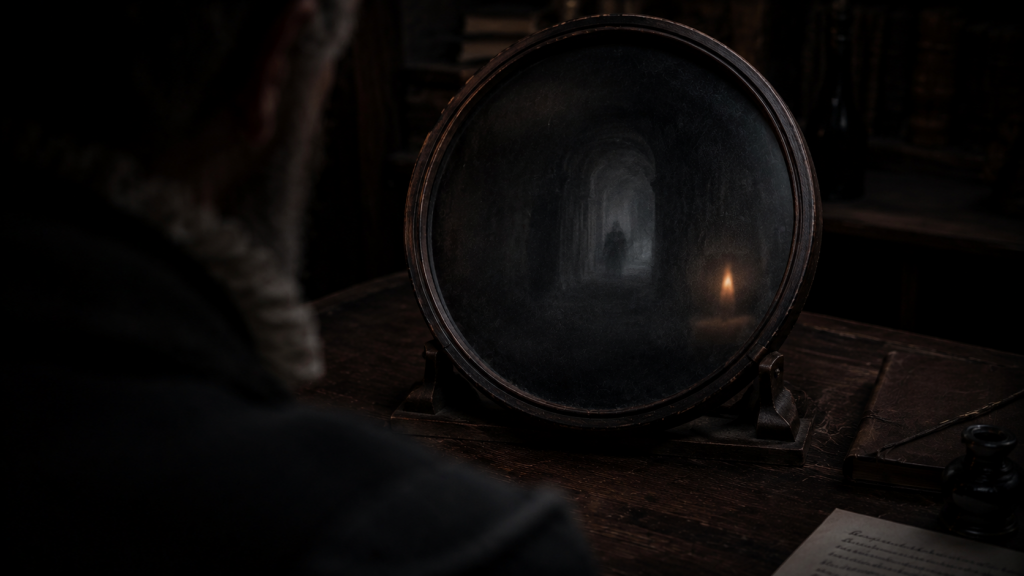
People who practiced scrying didn’t always expect a clear image to appear like a picture on a screen.
They might notice a shape, movement, color, or change in the reflection and then interpret it according to their beliefs.
Concentration and expectation were an important part of the experience.
A person who believed the mirror could reveal spirits or messages would naturally pay close attention to small visual changes.
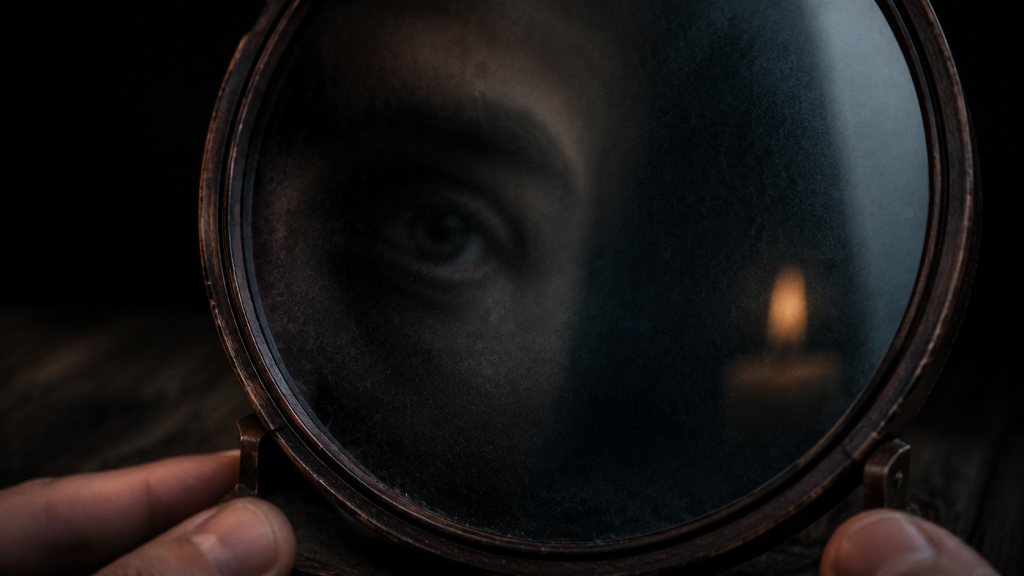
Modern studies have also shown that staring into a mirror in low light can affect perception. Facial features may seem to blur or change, and some people report seeing unfamiliar faces or figures after looking for several minutes.
This doesn’t prove that every historical account had the same explanation. Spiritual beliefs, ritual settings, and personal expectations all shaped what the gazer believed was happening.
Black mirrors remain interesting because they sit between several different histories.
They can be studied as carefully made objects, religious symbols, tools of European magic, and examples of how human perception works.
Their surfaces may be dark, but the beliefs gathered around them tell us a great deal about how people in different times and places understood sight, knowledge, and the things they couldn’t easily explain.
