
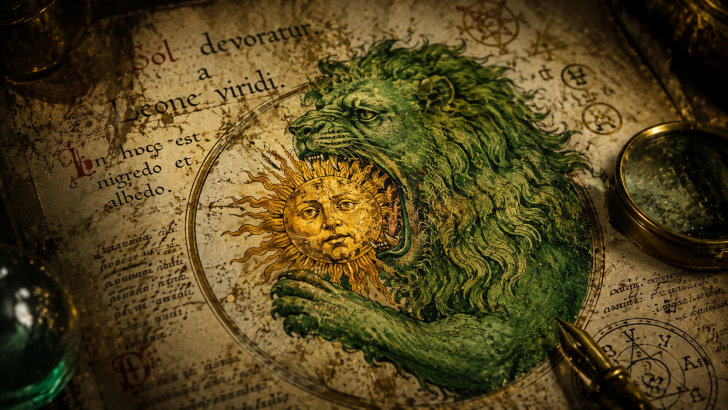
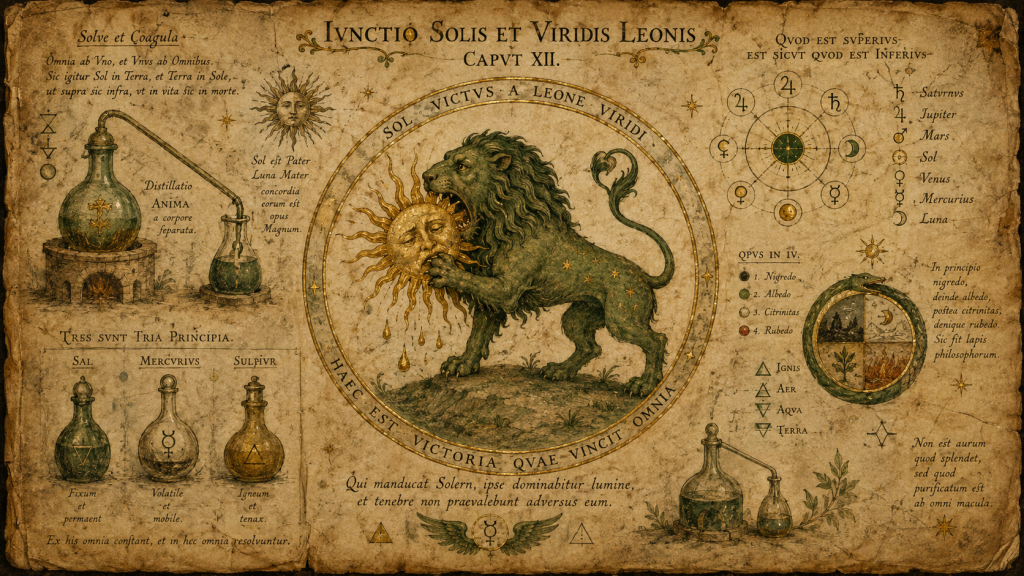
The Green Lion is a strange image from alchemy. It shows a lion biting the Sun, with liquid flowing from the wound.
Although the scene looks surreal and visceral, it was primarily meant to describe ideas about chemical change.
For early alchemists, this image combined symbolism with practical meaning.
To understand what the Green Lion meant in practice, we need to look at the texts and substances that inspired it.
1. The Famous Image Appeared in the Rosarium Philosophorum
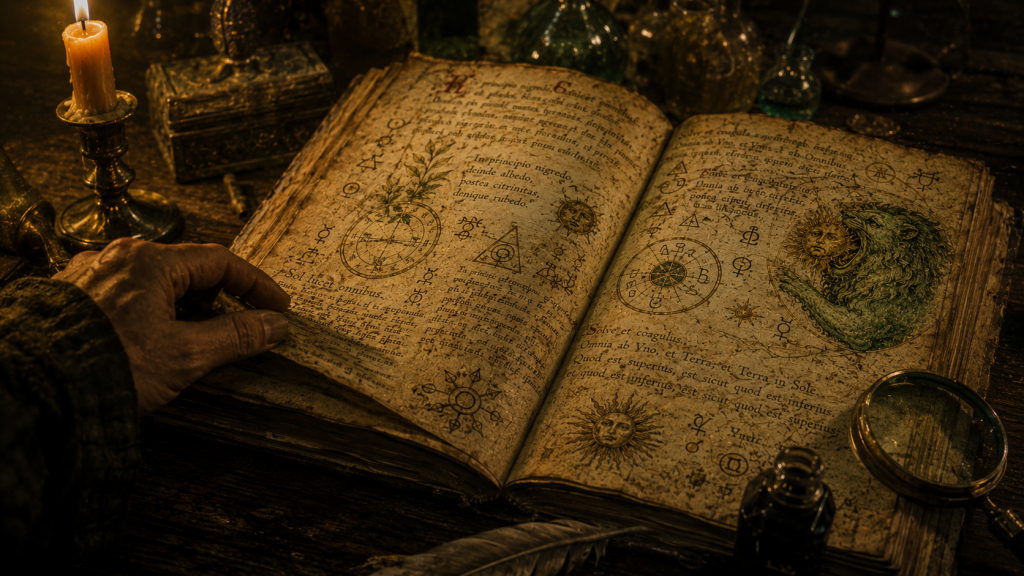
The best-known Green Lion appears in the Rosarium Philosophorum, an anonymous alchemical work printed in Frankfurt in 1550 as part of a larger collection.
Its 20 woodcuts turn the alchemical work into a strange visual story. The green lion appears as image 18, surprisingly close to the end.
The image is very direct. A lion is biting a Sun with a human face, and liquid flows down.
The text calls it “our Mercury” and the “Green Lion Devouring the Sun.” It also says the philosophers’ secrets are hidden in this green and gold creature.
Green lions already appeared as alchemical cover names in late medieval writings, meaning the Rosarium gave unforgettable visual form to a symbolic language that was already circulating.
2. Why a Lion?
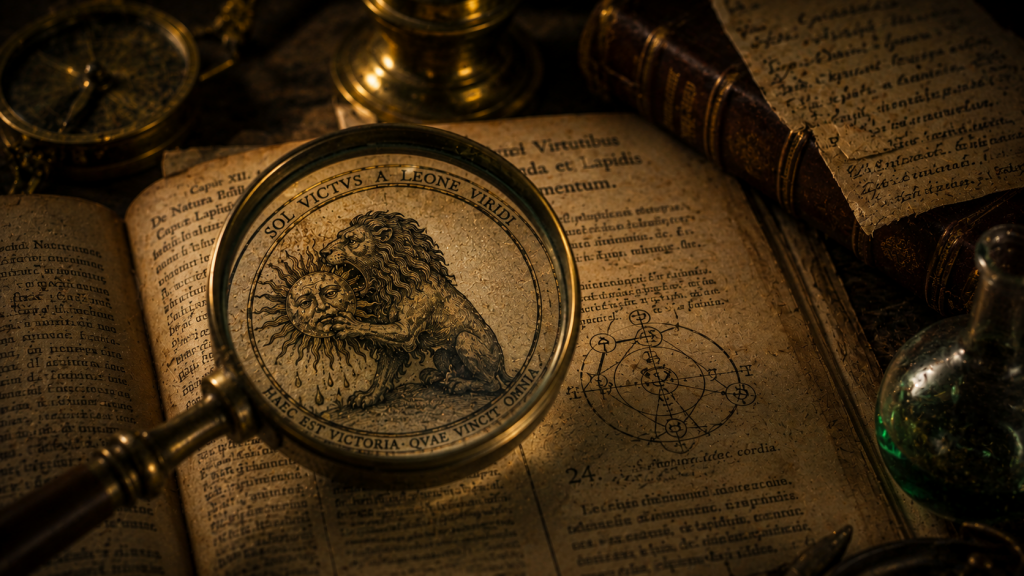
Alchemy frequently turned chemical behavior into animals. Vapors were often shown as birds, and substances that broke down solids were shown as predators.
Lions devour bodies, and alchemical writers used similar language for substances that could break metals down.
Historian Lyndy Abraham notes that the Green Lion was associated with matter capable of reducing metallic bodies toward their supposed “first matter.”
The animal also suggested enormous force.
In Michael Maier’s Atalanta Fugiens of 1618, the green lion is identified as the “ore of Hermes.” The Rosarium describes its Mercury as something that penetrates bodies and changes their condition.
So the jaws are doing chemical work. The lion “eats” because the material it represents can overcome another body.
3. Green Didn’t Have One Fixed Meaning
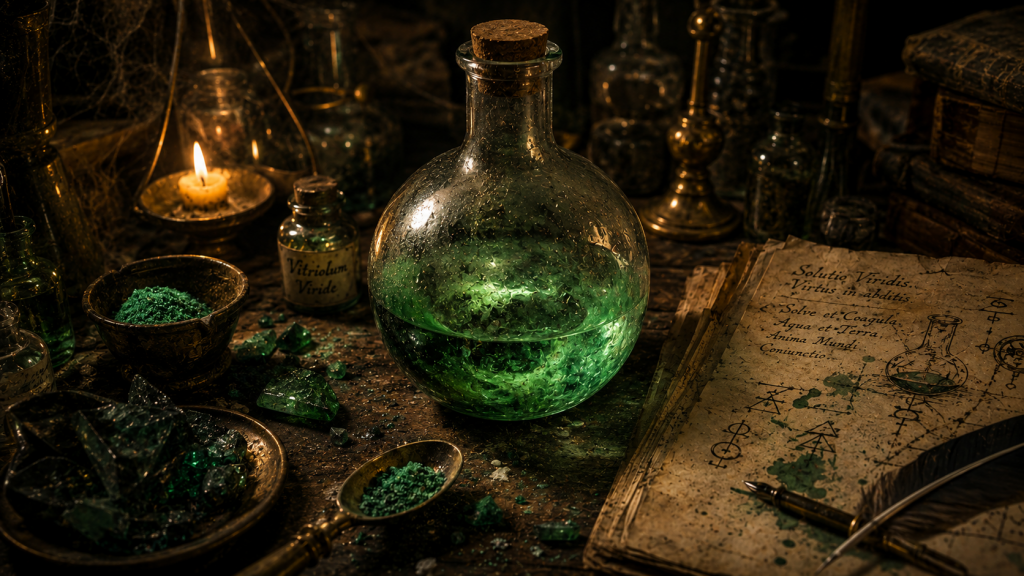
Modern explanations often identify the Green Lion with vitriol, and there is good historical reason for that.
“Vitriol” could refer to metallic sulfates, while green vitriol, also called copperas, was iron sulfate with a distinctive green color.
Historical studies of alchemical imagery note that the Green Lion sometimes served as a name for vitriol.
But old alchemy rarely gives us a perfect symbol dictionary. George Ripley, an influential English alchemical writer, actually criticized those who identified vitriol too neatly with the Green Lion.
Green could also mean something not fully developed. Alchemists sometimes thought metals grew inside the earth, with gold as the finished form.
A “green” substance was therefore still unfinished, like unripe fruit, but it had the potential to become something better.
That ambiguity matters because the Green Lion wasn’t necessarily one substance with one permanent definition.
4. The Sun Usually Pointed Toward Gold
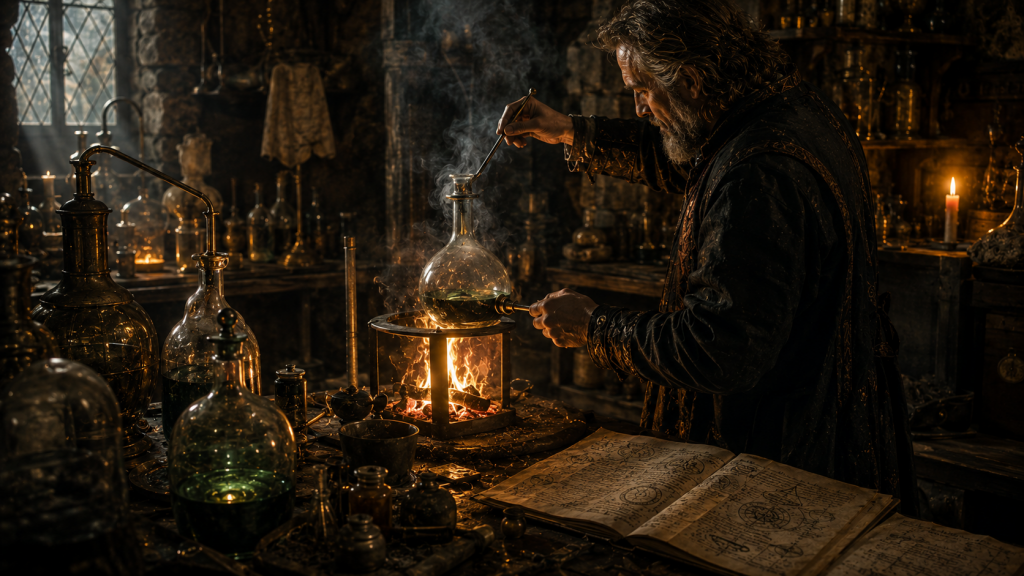
The Sun is easier to decode. In European alchemy, Sol was strongly associated with gold. Gold seemed unusually perfect because it resisted ordinary corrosion and kept its brilliance.
Solar imagery could carry additional meanings, including the hot principle associated with philosophical sulphur. As always with alchemy, context mattered.
In this image, though, gold is crucial. The Rosarium discusses the destruction of gold as part of the attempt to uncover its hidden generative power.
The Sun can be read as the perfected metallic body being attacked so that something concealed inside it might be released.
And that creates the image’s central shock. The metal every alchemist supposedly wants is shown being swallowed alive.
5. Devouring the Sun Means Destroying Perfection on Purpose
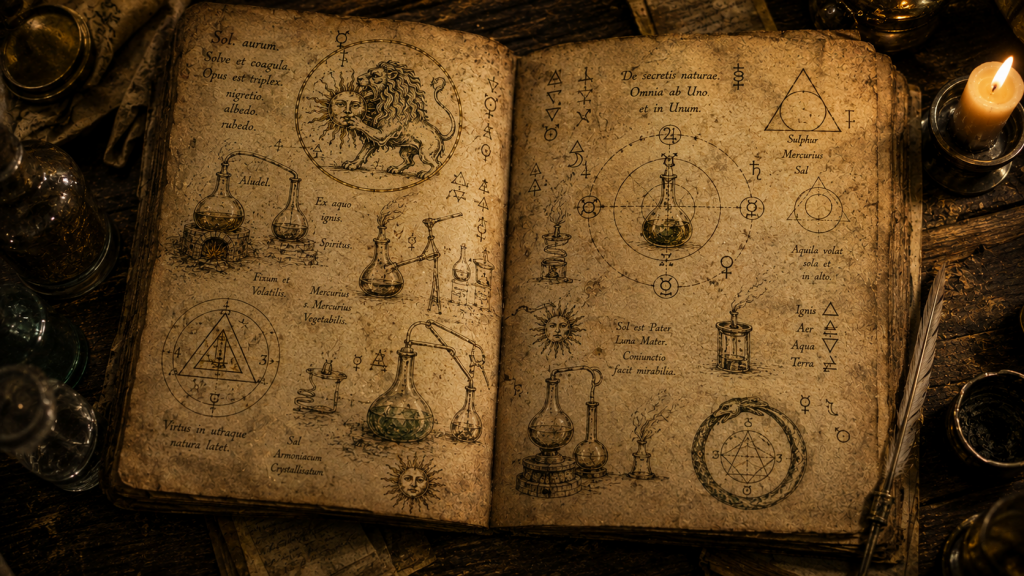
Why destroy something represented as gold when gold is the goal?
Because alchemical perfection could require dissolution first.
A solid substance had to break down so something could be drawn out. The Rosarium often describes matter dissolving, breaking apart, and reforming in a new state.
The Green Lion turns that complicated idea into one viscious scene. The fixed solar body disappears into a devouring fluid power.
For an alchemist, destruction wasn’t necessarily failure.
Breaking a substance apart could be the opening stage of another operation.
There’s also a useful warning here. Today, the emblem is often explained simply as nigredo, the blackening or death stage of alchemy.
But the lion is number 18 in a set of 20 images in the Rosarium. The original sequence doesn’t fit neatly into the later stage systems that writers tried to impose on alchemy.
6. The Monster Had a Real Laboratory Side
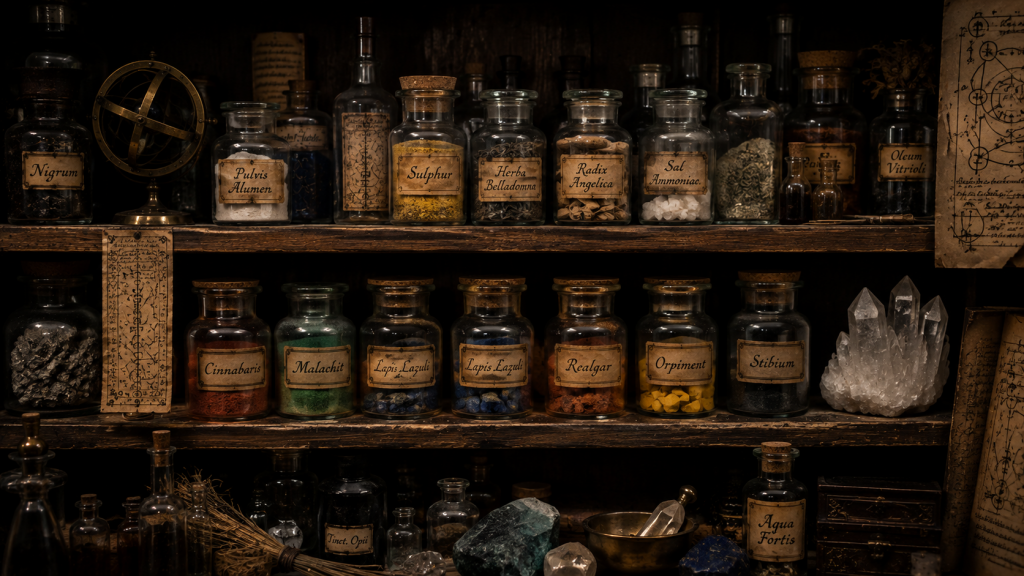
Alchemists handled genuinely corrosive substances, which makes the emblem considerably less fantastical.
Vitriols were metallic sulfates. When heated, some could produce strong acids, including oil of vitriol, an early form of sulfuric acid.
These mineral acids became important in medieval and early modern labs because they could attack metals in ways ordinary liquids could not.
European alchemists also worked with aqua regia, the famously aggressive mixture capable of dissolving gold.
That makes it very tempting to imagine the Green Lion as an acid bath swallowing solar gold.
Still, “Green Lion equals aqua regia” is too simple. Historical uses of the name vary, and sulfuric acid itself isn’t the usual gold-dissolving agent.
More importantly, the Rosarium explicitly calls its lion “our Mercury.”
Here, Mercury doesn’t just mean the shiny liquid metal in a bottle.
Alchemical writers also used the idea of a “philosophical Mercury”—a more complex substance or principle thought to dissolve, penetrate, combine with, and transform other matter.
7. Even the “Blood” Has a Meaning
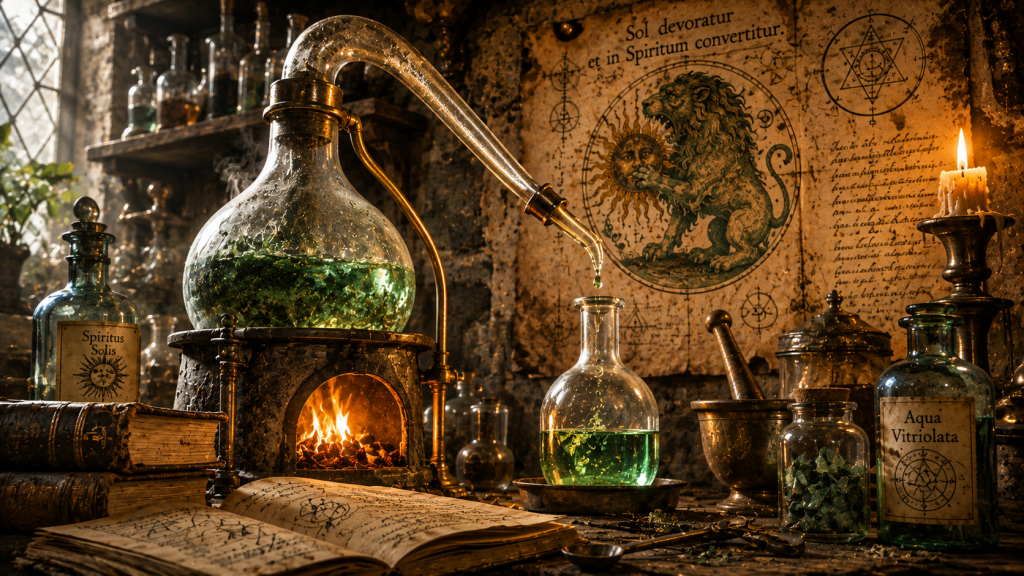
Look closely and the emblem becomes almost gruesome.
The lion closes its mouth around the Sun’s face while liquid streams downward. In colored versions of the image, the scene can look disturbingly like blood pouring from the attack.
And “Blood of the Green Lion” was itself an alchemical term.
Historical alchemical texts link this phrase to strong, corrosive liquids associated with the lion. Some writers simply called this “blood” a secret, biting water capable of attacking metals.
So the dripping liquid may carry technical meaning alongside the visual horror.
Alchemy often made matter behave like a living body. Substances could die and later revive, while metals could be wounded or consumed, and liquid could behave like a hungry creature.
The disturbing imagery helped make an invisible chemical process visible.
8. A Sixteenth-Century Reader Wouldn’t Have Expected One Answer
An experienced alchemist wouldn’t look for a single clear meaning.
The lion could identify a kind of matter while simultaneously showing what that matter was supposed to do.
Its greenness could describe a substance, suggest immaturity, or carry another meaning determined by the surrounding text.
The Sun could represent gold while also participating in a wider network of solar symbolism.
En Rosarium itself uses many different names for Mercury, reflecting how alchemical writers often disguised their processes with unusual terms and images to keep the work obscure to outsiders.
Much later, Carl Jung and Jungian thinkers reinterpreted the Green Lion in psychological terms.
In this view, the swallowed Sun can symbolize consciousness or a former sense of self being overwhelmed as part of transformation.
Those interpretations can be interesting, but they came much later. They shouldn’t be treated as the definitive meaning a sixteenth-century alchemist would have seen.
The historical image is already strange enough.
A green beast devours the symbol of metallic perfection because, in alchemy, even gold had to lose its familiar form before its hidden nature could be revealed.
