
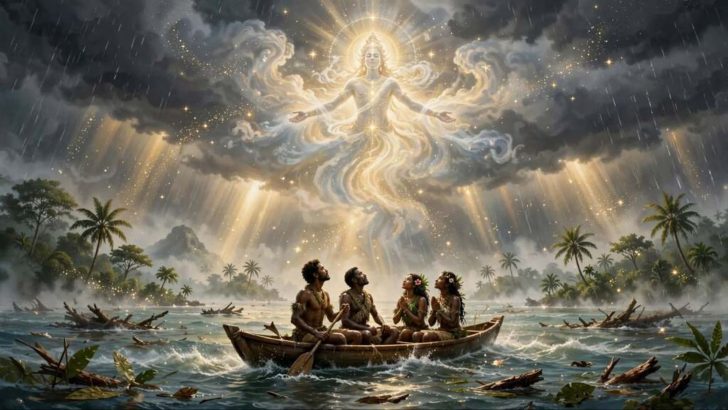
The story of Noah’s Ark is the flood myth most of us are familiar with.
But, what’s more interesting, these legends about a cataclysmic flood exist in numerous mythologies.
While science disagrees that there was ever a single great flood that covered the earth, that’s exactly how these legends present their massive, local floods.
Here are 12 lesser known flood myths!
1. Aztec: Coxcox
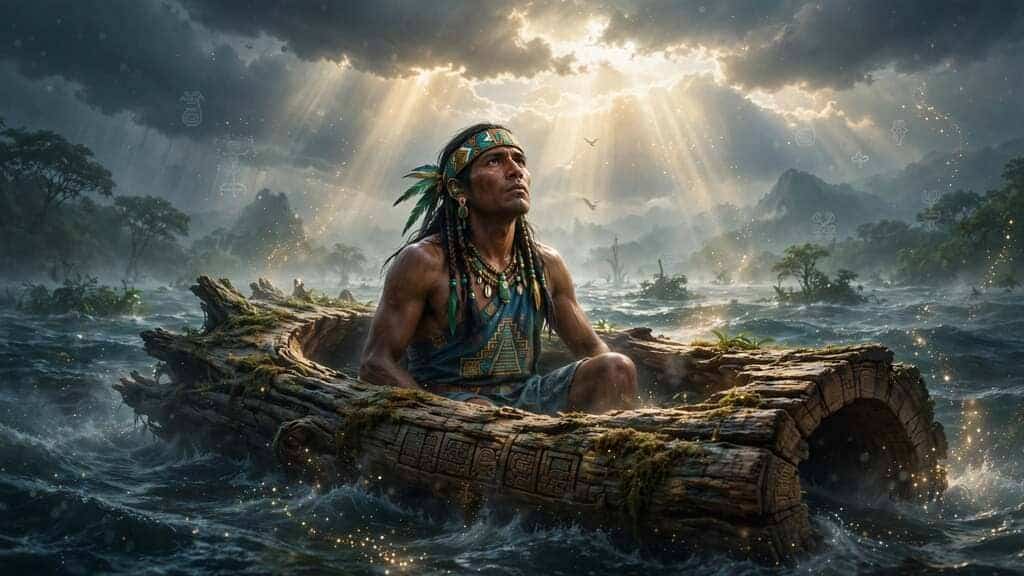
In Aztec tradition, the world had already been destroyed several times before humans came to be. One of those destructions came from a flood.
Coxcox survived the flood that ended the age known as the Sun of Water.
The legend goes that he made it alive because he hid inside a huge, hollowed out log, riding on the water until the earth could be walked again.
This catastrophe was a part of the cyclical destruction, in which each “sun” collapsed differently.
Destruction came from fire, wind, water, and even jaguars, and then came rebirth.
Like most other myths, the Aztec legend doesn’t treat the great flood as a random tragedy. It’s part of existence.
And Coxcox, much like Noah, survives as the last grain of hope for the rebirth of humanity.
2. Maya: Huracan
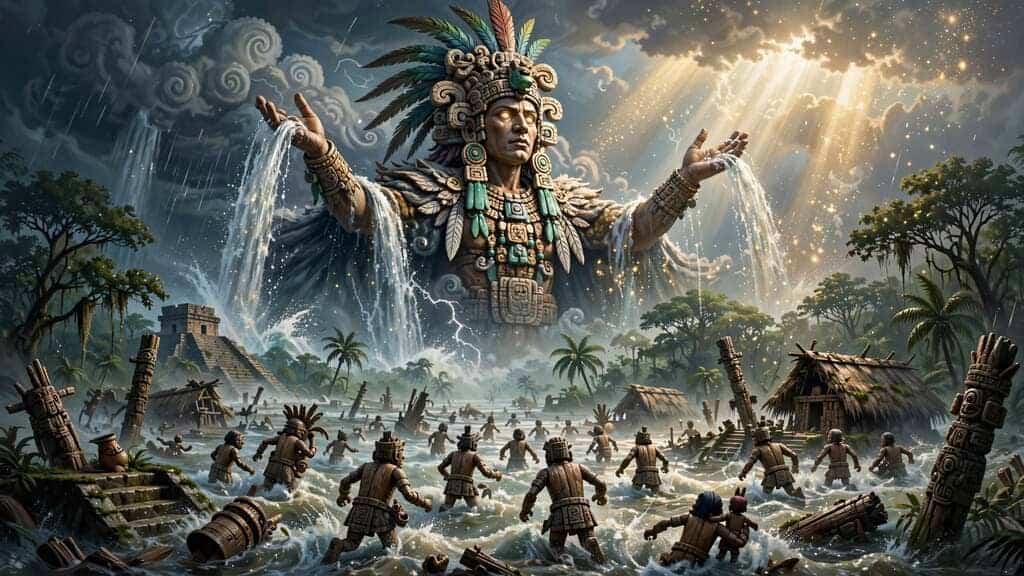
En Popol Vuh is the sacred text of the K’iche’ Maya. It reveals that the gods didn’t get creation right on the first try.
In the beginning, they created the wooden people from trees. These creations could walk and talk, but they had no soul or gratitude. They felt no connection to the gods.
En storm god Huracan sent a devastating flood across the earth to drown them. Their own animals and tools also turned against them.
The destruction isn’t at the center of this legend; gratitude is.
The Maya understood that a creation without soul and gratitude can’t last.
The flood came as a correction, clearing space for something better to be made.
3. Genesis and Gnostic Legends
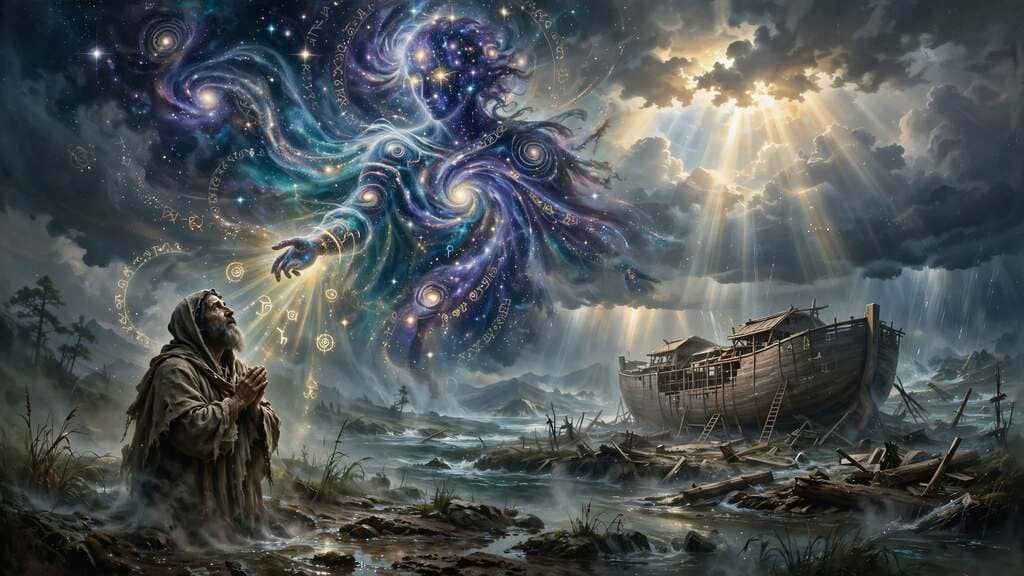
The Genesis flood is the most popular flood legend in the West, and likely, the world.
God was disappointed by human corruption, so he decided to cleanse the earth entirely through a single righteous family.
What’s especially interesting, this story was retold in Gnostic tradition, too.
En el Secret Book of John y el Hypostasis of the Archons, the flood is portrayed as something even stranger than God’s wrath.
It’s presented as a cosmic battle between sabiduría divina and the powers of the material world.
The Gnostic versions suggest that Noah’s survival was a result of hidden spiritual guidance, something even more mysterious than the God and the heaven we know from the Bible.
4. Noah’s Ark
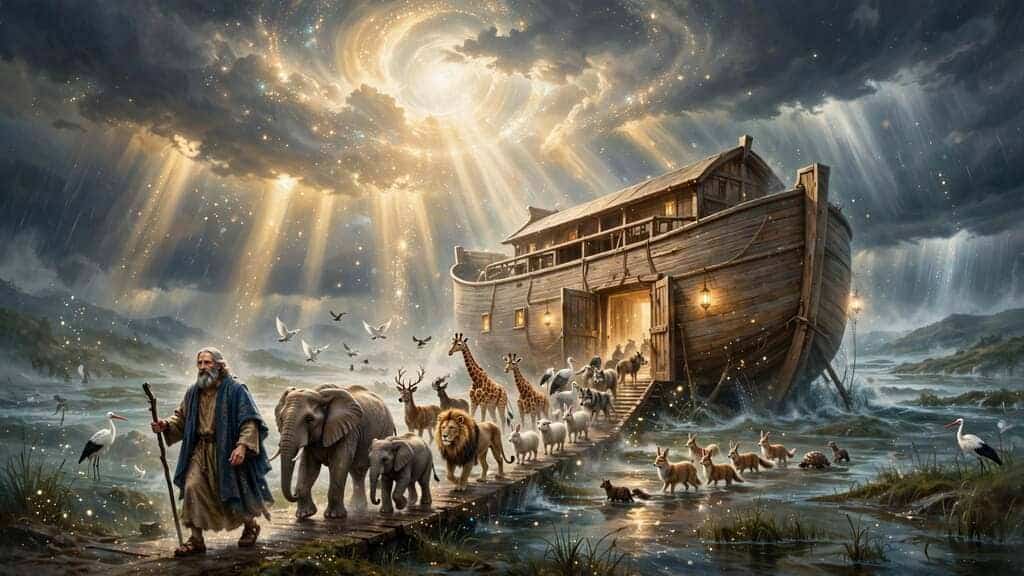
Even the people who never opened a Bible know the legend of Noah, the enormous ark he bult, the endless rain, and the animals he saved.
In a generation that had completely lost its way, Noah was a righteous man. So, he was instructed by God to build an ark large enough to preserve a couple of every species on earth.
The story goes into the specifics. We get exact measurements and a timeline.
Many people agree that it reads like something written from memory rather than an allegory.
When it was done, a rainbow stretched across the sky as a promise that a catastrophe of that size would never happen again.
The natural disaster became a sacred warning.
5. Islamic View of Noah
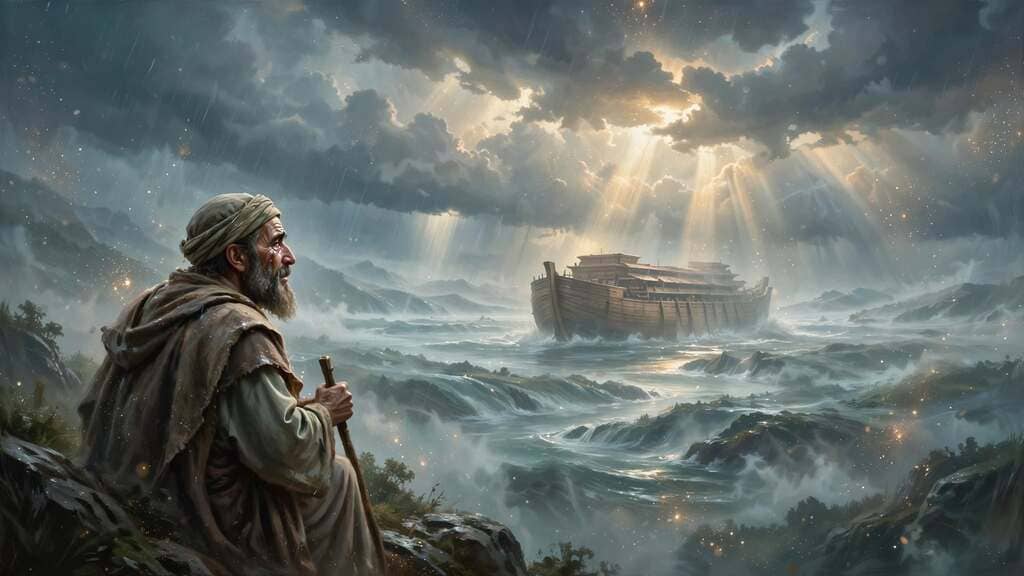
In the Quran, Noah is named Nuh, and he is recognized as one of the major prophets sent by Allah to warn people against corruption.
Nuh has been patiently preaching for centuries, begging his community to abandon idolatry, but he was mocked and rejected.
Finally, the flood comes as a result of generations denying the truth and refusing the love and patience offered to them.
According to legend, even Nuh’s own son refused to board the ark. Instead, he chose to climb a mountain, believing it was tall enough to keep him safe.
Nuh story is deeply tragic because he has to watch his own family choose sin over the truth he preached, and die in the flood.
There is more duelo than wrath in this version of the Great Flood.
6. China: The Great Flood
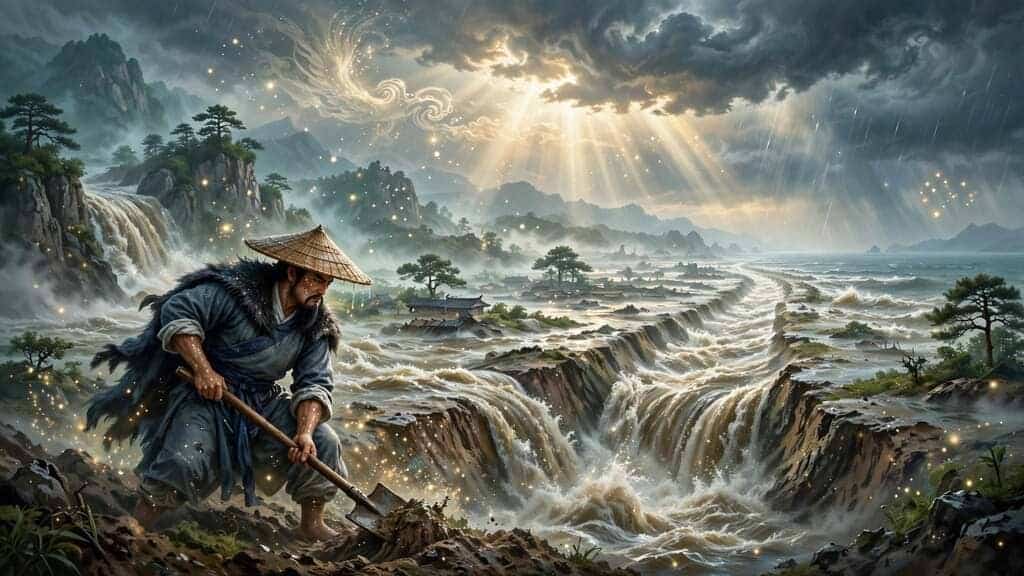
In Ancient Chinese tradition, the Great Flood didn’t come as divine punishment, but an engineering problem!
The legendary emperor Yu the Great needed to tame the catastrophic floodwaters that had defeated his father before.
His father built dams and walls to contain the water, but Yu took a different approach.
He built canals to guide the floodwater into the sea, and he spent thirteen years doing this.
The mystical idea behind this flood myth is that humanity has the power to stop the cataclysm.
It’s not divine influence, but sheer willpower and wisdom of one man that saves everyone from drowning.
All the flood myths hold us responsible, but this one does it directly.
There’s also a lot of optimism here. Humanity isn’t the cause of the disaster, but the solution!
7. Iran: The Videvdad
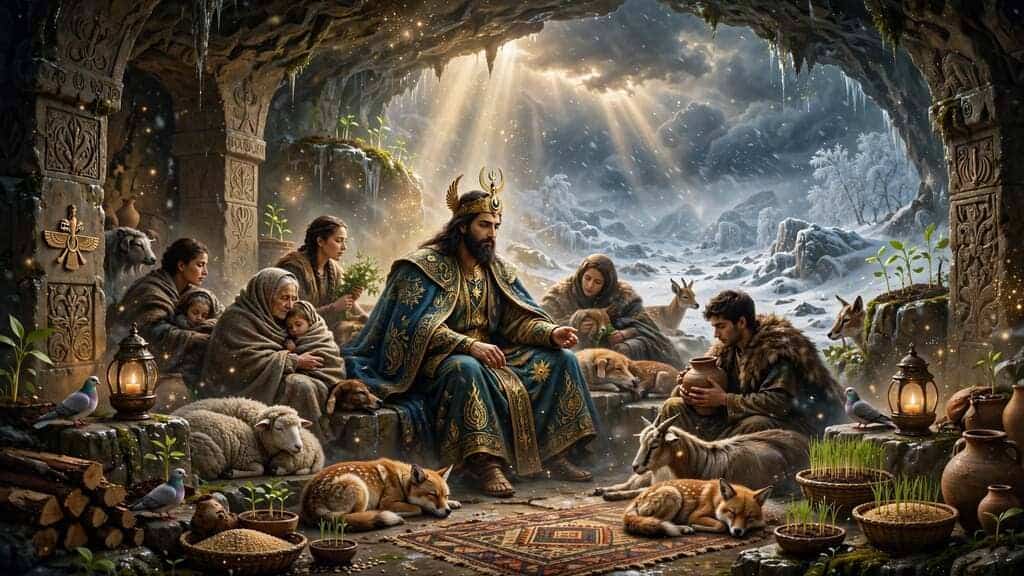
En Videvdad speaks of Yima, a ruler favored by the divine, who is warned by Ahura Mazda that a devastating winter was coming.
This legend doesn’t explicitly contain a flood, but the winter was just as destructive. It would wipe out nearly all life on earth.
Yima creates an underground shelter called a Vara. He gathers the finest specimens of every animal, plant, and human to help them survive.
Unlike the flood, where everything happens out in the open, here, life is preserved underground.
Like a seed of hope, it waits for the winter to end.
Once the danger passes, Yima opens the shelter, and life spreads throughout the earth once more.
Another thing that makes this legend similar to the great flood is that only the chosen get to live.
8. India: Pūluga and the Andaman Islands
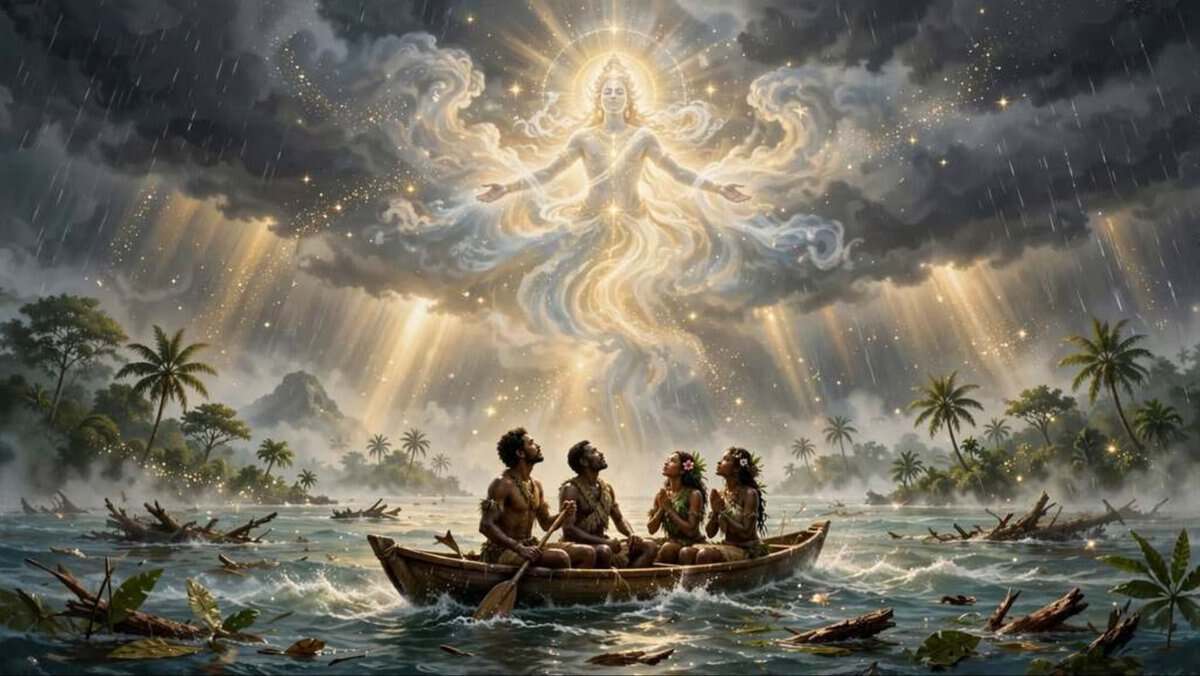
The legend of Pūluga, the creator god, shows him becoming disappointed in humanity, much like Yahweh in Genesis.
People started ignoring the sacred laws that were given to them.
When ignoring eventually became a rejection of the laws, Pūluga responded by drowning the world in a massive flood.
Only four people survive, two men and two women, becoming all that connects the new world with the one that was destroyed.
It’s interesting to note that the Andaman Islands were home to an isolated community at the time.
This suggests that the flood myths came to be independently; that they weren’t different retellings of an original myth.
9. Philippines: Ifugao

The Ifugao people of the Philippines tell a flood legend that reflects our separation from nature.
One year, the rain season didn’t arrive when expected. People grew desperate, so they started digging into the dry riverbed in search for the soul of the river!
They hoped that, by finding the soul, they could bring life to the river again.
Instead, they found a hidden spring, and this enraged the river gods.
The gods sent the rain, but not the life-giving kind. A massive flood ended up drowning everyone except two people, Wigan and Bugan.
This isn’t so much a warning against corruption but against overstepping boundaries and thinking that we have the power to control nature.
10. Ancient Greek Flood Myths
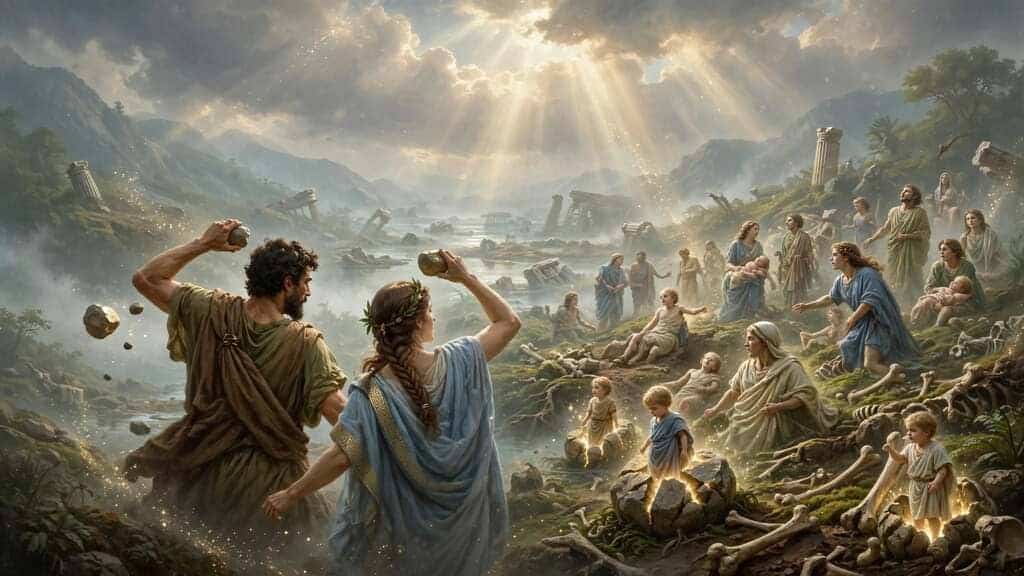
Deucalion and Pyrrha survived a flood sent by Zeus, after he had had enough of human cruelty and corruption.
Deucalion had been warned in advance, so he built a small ark and floated on it for nine days and nights of endless rain.
Finally, the water retreated just enough for him and Pyrrha to safely land on a mountaintop.
What happens next makes this legend truly poetic.
The two of them are instructed by the gods to repopulate the earth by throwing the “bones of their mother” detrás de ellos.
After some time, the riddle becomes clear to them: the bones of the mother are the stones of the earth. Each stone they throw becomes a person.
This way, humanity isn’t born through a chosen bloodline, but literally of the earth!
11. Baltic: Vineta
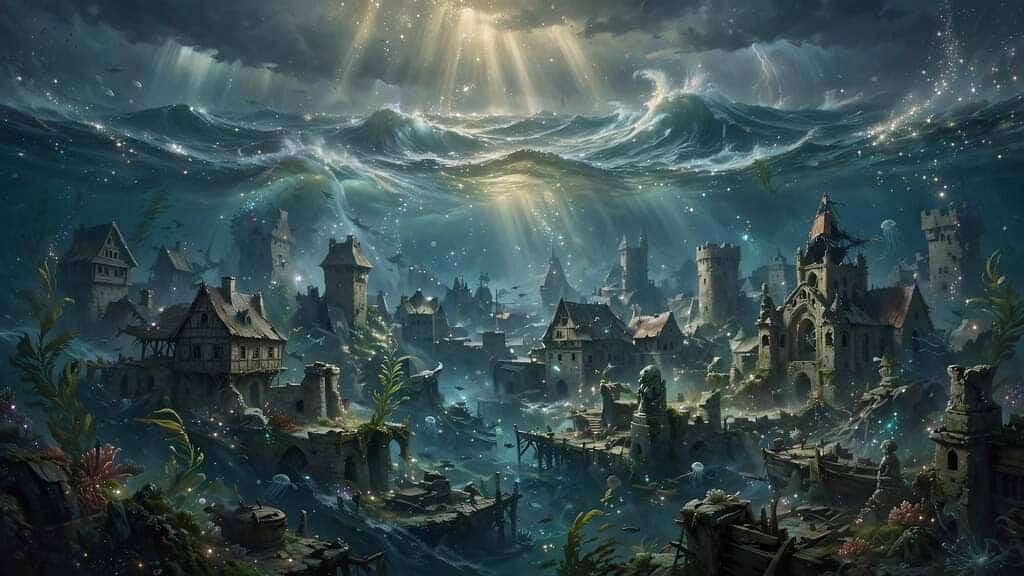
Along the Baltic coast, the legend places the city of Vineta. The city became so consumed with excess and pride that the sea itself rose up to swallow it!
Sometimes, Vineta is described as the most beautiful and powerful city to ever exist, but it ends up destroyed by its own codicia.
The waters didn’t just flood the city. Instead, it was swallowed whole until it disappeared!
It’s said to still rest under the waves. Its haunting bells can be heard from the deep.
Local beliefs even claim that on rare days, Vineta actually becomes visible, and it’s a ruined shell of its former self.
12. Irish: Cessair
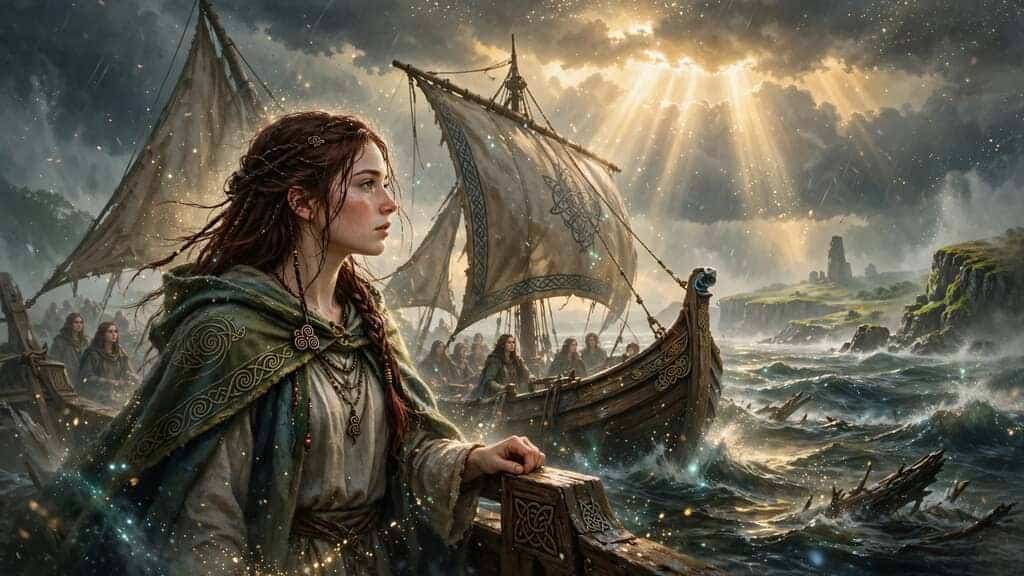
According to the Irish legend from the Lebor Gabála Érenn, Noah had a granddaughter named Cessair.
She fled the biblical flood by sailing to Ireland before it even happened. She hoped that the island could somehow escape the catastrophe.
She arrived in Ireland with a small group of mostly women and some men.
The flood, eventually, reached Ireland, too, wiping out her entire settlement. Of all of them, only a man named Fintan survived.
This is where the myth stops being biblical and gets fully Irish. Fintan survives the flood by turning into a salmon, then an eager, and then a hawk.
He is left as the only witness of what existed before the flood took everything.

A little Aquarius, devoted to writing and embroidery. Through my writing, I hope to empower readers to align with their true selves and navigate life’s mysteries with confidence.