
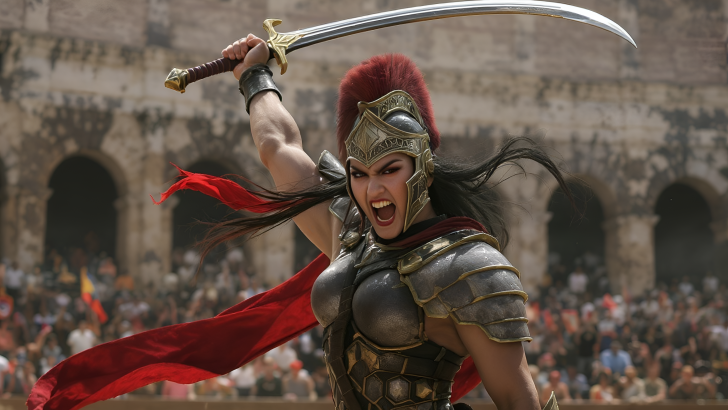
The world of gladiators is one of the most thrilling and brutal aspects of ancient Rome, filled with tales of courage, skill, and spectacle.
While male gladiators dominate most historical accounts, a lesser-known group also left a mark on Roman entertainment: the gladiatrices, or female gladiators.
These women fought in arenas, often in specially arranged spectacles, to entertain the public and demonstrate skill, strength, and courage.
While their existence was rarer and less documented than their male counterparts, archaeological evidence, inscriptions, and artistic depictions confirm their presence.
The gladiatrices challenge traditional perceptions of Roman women, showing that some women in antiquity could enter spaces of extreme danger and public performance.
Here are four fascinating facts about the world of female gladiators in Rome, exploring their lives, training, social impact, and the cultural fascination they inspired.
1. Female Gladiators Existed and Were Documented in Rome

Although the majority of gladiators were men, evidence confirms that women also fought in the arena.
Roman historian Cassius Dio mentions Emperor Domitian hosting games where women fought for a public spectacle.
Inscriptions and mosaics from the first and second centuries CE depict female fighters in full combat gear, often armed with swords, shields, or tridents.
These women were called gladiatrices, a term derived from gladiator but with a feminine suffix.
They were usually considered a novelty, and their participation often reflected social and political statements rather than traditional career paths.
Wealthy sponsors sometimes organized their matches to demonstrate extravagance or entertain audiences with an unusual spectacle.
Gladiatrices were trained like male gladiators, practicing combat skills and endurance to survive fights.
Despite being rare, their presence in arenas highlights the Roman fascination with skill, strength, and spectacle, proving that women could defy typical social norms and participate in extreme displays of courage and athleticism.
2. Their Training Was Intense and Dangerous

Female gladiators underwent rigorous and often brutal training similar to male fighters.
They were typically trained in specialized schools called ludus, where instructors taught combat techniques, weapon handling, and strategies for surviving the arena.
Training included physical conditioning, sparring with other gladiators, and mastering different weapon types such as swords, spears, or nets.
Their preparation was both physically demanding and mentally taxing, as failure could mean severe injury or death in public combat.
Despite their small numbers, the stakes were equally high for gladiatrices, as their fights were often considered novelty spectacles, increasing public scrutiny.
Evidence suggests that these women were carefully selected for strength, agility, and endurance.
While some may have volunteered, others were likely enslaved or compelled by circumstance.
Their training demonstrates that female gladiators were skilled professionals, capable of surviving in an environment dominated by violence, competition, and high stakes.
3. Gladiatrices Challenged Traditional Roman Gender Roles

The presence of women in the arena disrupted conventional Roman ideas about gender and female behavior.
Roman society largely expected women to remain in domestic spaces, focused on family, household duties, and modesty.
Gladiatrices defied these expectations by participating in violent public spectacles, demonstrating physical strength, courage, and combat skill.
Some historians suggest that female gladiators were also used as political or social tools, symbolizing the extraordinary wealth or power of their sponsors.
They provoked both fascination and scandal, as audiences were simultaneously impressed and shocked by women taking on roles traditionally reserved for men.
Artistic depictions often emphasized their physical prowess and sometimes eroticized their appearance, highlighting the tension between admiration and spectacle.
These women challenged the boundaries of femininity and public expectation in ways that remain remarkable to modern observers.
4. Their Legacy Survives in Art and Inscriptions

While the lives of individual gladiatrices are often obscure, their presence has been immortalized through art, inscriptions, and tombstones.
Mosaics from Roman villas depict female fighters in combat, sometimes alongside male gladiators.
Inscriptions honor their victories and sometimes provide names, suggesting that at least some female gladiators were celebrated for skill and bravery.
These records indicate that their contribution to Roman entertainment was recognized, even if their rarity made them exceptional.
Some tombstones commemorate gladiatrices, hinting at the respect or notoriety they achieved.
Modern historians and archaeologists study these artifacts to better understand the lives of women who participated in the violent spectacle of Roman arenas.
The legacy of gladiatrices challenges the idea that Roman women were passive observers, proving that they could participate actively in public life, even in extreme and dangerous roles.
Their story provides a fascinating glimpse into the intersection of gender, spectacle, and social dynamics in ancient Rome.

Siempre sentí una fuerte conexión con lo Divino desde mi nacimiento. Como autora y mentora, mi misión es ayudar a los demás a encontrar el amor, la felicidad y la fuerza interior en los momentos más oscuros.