
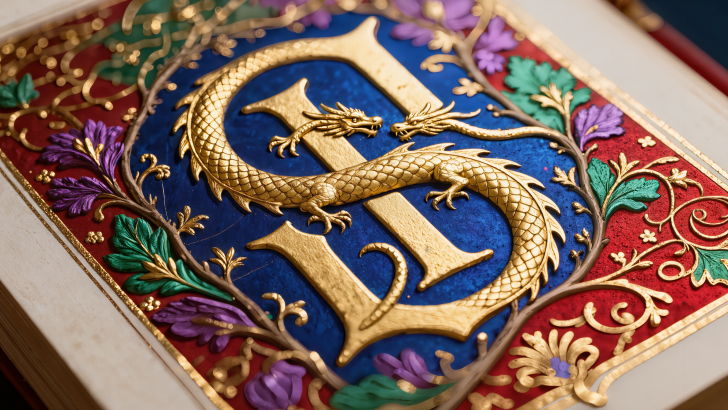
At first glance, a dragon coiled around a bishop’s crozier or slithering through the margins of a prayer book feels like it doesn’t belong.
Yet to medieval Christians, that creature was a powerful piece of visual theology.
Sometimes it was the Devil himself. Other times, it stood for the chaotic forces faith was about to crush.
Here’s why dragons kept showing up in medieval Christian art, and why those scenes packed such a heavy punch.
1. Giving Evil a Physical Form
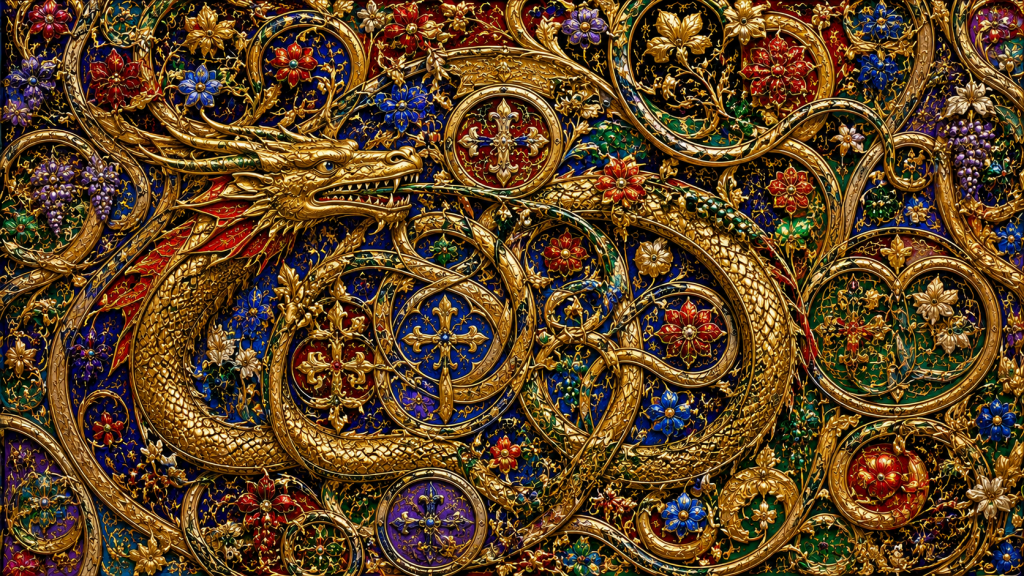
Medieval Christianity inherited one of its clearest dragon images straight from the Book of Revelation.
There, a great dragon is explicitly linked to the ancient serpent, the Devil, and Satan—an association that transformed a simple garden snake into a terrifying, cosmic adversary.
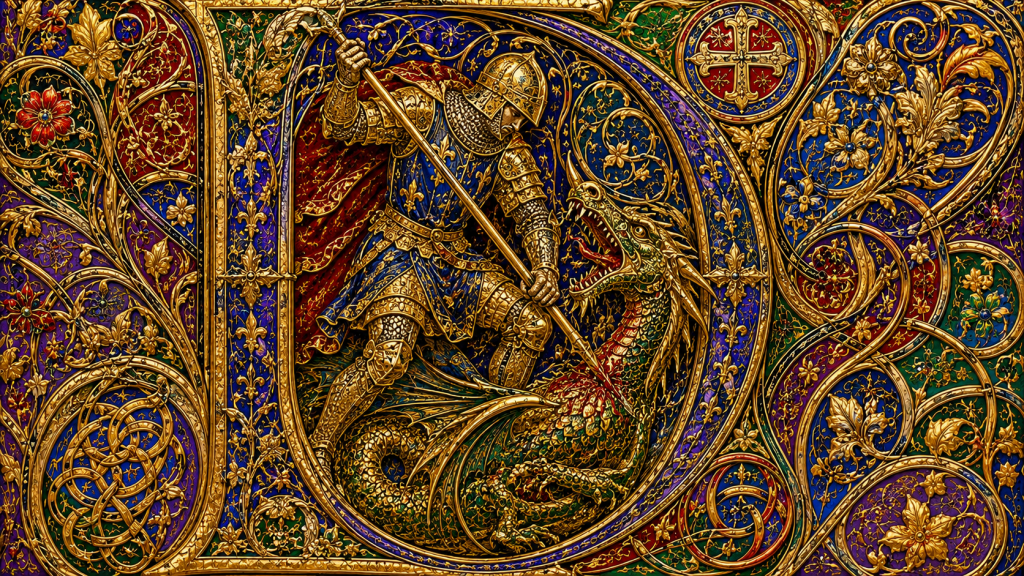
Because of this, placement was everything. Whenever a dragon showed up beneath Christ, an angel, or a saint, it was there to be conquered.
Whether crushed underfoot, run through with a spear, or forced into submission, the creature was always being overcome.
A medieval altar cross base now held by The Metropolitan Museum of Art, for example, places holy figures directly above dragons.
The design translates an abstract spiritual war into cold, hard physical reality. Holiness ascends, evil gets pushed downward, and divine order literally sits atop chaos.
2. A Defeated Dragon as a Visual Sermon
Most medieval Christians learned their theology through sight rather than text, receiving religious lessons through vivid imagery.
A battle with a dragon took a complicated spiritual idea and made it remarkably easy to digest.
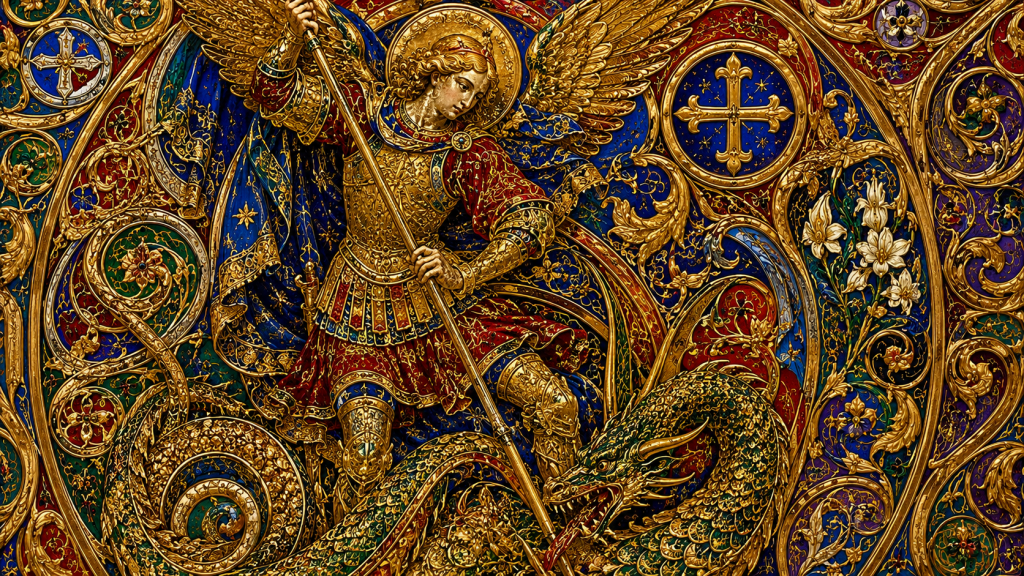
You didn’t need a long, head-spinning theological explanation to understand Saint Michael driving his spear into a monster’s jaws. Evil is real and powerful, but it loses in the end.
This message became especially meaningful on croziers, the ceremonial staffs carried by bishops and abbots.
Workshops in Limoges regularly placed Michael fighting the dragon right inside the curved head of the staff. And carrying that object meant carrying a clear declaration.
It tied Michael’s heavenly triumph directly to the bishop’s earthly job to guard the faithful, resist corruption, and protect Christian teaching.
3. Monsters in the Medieval Mindset
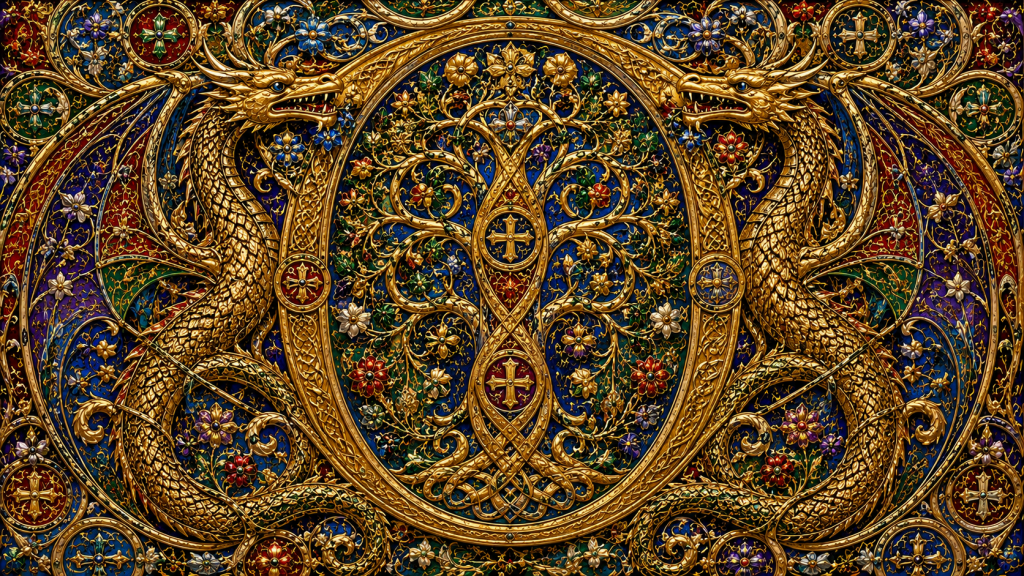
Today, dragons belong firmly in the fantasy section. But medieval bestiaries didn’t draw a hard line between the real and the imaginary. There just wasn’t a strict divide between the two worlds.
These bestiaries cataloged real and mythic beasts side-by-side, treating every creature as a message from God about morality and the human soul.
Writers described the dragon as the greatest of serpents—monsters so massive they could wrap their tails around an elephant and drag it down.
Christian writers quickly seized on that imagery. Just as the dragon strangles the titan of the land, Satan waits to drag noble souls down to hell.
Whether a medieval reader thought dragons were lurking in unexplored lands or viewed them as pure moral allegory didn’t really matter.
The creature wasn’t a random fictional detail on a sacred artifact. It belonged to their fundamental understanding of creation itself.
4. Absorbing Older Traditions
The dragon wasn’t a Christian invention. Long before medieval churches were built, serpentine monsters slithered through ancient myths and the intricate knotwork art of Northern Europe.
As Christianity spread, artists didn’t erase these older visual motifs. They repurposed them. They took familiar beasts from the past and set them alongside crosses, saints, and church doors.
In areas steeped in Viking heritage, traditional animal styles lived on inside Christian carvings. The creatures kept their powerful, imposing look, but they received a completely new meaning.
That doesn’t mean every dragon on a Christian artifact was secretly pagan. The image had simply become adaptable.
Christianity routinely transformed inherited symbols by weaving them into a new story.
A frightening monster from an older tradition wasn’t a threat anymore. It was now the beast defeated by Christ, Michael, or a Christian saint.
5. Designed for Borders, Curves, and Thresholds
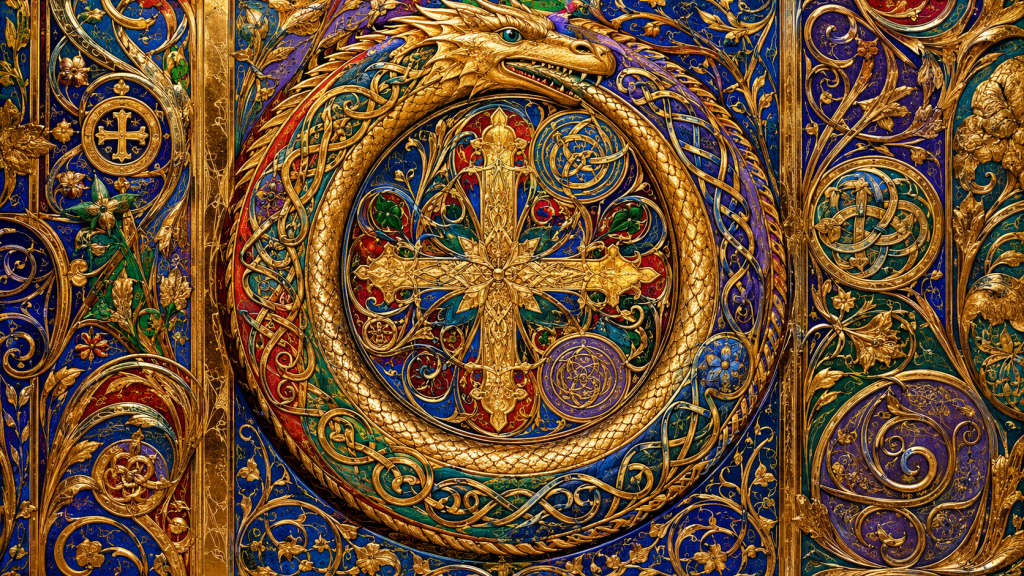
There was also a wonderfully practical reason dragons appeared so often. Their bodies could go almost anywhere.
A serpentine tail could sweep along the border of a manuscript, an arching neck could fill the loop of a staff, and a gnarled mouth could swallow the end of a handle.
Artists could twist, stretch, and contort a dragon without losing its identity.
This flexibility often placed dragons along the edges of sacred objects—and edges already carried spiritual tension. These were the boundary zones between the clean, sacred center and the unknown outside.
On some medieval churches, dragon-serpents near the doorways even stood as guardians, confronting danger right at the threshold.
Of course, not every manuscript dragon was a heavy theological statement. Some were clearly just medieval artists having fun in the margins.
But that uncertainty is part of what makes them so fascinating.
The dragon could be the Devil, a strange creature from the edge of the world, or a stylized monster curling around something holy—always close to the sacred, but never powerful enough to conquer it.
