
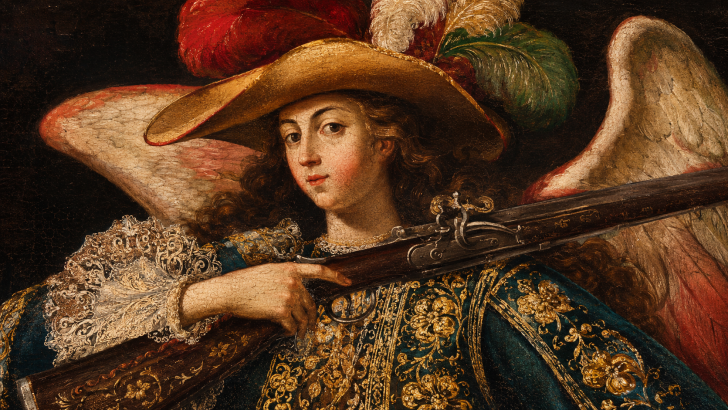
These angels look as though they’re dressed for a royal celebration.
Their sleeves are enormous, their clothing is covered in elaborate patterns, their hats are decorated with feathers, and their wings spread behind them in carefully arranged layers.
And then you notice the gun.
Paintings like these appeared across the colonial Andes beginning in the late 17th century. Today, the figures are known as ángeles arcabuceros, or arquebusier angels.
1. This Wasn’t One Painter’s Strange Idea
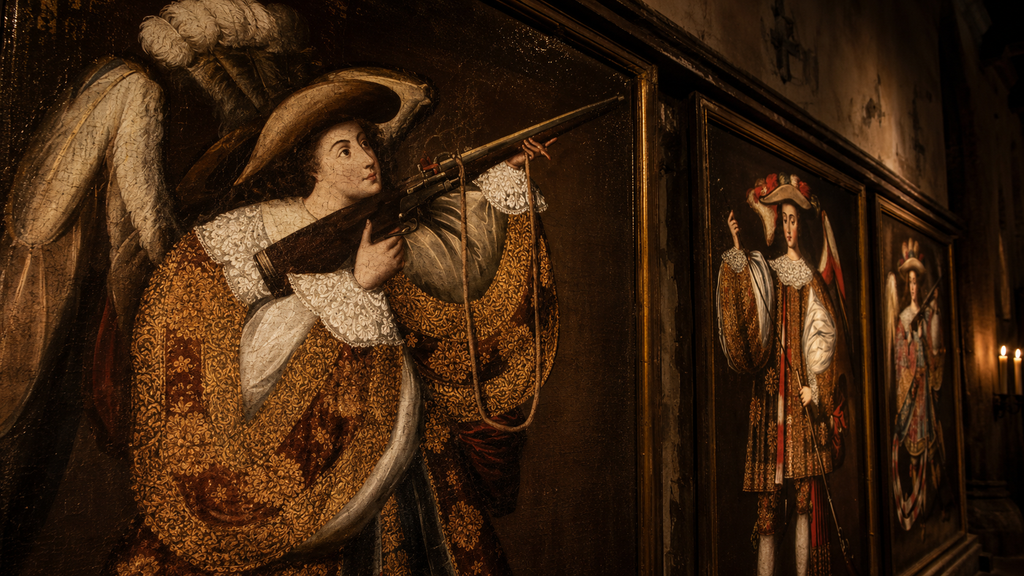
Arquebusier angels weren’t the invention of one artist who decided heaven needed better weapons.
They became an entire genre.
The paintings developed in workshops around Cusco and Upper Peru, an area that included parts of present-day Bolivia, during the late 1600s.
The Museo Pedro de Osma places their emergence around the 1680s and describes them as an unusual form of colonial art with no direct European precedent.
European artists had painted military angels before, especially the Archangel Michael.
But Michael usually carried a sword, spear, or shield. An angel handling a long firearm while dressed in embroidered court fashion was something completely different.
These figures were often painted as part of larger groups.
Displayed together inside a church, they could resemble a heavenly regiment, with each angel holding a weapon, banner, musical instrument, or ceremonial object.
One of the best-known surviving groups is associated with the church at Calamarca in present-day Bolivia.
The unidentified artist behind those paintings is generally called the Master of Calamarca.
That isn’t necessarily one person’s real name. It’s a label historians use for an artist—or possibly a workshop—whose identity remains uncertain.
According to the International Council of Museums, colonial paintings from Cusco and Quito were frequently produced by workshops completing commissions for distant patrons.
Many of the artists were never named in surviving records. Their angels, however, wouldn’t be so easily forgotten.
2. The “Gun” Was Really an Arquebus
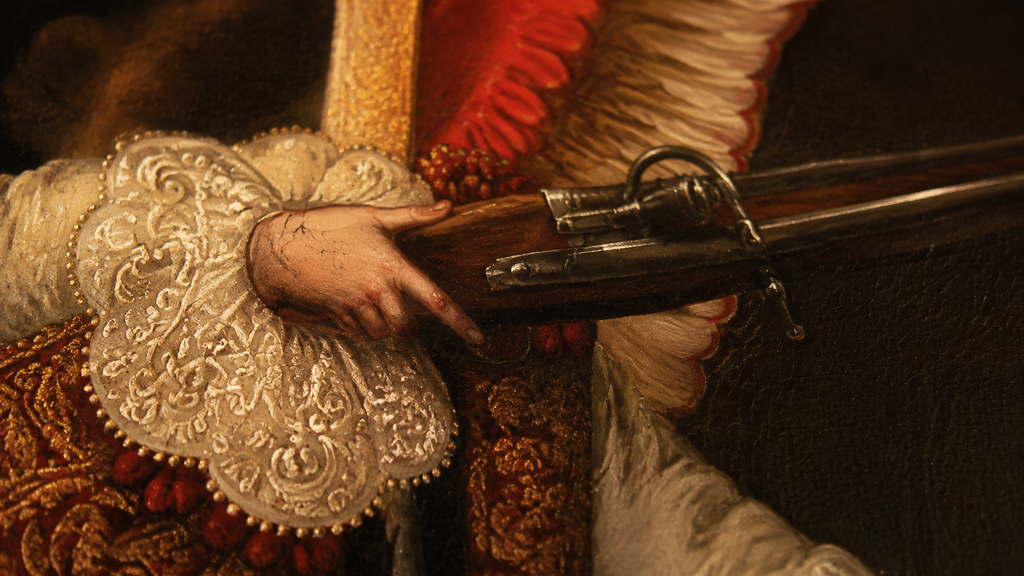
The weapon these angels carry is generally identified as an arquebus.
It was an early muzzle-loaded firearm used by soldiers in the 16th and 17th centuries. It had a long barrel and could be awkward to operate.
Loading one involved several steps. A soldier had to handle the powder, prepare the ammunition, use a ramrod, position the match, and bring the weapon into the correct firing position.
That complicated process helps explain why the angels appear in so many different poses.
One may hold the arquebus upright. Another carries it across his body. A third appears to be working with the ramrod. Some look ready to march, while others seem to be presenting their weapons for inspection.
But they rarely look angry.
In fact, their faces can be surprisingly calm. The gun doesn’t turn them into violent figures. It gives them the controlled appearance of trained soldiers.
That would’ve carried a great deal of meaning in the colonial Andes.
Firearms had arrived with Europeans, and they were closely connected to military force and colonial power.
Placing one in an angel’s hands transformed it into something more than a battlefield weapon.
It became a visible sign of supernatural authority.
3. A Dutch Military Manual Probably Helped With the Poses
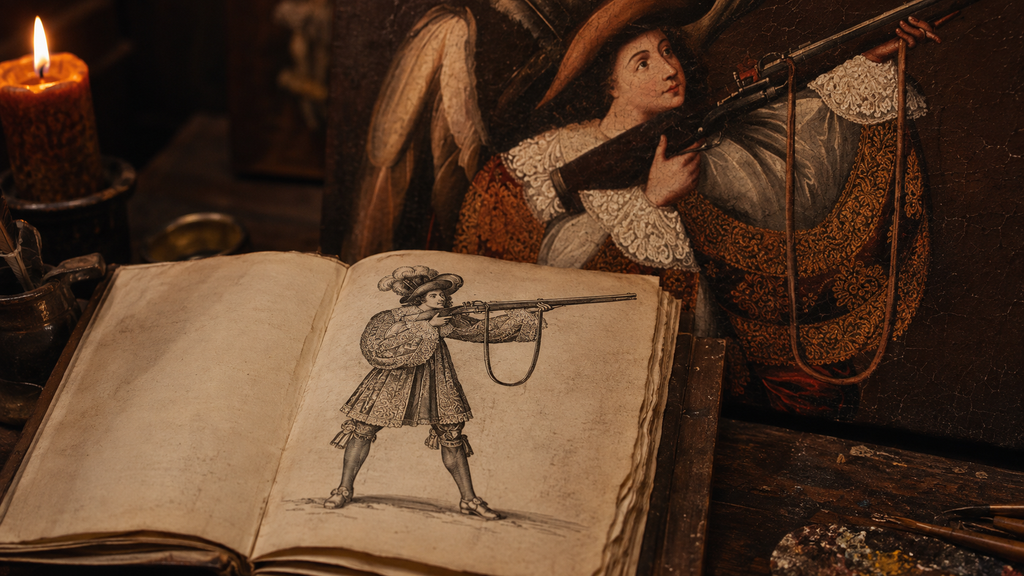
The angels may look otherworldly, but their gun-handling techniques came from a very practical source.
Many of their poses closely resemble illustrations found in European military drill manuals.
One of the most important was Jacob de Gheyn II’s The Exercise of Arms.
The complete volume was published in 1608 and contained 117 numbered plates showing soldiers how to handle muskets, firearms, and pikes.
The Metropolitan Museum of Art holds engravings from the manual and notes that it was soon produced in several languages.
Copies and related prints circulated far beyond the Netherlands. At some point, versions of these military images reached artists in the Spanish Americas.
Andean painters could then use the printed soldiers as models. But they didn’t simply reproduce them.
The stiff European servicemen acquired enormous wings, luxurious clothing, delicate faces, and gold decoration.
A manual designed to train ordinary soldiers became a sourcebook for painting heaven’s army.
That transformation is one of the strangest—and most creative—parts of the story.
4. Their Clothing Was Almost as Important as Their Weapons
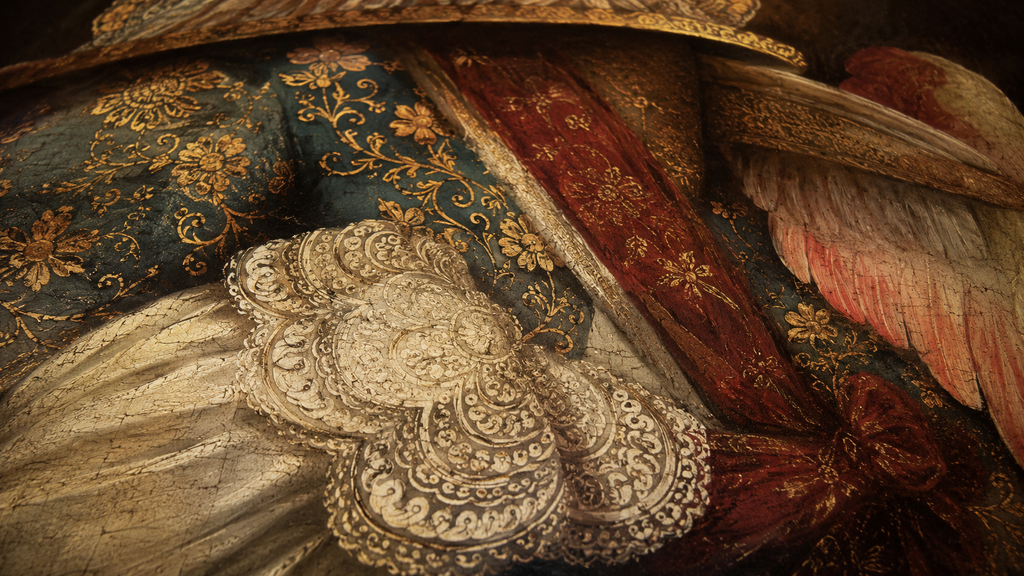
The gun grabs your attention first, of course, but the clothing often takes up far more of the canvas.
These angels appear in wide sleeves, embroidered coats, lace collars, ribbons, stockings, feathered hats, and shoes decorated with bows.
Gold patterns run across their clothing, sometimes turning the fabric into a field of flowers and curling vines.
They look like soldiers, aristocrats, and performers all at once.
Some elements came from European court and military fashion, while others were reshaped through the artistic traditions of the Andes.
The result wasn’t purely Spanish or purely Indigenous. It belonged to the colonial Andes.
The clothing also separates the angel from an ordinary armed man.
A real arquebusier might’ve been exhausted, dirty, and dressed for work. These figures, however, seem untouched by the physical demands of war.
Their enormous sleeves never get in the way. Their feathers remain perfectly arranged. Their guns are heavy, but they hold them without effort.
Everything about the outfit says this is no ordinary soldier.
This is someone from a much higher court.
5. Andean Artists Turned Imported Ideas Into Something New
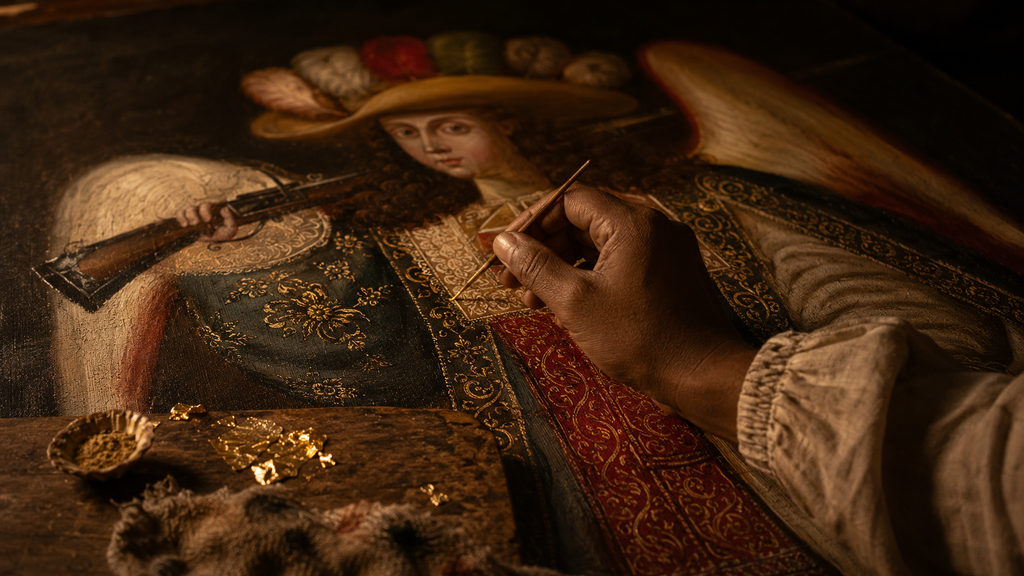
Religious art played a major role in Spain’s effort to spread Catholicism throughout the Americas.
European prints gave colonial artists models for saints, angels, biblical scenes, and the Virgin Mary. Church authorities and patrons commissioned paintings to communicate religious ideas visually.
But the finished works weren’t simply European paintings made elsewhere.
Indigenous and mixed-heritage artists in Andean workshops developed styles shaped by local materials, colors, artistic traditions, and ideas about sacred power.
The Metropolitan Museum of Art notes that many questions remain about the identities of the Indigenous makers behind Cusco School paintings.
Their names were often omitted from written histories, even when their work traveled hundreds of miles.
The arquebusier angels show how those artists could transform imported imagery.
Some scholars suggest Andean viewers connected the armed angels with older ideas about winged warriors or powerful supernatural beings.
Another theory links the arquebus to Illapa, an Andean deity associated with thunder, lightning, and rain.
The Museo Pedro de Osma discusses that interpretation, but it shouldn’t be treated as definitive.
Meanings could vary depending on who commissioned a painting, where it was displayed, and who viewed it.
What seems clear is that Andean artists weren’t simply copying Europe, and that they were creating a new visual language from several traditions at once.
6. Some of the Angels Had Mysterious Names
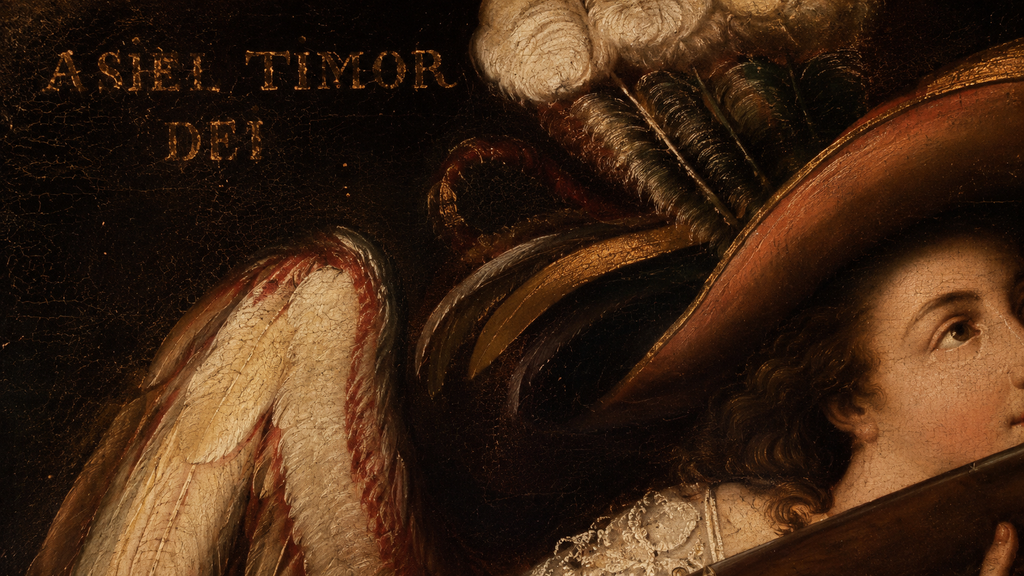
Not every armed angel is identified as Michael, Gabriel, or Raphael.
Some paintings carry unfamiliar names, including Asiel Timor Dei, commonly understood as “Asiel, Fear of God.”
The angel stands elegantly with an arquebus held close, his fingers carefully positioned away from the trigger.
Asiel isn’t one of the familiar archangels named in the Catholic Bible.
Other paintings use names from noncanonical angel traditions, while some titles are still difficult to interpret. The word Dei, meaning “of God,” connects the angel to a divine quality or function.
Placed together, these figures could form an expanded heavenly court.
The distance between Rome and the Andes was also important.
Images could develop beyond official approaches to angelic devotion, giving local patrons and artists room to make the heavenly world feel larger—and considerably better armed.
7. The Guns Probably Carried Several Meanings at Once
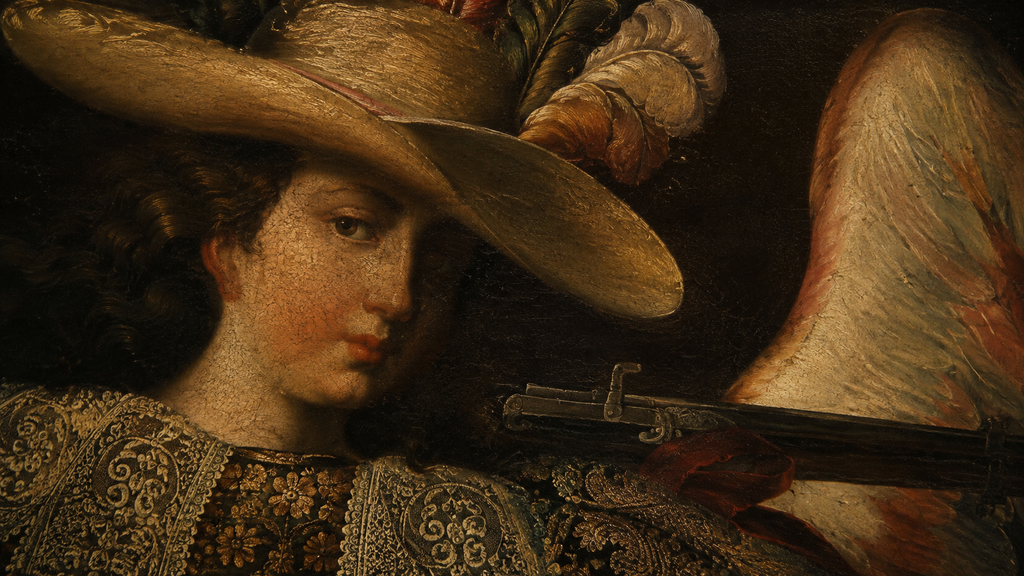
So why were these angels painted carrying guns?
There probably wasn’t one answer.
The arquebuses could represent spiritual warfare, with angels defending heaven, fighting evil, and protecting the faithful.
They also symbolized earthly military authority, linking heavenly order with the colonial power imposed by Spain.
Andean viewers may have seen more. Gunfire could evoke thunder, while the angels’ wings and elaborate clothing may have recalled older supernatural figures and local ideas about power.
These meanings could coexist. The paintings might suggest Christian protection, colonial authority, Andean traditions, or all three at once.
What makes them especially striking is their calmness. Dressed in feathers, lace, gold, and enormous wings, the angels hold their weapons but rarely fire them.
They look less like soldiers caught in battle than heavenly guards waiting for orders.
