
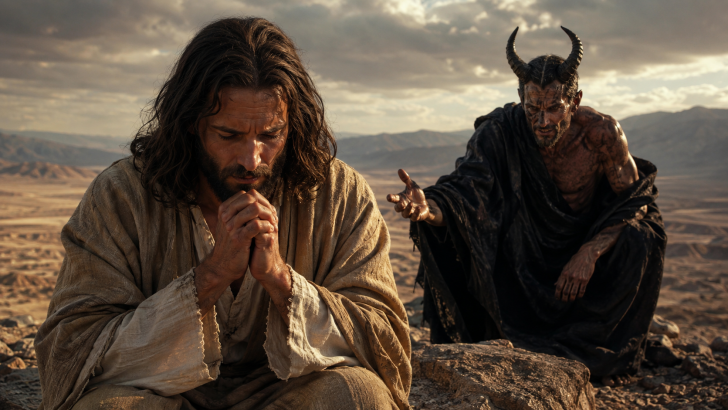
The temptation of Jesus creates an interesting question. If Satan understood that Jesus was the Son of God, why would he even attempt to tempt Him?
The Gospels describe Satan confronting Jesus in the wilderness after Jesus had fasted for forty days.
He tempted Him with food, spectacular displays of divine protection, and worldly authority. Each time, Jesus refused and responded with Scripture.
At first, Satan’s plan can seem pointless. If he knew Jesus’ identity, surely he should also have known that tempting Him would be extraordinarily difficult.
Christian theologians have offered several explanations. The temptation was not necessarily based on Satan believing Jesus would be easily deceived.
Instead, it can be understood as an attempt to challenge His mission, test His obedience, and offer alternatives to the path He had come to follow.
Here are five things to know about why Satan tempted Jesus.
1. Knowing Jesus’ Identity Did Not Mean Satan Knew Everything

Christian teaching never describes Satan as omniscient. That attribute belongs to God.
The Gospels show supernatural beings recognizing something extraordinary about Jesus. Demons identify Him with titles such as the “Holy One of God” and “Son of God.”
That suggests the spiritual forces opposing Jesus recognized His divine authority. But recognition is not the same as complete knowledge.
Satan could understand who Jesus was without possessing perfect knowledge of everything Jesus would do, how every event would unfold, or exactly how God’s plan would reach its fulfillment.
This distinction helps explain why Satan could still attempt temptation. Christian theology portrays him as intelligent and dangerous, but limited.
He can make decisions based on what he knows. He can also fail.
The wilderness temptation therefore does not require Christians to believe Satan somehow forgot Jesus’ identity.
It demonstrates that knowing something about God’s plan does not give Satan God’s complete knowledge of it.
2. Satan Was Tempting Jesus to Use His Power for Himself

The first temptation happens after Jesus has fasted and become hungry. Satan tells Him to turn stones into bread.
On the surface, this may seem like a surprisingly small temptation. Eating bread is not sinful, and Christianity teaches that Jesus possessed extraordinary power.
That is precisely what makes the temptation interesting. The issue is not bread itself.
Satan is challenging Jesus to use His power according to immediate physical desire rather than remaining obedient to the Father’s purpose.
Jesus answers with Scripture: humanity does not live by bread alone. This establishes an important pattern.
Satan does not necessarily tempt Jesus by presenting something obviously evil.
Instead, he offers something understandable at the wrong time and for the wrong reason. Jesus refuses to let hunger determine His obedience.
3. Satan Offered Jesus a Shortcut to Earthly Power

Perhaps the most revealing temptation involves the kingdoms of the world. Satan shows Jesus worldly kingdoms and offers authority over them in exchange for worship.
Jesus refuses. From a Christian perspective, this can be understood as a shortcut.
Jesus’ mission ultimately leads toward kingship and victory, but His path involves obedience, rejection, suffering, and eventually resurrection.
Satan offers power without that path. The price, however, is allegiance to him.
This makes the temptation far more significant than simple political ambition. It presents two completely different ways of exercising authority.
One involves faithfulness to God. The other offers immediate worldly greatness through compromise.
Jesus responds that God alone must be worshipped. Christian teaching frequently applies the same principle more broadly.
Not every opportunity is good simply because it leads toward something desirable. How someone reaches a goal matters as much as the goal itself.
4. The Temptation Shows Jesus Succeeding Where Humanity Failed

The wilderness story also carries strong biblical symbolism.
Jesus spends forty days in the wilderness, reminding us of other important periods involving the number forty in Scripture.
His responses to Satan come from Deuteronomy, connecting the scene particularly strongly with Israel’s wilderness experience.
There is also a broader Christian contrast between Jesus and Adam. Adam and Eve lived in an abundant garden and disobeyed when tempted.
Jesus enters a barren wilderness while physically hungry and remains obedient. This contrast became extremely important in Christian theology.
The New Testament presents Christ as succeeding where sinful humanity failed.
The temptation therefore serves a purpose within the Gospel story beyond explaining Satan’s strategy.
It reveals Jesus’ faithfulness. Satan presents genuine temptations, but Jesus refuses each one.
5. Satan Could Tempt Jesus, but He Could Not Control Him

Perhaps the simplest explanation is that Satan attempts things he cannot ultimately accomplish.
Christianity does not portray Satan as someone who only acts when victory is guaranteed.
Throughout biblical tradition, evil resists God even though Christian theology teaches that God’s final victory is certain.
The temptation of Jesus follows this larger pattern. Satan can approach. He can suggest.
He can challenge. He can offer alternatives. But he cannot force Jesus to accept them.
That distinction is central to the story. After Jesus repeatedly refuses, Satan eventually leaves.
Luke’s Gospel adds the interesting detail that the devil departed “until an opportune time,” suggesting that the wilderness was not the end of spiritual opposition surrounding Jesus’ mission.
Yet the result does not change. Satan’s knowledge of Jesus’ identity does not make him equal to Jesus, nor does it give him control over what happens.
From a Christian perspective, the wilderness temptation therefore reveals Satan’s limits as much as his intentions.
He recognizes someone powerful enough to threaten his purposes and still attempts to interfere.
The story ultimately focuses less on why Satan believed temptation might work and more on what happens when it does not:
Jesus leaves the wilderness without compromising His identity, obedience, or mission.

私は生まれたときから、常に神との強いつながりを感じていた。作家として、また指導者として、私の使命は、人々が最も暗い時代に愛と幸福と内なる強さを見つけるのを助けることである。