
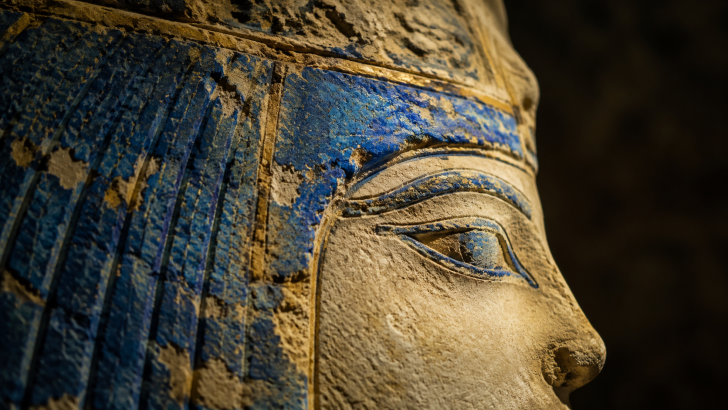
Egyptian blue is an ancient color, sometimes vivid, sometimes barely hanging on.
But shine visible light on it and view it through the right camera, and suddenly, a second version blazes out—one that’s been hiding beyond human sight for thousands of years.
1. Blue Had to Be Invented
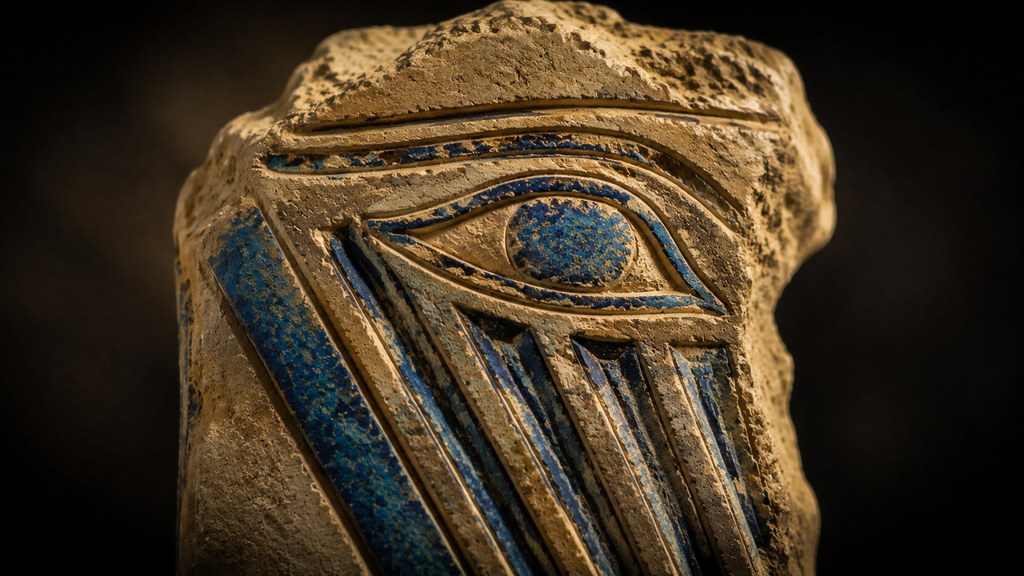
Blue was never easy to pull from the earth. And while lapis lazuli delivered a glorious version, the stone reached Egypt across thousands of miles from what’s now Afghanistan.
Turning that treasure into everyday paint wasn’t exactly practical.
So Egyptian craftspeople did something far stranger. They built blue.
By roughly 3100 BCE, they were producing what researchers call the world’s oldest synthetic pigment.
It wasn’t crushed blue rock or juice squeezed from a plant. Heat transformed plain raw materials into a new substance.
And that changed what color could be.
Blue no longer had to wait inside a rare stone. It could spread across tomb walls, coffins, statues, and papyrus, carrying the echo of lapis and turquoise far beyond the stones themselves.
2. The Recipe Lived Inside the Furnace
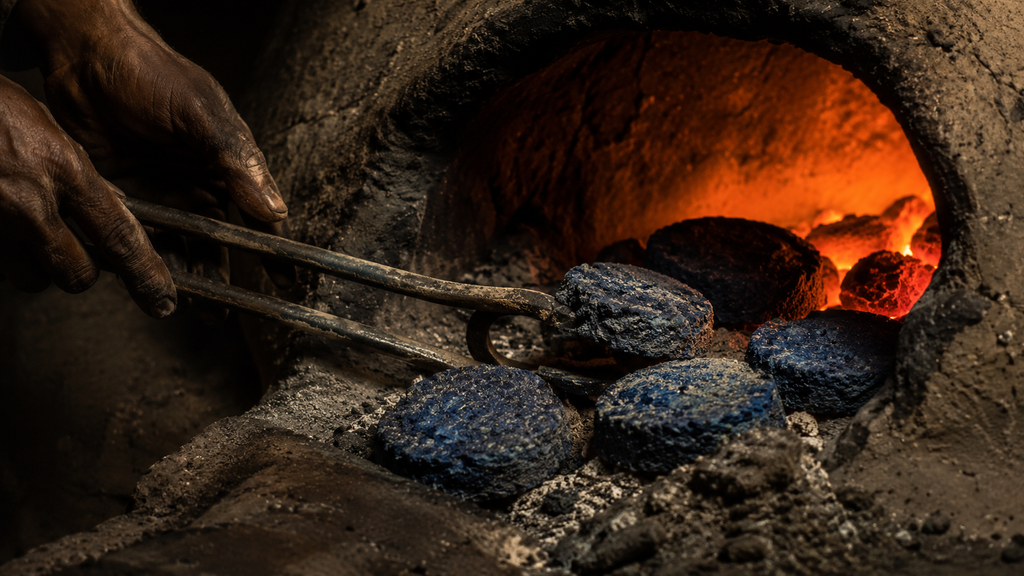
Into the workshop came quartz-rich sand, a source of calcium, copper from mineral or metal, and an alkaline flux.
But the real ingredient was control. Get the firing wrong and the result could lean green, turn dull, or refuse to become blue at all.
No surviving Egyptian text walks us through the process.
Centuries later, the Roman architect Vitruvius described sand, copper, and natron being shaped into balls and fired. Modern analysis fills in what his short recipe leaves out.
Still, ancient pigment wasn’t one perfectly pure chemical. It held cuprorivaite crystals tangled through glassy material and other mineral phases.
And grinding changed it again: coarser grains gave deeper blue, while finer ones looked paler.
So there was never just one Egyptian blue. Every furnace left an accent in the color.
3. Then the Blue Slips Past Your Eyes
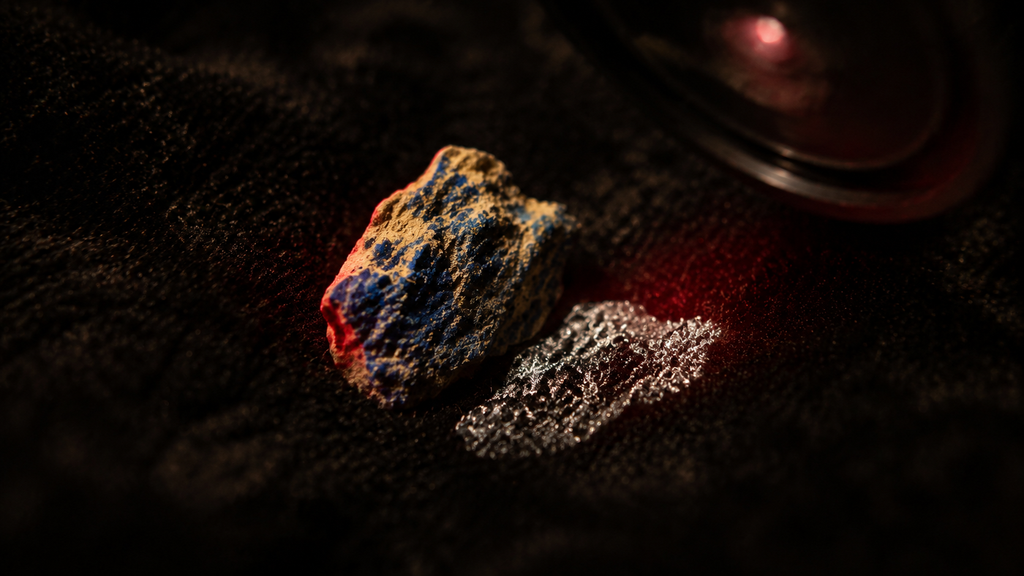
Here’s where an old pigment starts acting like something from a future laboratory.
Shine visible light on cuprorivaite and its copper ions absorb some of that energy.
Then, as their electrons settle back down, the material releases light at a lower energy, peaking around 910 nanometers.
That sits in the near-infrared—past the red edge of what your eyes can catch.
But an infrared-sensitive camera catches it easily. And the signal is unusually intense, with researchers reporting a 10.5% quantum yield for the bulk material.
The pigment hasn’t been storing sunlight since a pharaoh’s lifetime, either. Each fresh exposure starts the process again.
What survived is the crystal structure that makes the reaction possible.
4. A Camera Sees What Time Erased
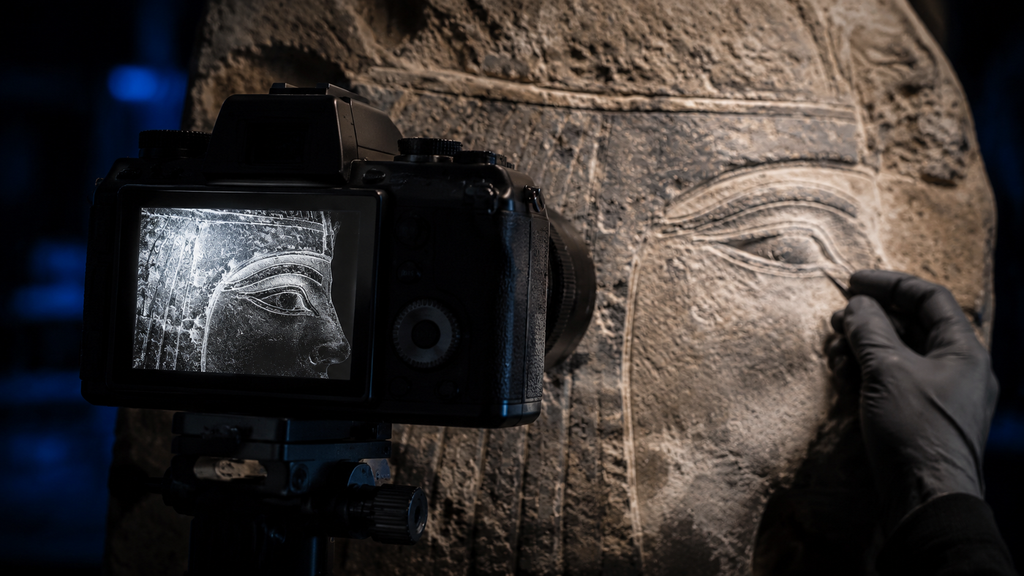
To find that glow, conservators use visible-induced luminescence imaging.
They illuminate an object with visible light stripped of infrared, then photograph it with an infrared-sensitive camera behind a filter that blocks the visible wavelengths.
And there it is. Egyptian blue often appears as a fierce white signal in the finished image because the picture maps invisible infrared intensity into something you can see.
The technique doesn’t demand a chip from the artwork. And the blue doesn’t need to look blue anymore.
The camera catches particles mixed with other colors, hidden beneath varnish, or lost to the naked eye.
So a surface that looks blank can still hold its painter’s decisions. Time removed the display, but not the evidence.
5. Lost Colors Start Haunting the Surface
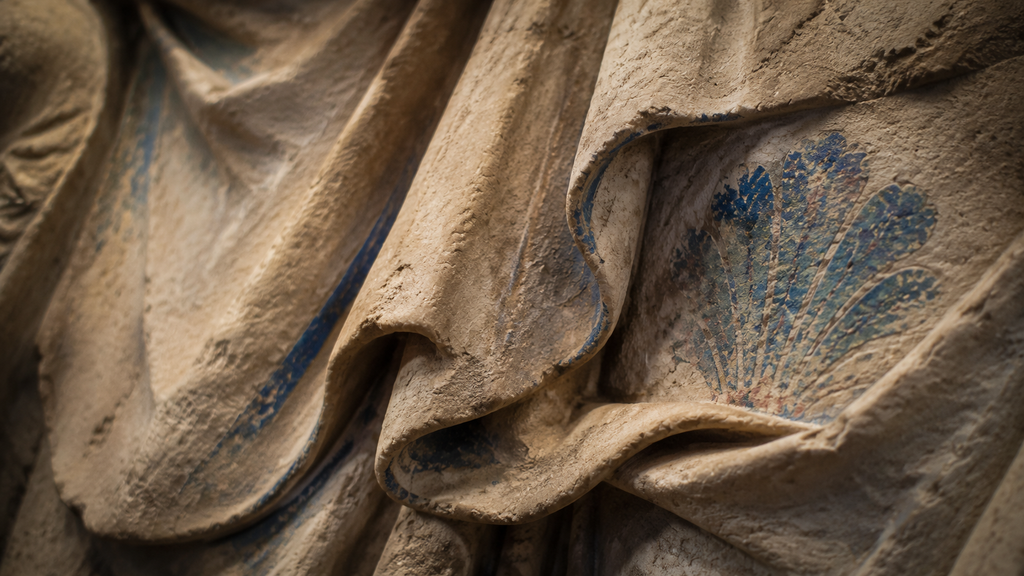
For generations, pale marble helped sell a clean fantasy of Greek antiquity. Then infrared luminescence found Egyptian blue on the Parthenon sculptures in 2009.
The British Museum’s investigation gave back part of a painted world that time and damage had pushed out of sight.
And on Roman Egyptian mummy portraits, the surprise runs deeper.
Blue rarely stays in the places you’d call blue. The Getty’s research records it mixed into gray backgrounds, pale clothing, eye whites, lips, hair, and the cool shadows of painted skin.
At least 47 portraits in the project’s published count contained it.
Think about that for a second. A face that looks warm, pink, beige, or brown can carry blue inside its modeling.
The infrared camera exposes how artists thought beneath the final color you see.
6. The World Forgot, but the Crystal Didn’t
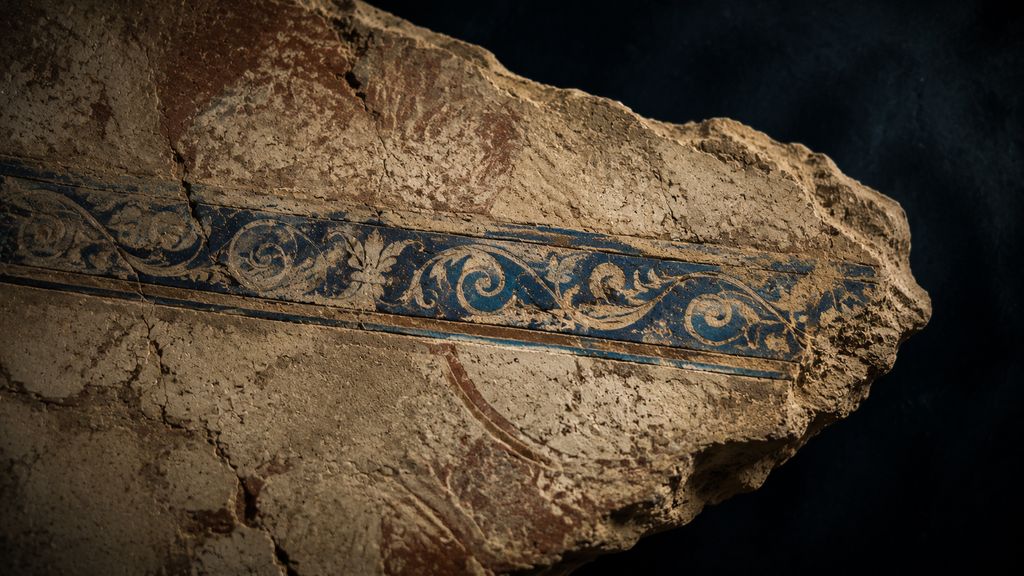
Egyptian blue traveled. Workshops and trade carried it through the Mediterranean world, while Romans knew versions of it as caeruleum. Then its long reign thinned out.
But “lost” needs a little care here. Researchers have found the pigment on works created well beyond the fall of Rome, including medieval examples and even a painting from 1524.
What vanished wasn’t every last grain on one date. The manufacturing tradition broke apart, surviving use grew rare, and other blues took over.
Still, the old material held its structure. Sun, burial, dirt, damaged surfaces—none of them erased that infrared response from every remaining crystal.
And there’s the beautiful reversal. Ancient makers left no full technical manual.
Yet the pigment became its own record, answering modern instruments in a wavelength its creators couldn’t see.
7. Now the Old Blue Is Looking Forward

Researchers aren’t done asking what Egyptian blue can do.
In 2020, a team peeled its layered crystals into nanosheets, some under 20 nanometers across and down to one nanometer thick.
The sheets kept their near-infrared fluorescence, resisted bleaching, and were tracked in fruit-fly embryos and taken up by plants.
And that opened experiments in bioimaging and remote sensing, with wider ideas stretching toward security inks and optical technology.
Then a 2025 reconstruction study produced 12 variations and compared them with ancient artifacts.
One result knocked down the idea of a single perfect recipe: a deep blue could emerge when only about half the material was cuprorivaite.
Particle size, glass, raw materials, and the surface beneath the paint all altered what the eye received.
So the pigment’s newest lesson is also its oldest.
Egyptian blue was never just a color. It was controlled transformation—matter pushed through fire until it learned to do something new.
And five thousand years later, it’s still doing it. Quietly in visible light. Brilliantly just beyond you.
