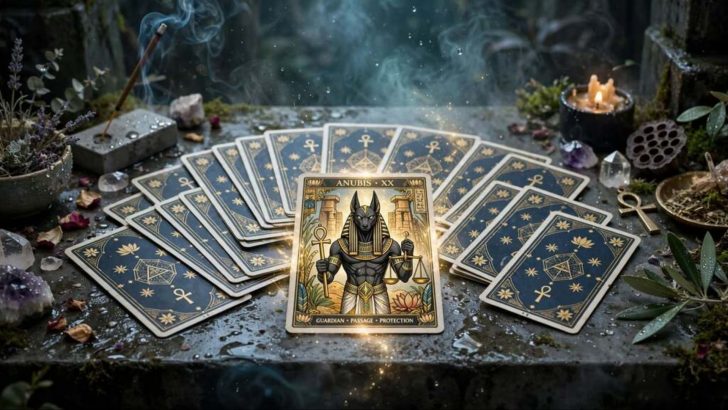
To some extent, most of us are familiar with traditional tarot and its medieval symbolism.
This practice actually comes in different shades, and one of them is built on Egyptian mysticism and gods.
It’s the same deck with 78 cards that helps you understand the secrets of the universe, only through the ancient Egyptian lens!
1. The Myth That Started It All
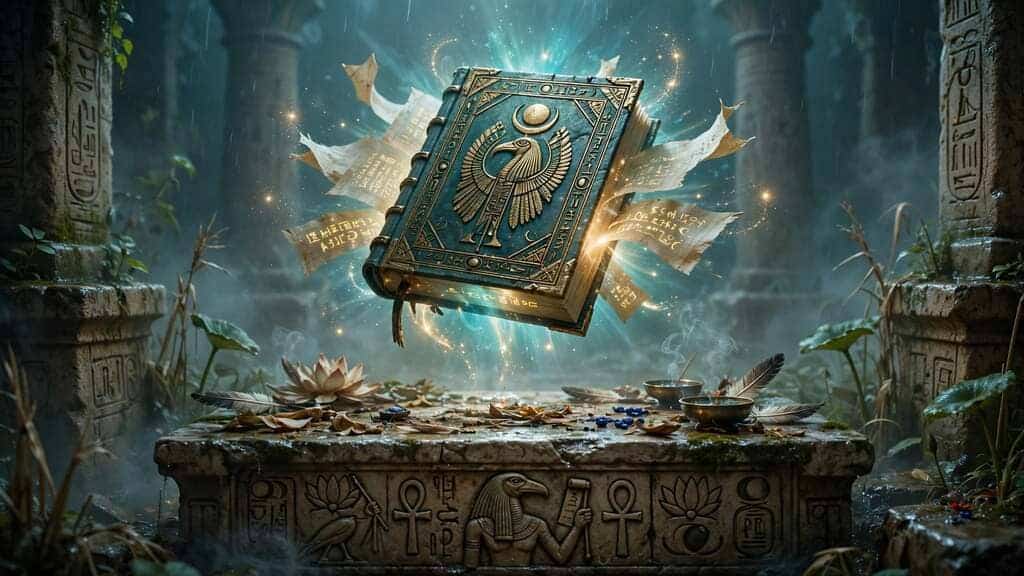
In the 1780s, Antoine Court de Gébelin believed that tarot wasn’t invented in Italy during the Renaissance, but that it was actually much older than that.
He believed that it was a remaining fragment of the Book of Thoth, disguised as a card game so the priests could hide the sacred knowledge from invaders.
So, was he onto something?
Well, not really. Actual tarot cards showed up in 15th-century Italy for playing party games.
But the occult community loved this myth and ran with it. Fortune tellers and mystics insisted on the Egyptian connection for centuries.
Eventually, deck artists decided to comply and create entire decks filled with Egyptian imagery.
Essentially, the legend grew so popular that it became reality!
2. The 78 Cards
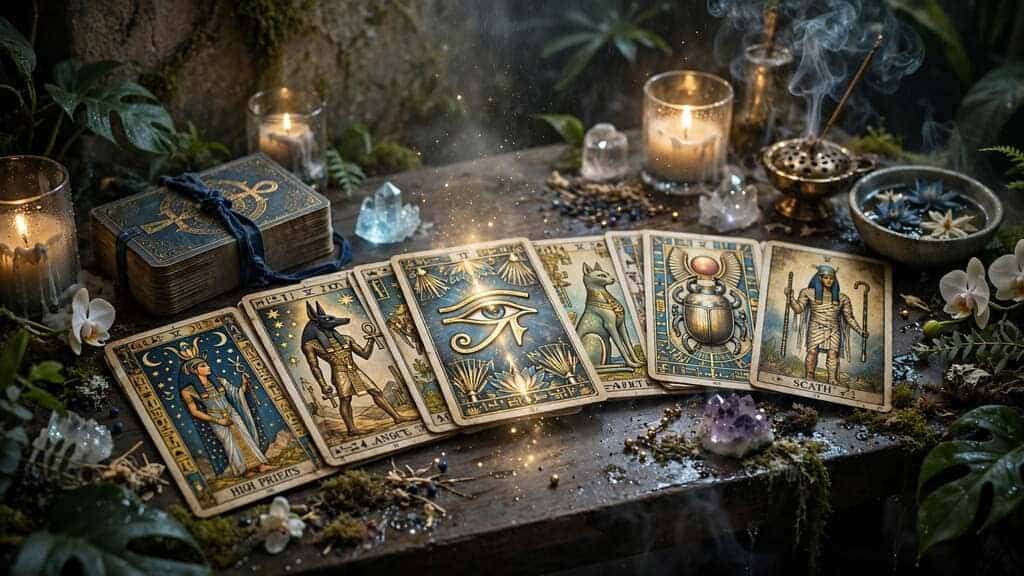
If you’re interested in learning the Egyptian Tarot, don’t panic; the knowledge you already have will serve you just fine.
These decks keep the standard structure of 78 cards, split into 22 Major Arcana そして 56 Minor Arcana across four suits.
It’s the surface that undergoes the most change.
Instead of medieval knights and Christian imagery, you’ll have to navigate through pharaohs, temples, papyrus reeds, scarabs, and gods.
について numbering lines up, too. Card I still stands for beginnings and willpower, and Card XIII still deals with endings.
This makes Egyptian Tarot relatively easy to learn if you already read cards.
You don’t have to memorize new meanings from scratch; however, understanding the mythology can definitely give your readings more weight!
3. The Gods
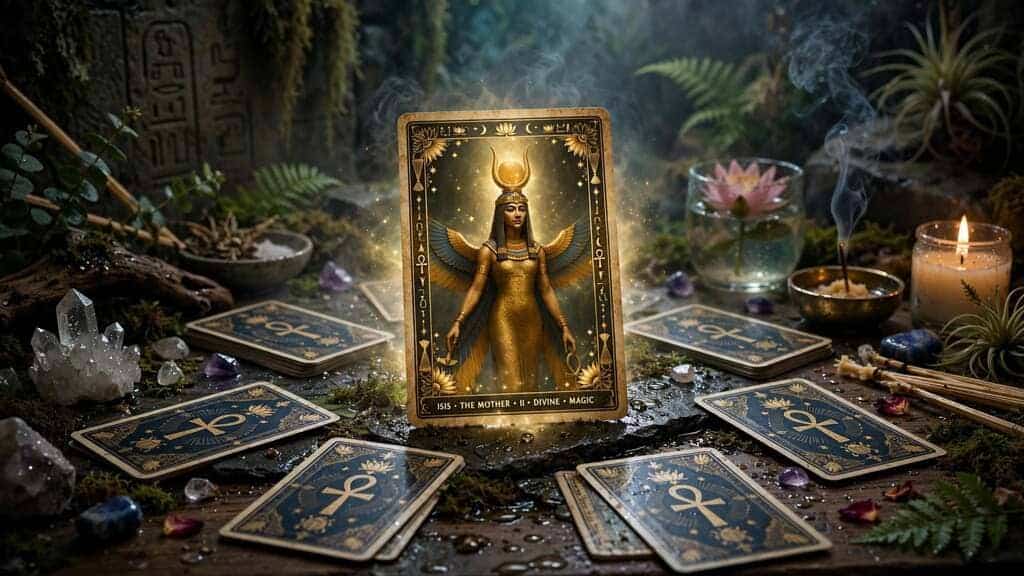
In Egyptian Tarot, the archetypes of the Major Arcana are replaced by actual 神々! It changes how your readings feel.
Instead of a Magician, you might draw Thoth, the god of magic and knowledge, with the power to change existing reality.
Instead of a High Priestess, you get the goddess Isis herself. She rules magic and motherhood, standing between worlds.
The Empress becomes Hathor, goddess of love and abundance.
Your readings become richer due to specific personalities and myths.
Egyptian Tarot tends to feel less vague compared to more traditional decks. The archetypes feel like ideas completely open to interpretation, while drawing Thoth makes it all feel more defined.
This is the biggest change beginners notice.
4. Thoth
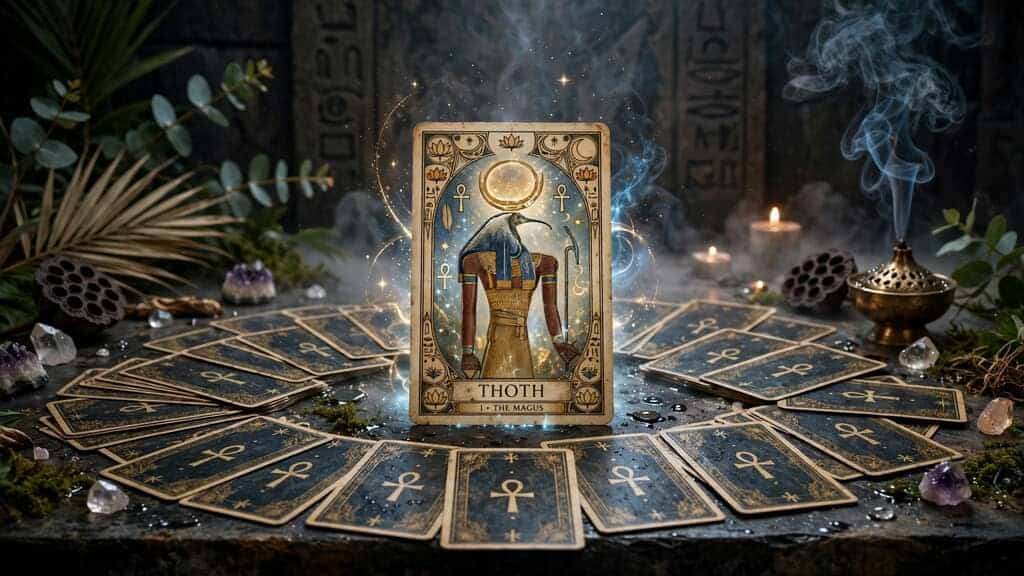
Thoth rules the deck in Egyptian Tarot.
According to ancient beliefs, Thoth invented writing and kept the records of the gods; he documents and reveals hidden truths.
As I said before, the Book of Thoth was believed to be the very origin of tarot in occult circles, so it made sense that he would get the most prominent place in the deck.
He’s not simply a replacement for the Magician archetype; his energy is felt throughout the deck.
Also, don’t confuse this tarot with the Thoth Tarot by Aleister Crowley. That deck follows a completely different artistic direction.
5. Zodiac Wheels and Hidden Hieroglyphs
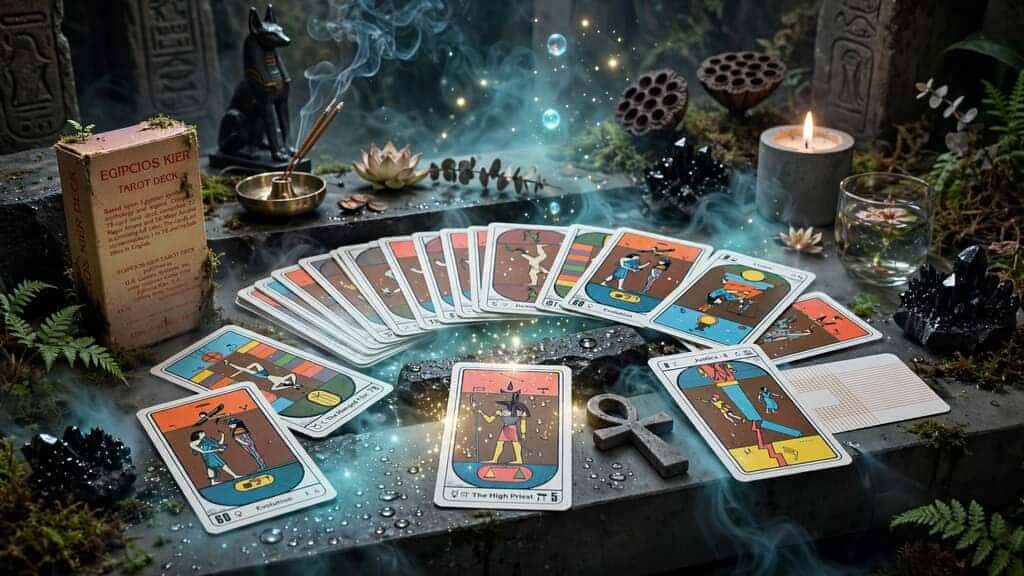
Egyptian Tarot decks, especially the Egipcios Kier, can be very fun to read because the cards come with hidden zodiac and planetary symbolism!
の中で corners of the cards, you’ll find hieroglyphs and Hebrew characters. They’re unassuming, and most practitioners compare them to Easter Eggs, waiting to be discovered.
These details quietly remind us that all of these mystical symbols are connected.
The occult tradition frequently connects tarot to 占星術 そして 数秘術, seeing them all as different ways to describe the cosmic truth.
So, if you know your way around astrology and numbers, each draw from these decks contains an interesting surprise.
Your readings get a whole other layer!
6. The Major Arcana
The Emperor becomes Pharaoh in Egyptian Tarot, governing structure and earthly authority.
The Hierophant becomes a high priest of Amun. He guards sacred ritual rather than church doctrine.
The Wheel of Fortune is sometimes changed into the Ankh and sometimes into a scarab. Both symbols stand for eternal cycles and rebirth.
Naturally, the Sun becomes Ra. The World becomes Ma’at, the goddess of cosmic balance.
As you can see, all of these changes are sensible, aligned with the original meanings of each tarot card.
Egyptian Tarot design takes a serious understanding of mythology to make sure nothing in the deck feels random.
7. Death With a Jackal Mask
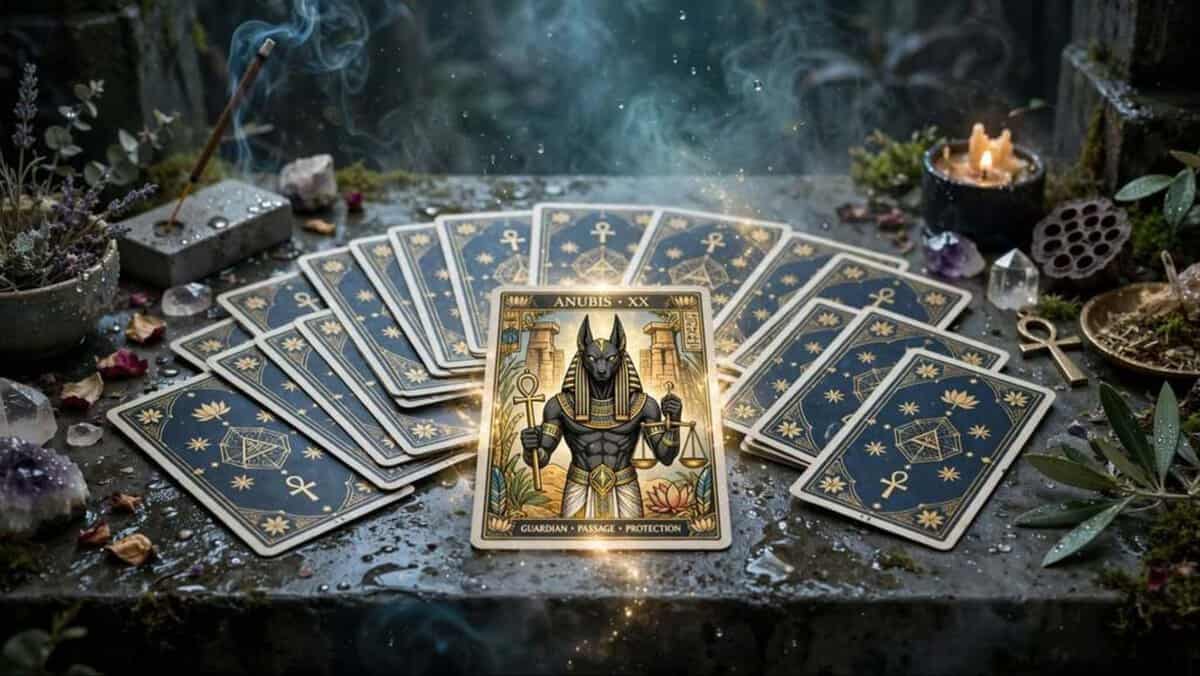
The Death card carries serious weight in any tarot deck, and in Egyptian Tarot, it’s naturally replaced by Anubis.
He is the god with the jackal head, who guides souls through the underworld and weighs their hearts.
Egyptian mythology, like most ancient belief systems, doesn’t treat death as an ending but as a 変形.
Drawing Anubis from the deck doesn’t mean you’re doomed, just like it doesn’t in traditional decks. It signals an ending or the need to be done with something that weighs on you.
The Death card shouldn’t terrify you, one way or another.
It’s a reminder to look ahead to what the future holds for you instead of sticking to something that no longer works.
8. The Minor Arcana
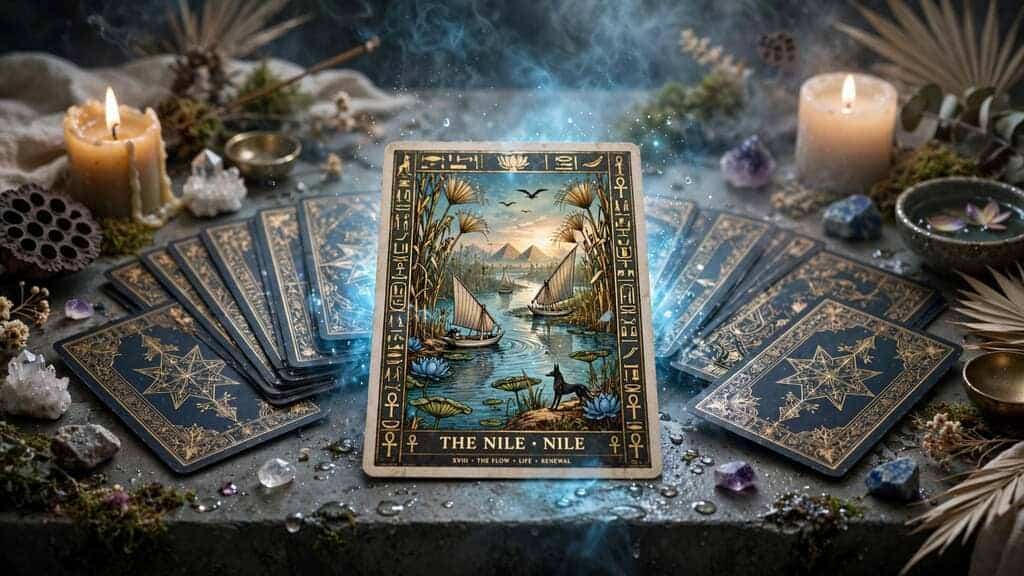
The Minor Arcana suits keep the familiar structure in Egyptian Tarot. However, these decks choose desert and river imagery to present them.
だから Wands might become papyrus stalks, still symbolizing ambition, fire, and creativity.
Cups are often presented as the Nile itself. The river stands for the water element, nurture, emotion, and abundance.
Swords can be reimagined as ceremonial blades; they’re still tied to intellect.
Pentacles frequently become golden discs or the sun.
The energy of each suit remains familiar: fire, water, air, and earth. Everything you’ve learned about tarot so far continues to serve you.
It’s only the cultural lens that’s different.
9. Sirius Rising
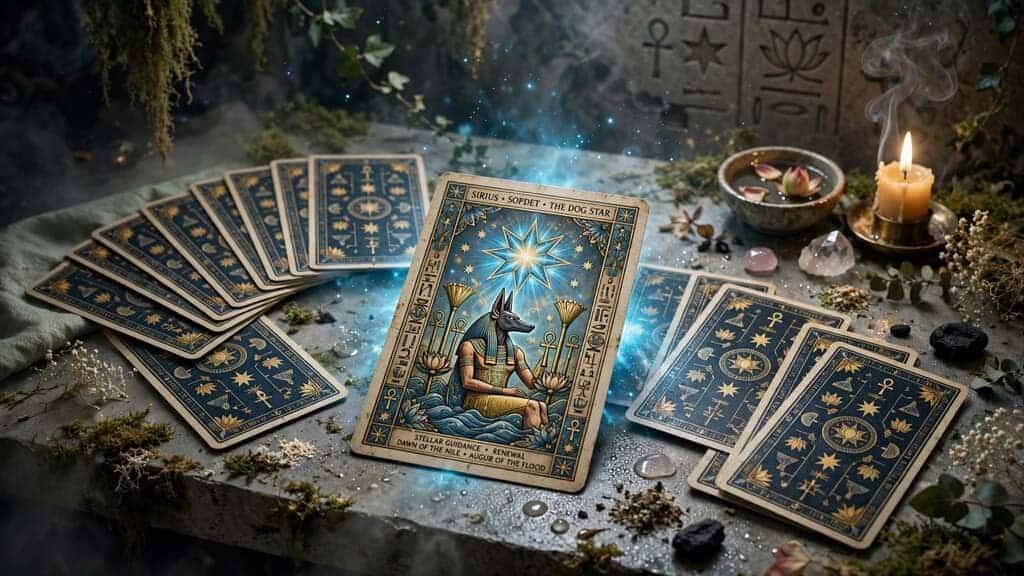
The Star card stands for hope and healing, and in Egyptian Tarot, it’s linked to Sirius.
Sirius is the brightest star in the night sky, seen as sacred by the ancients.
It’s yearly reappearance in the sky lined up with the flood season, so ancient astronomers built their entire calendar around it.
This one star was a literal sign that abundance and fertility were on the way!
This is an incredible mythological context to add to your reading. The hope and healing stop being symbolic and start to represent something literal!
Isis was also sometimes associated with Sirius, which can add a divine feminine layer to your interpretation.
The Star in Egyptian Tarot tells you, with complete certainty, to trust the timing.
10. The Scales of Truth
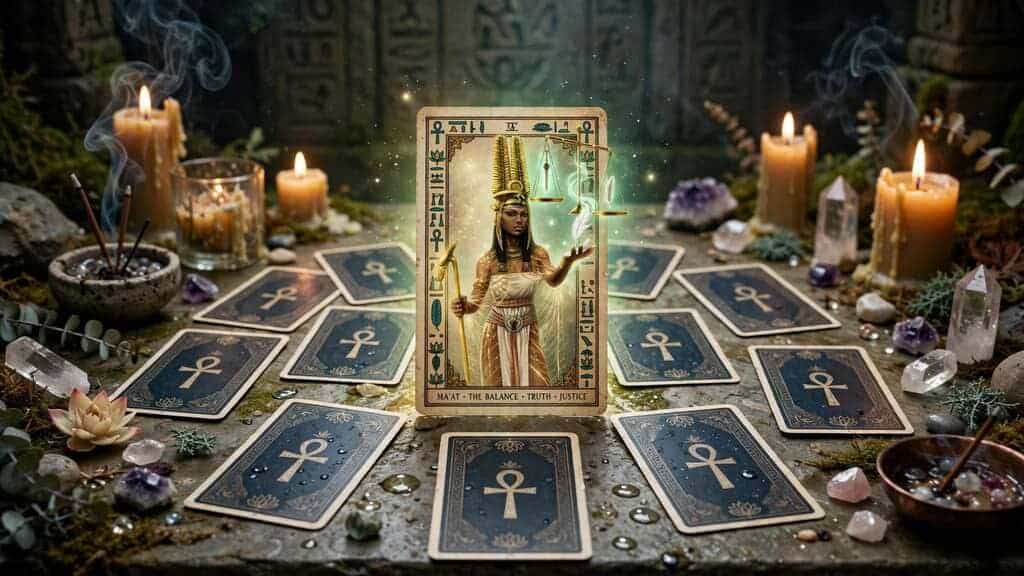
The goddess Ma’at is the philosophy behind Egyptian Tarot. She stands for truth, balance, justice, and cosmic order.
The ancients believed she held the whole universe together!
She shows up explicitly in cards tied to Justice.
Ma’at represented the correctness of everything. She is the opposite of Chaos.
The mythology expands the idea of justice and truth in a much larger context, while traditional tarot tends to be more individualistic.
11. How to Read the Egyptian Tarot
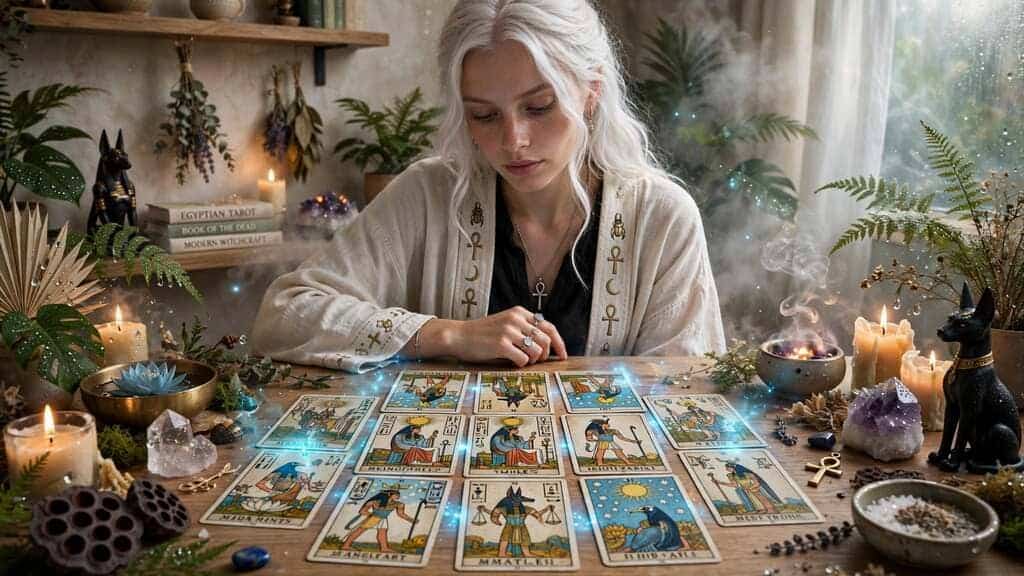
The process is the same as with regular tarot. Shuffle the cards, pull them, and lay them into any spread that works for you.
You might choose the three-card spread or the Celtic Cross.
The structure of reading doesn’t change. The most important change is your storytelling.
You’ll want to get familiar with Egyptian myths and use that knowledge to add weight to your readings.
If you’re working with a client, and they choose an Egyptian Tarot reading, it’s expected that you’ll see the symbolism through that lens.
For example, remember that Isis mourned and resurrected Osiris, or keep in mind just how essential the Nile was to this civilization.
These kinds of details, paired with your intuition, can make your readings so insightful!
12. Choose Your Deck
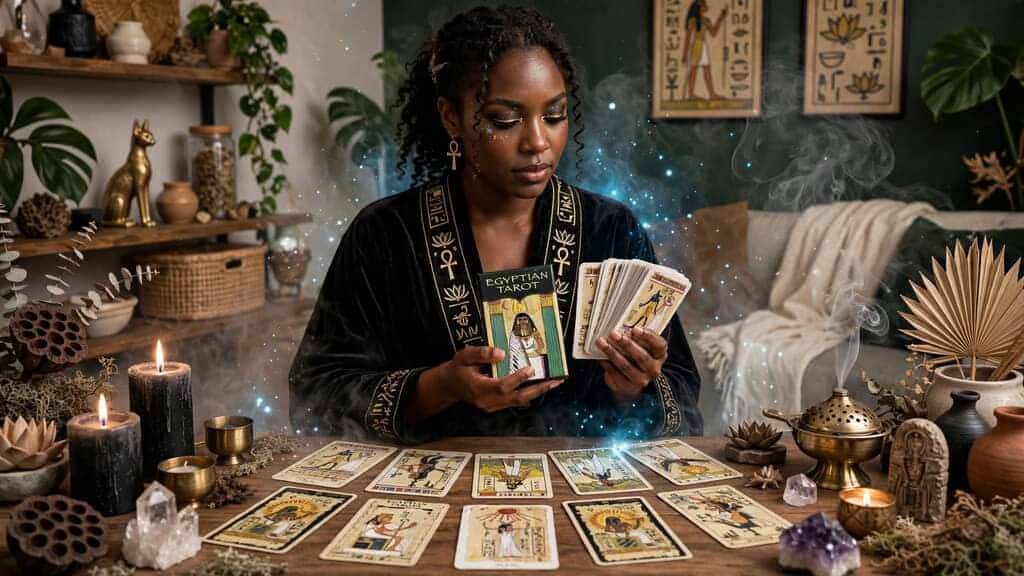
Before committing to either Egyptian Tarot deck, you’ll want to check them out to see which one works for you.
The Egipcios Kier deck is the most popular and available. It’s known for astrological connections and comic-style artwork.
Other decks can be more atmospheric, prioritizing mood over diverse symbolism.
Some actually lean on Crowley’s Thoth Tarot when it comes to 美学.
You might also want to consider whether the guidebook you get with the deck explains the mythology, or you’ll have to do independent research.
Look for the deck that feels right. Just like in a reading, it’s your intuition that leads the way.

A little Aquarius, devoted to writing and embroidery. Through my writing, I hope to empower readers to align with their true selves and navigate life’s mysteries with confidence.