
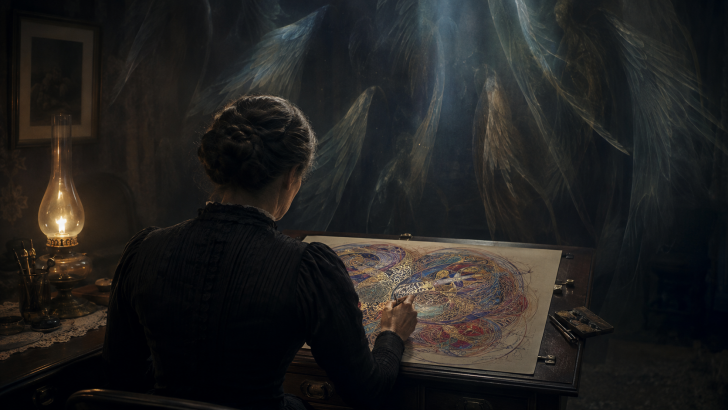
Decades before abstract art had a name, a Victorian woman was filling paper with luminous tangles of color, loops, and fine white threads.
Georgiana Houghton said she wasn’t creating them alone. She believed spirits, dead artists, and archangels guided her hand. Some accounts connect her work with a group of 70 archangels.
Her paintings look startlingly modern, but the story behind them belongs completely to the séance rooms of the 1860s.
1. Grief Opened the Door to the Unseen
Georgiana Houghton was born to British parents in Las Palmas, Gran Canaria, in 1814, then spent most of her life in London. She trained as an artist, though little is known about that education.
Her early life was marked by repeated loss.
Her brother Cecil died when she was twelve. Two more brothers died while she was young, and in 1851 she lost her beloved sister, Zilla, days after Zilla had given birth.
Both were artistic, and the death affected Houghton so deeply that she gave up painting for a time.
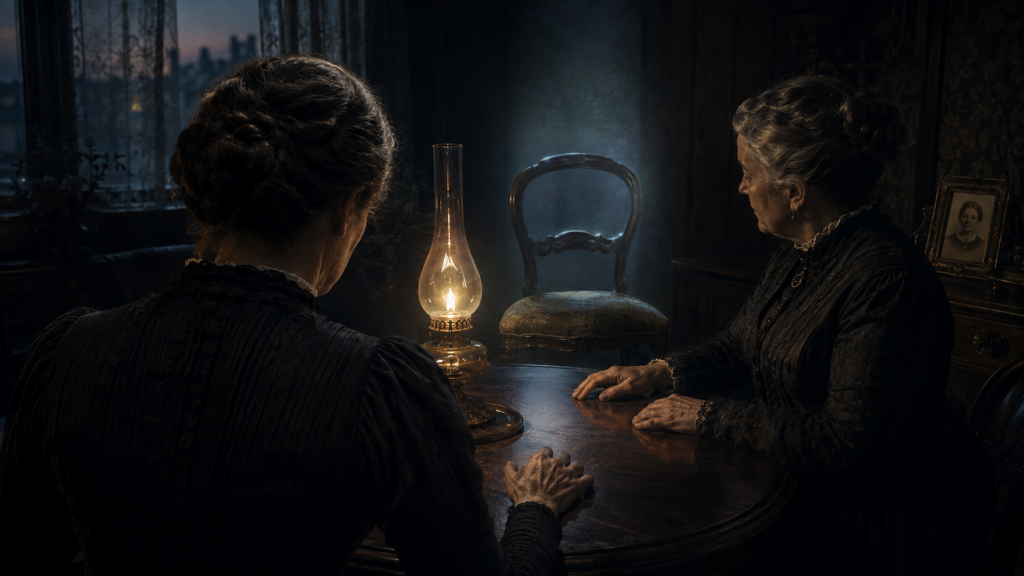
Then, in 1859, a cousin introduced her to the medium Mary Marshall. At a séance, Houghton believed she received convincing communications from Zilla and Cecil.
For her, this wasn’t a rejection of Christianity. She came to see Spiritualism as an extension of her faith and a way to understand what continued beyond death.
2. A Planchette Began to Draw
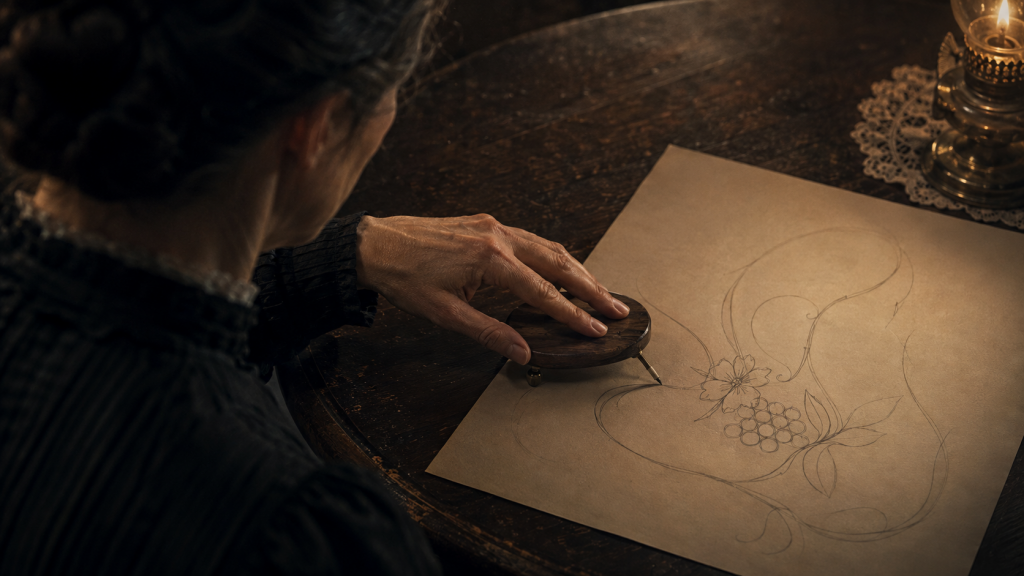
Houghton began developing her own mediumship at home. She and her mother sat at dusk with their hands on a small table.
After months of practice, Houghton reported movements and messages, and by 1861, she had obtained a planchette, a small wheeled board that held a pencil.
The spark came when she heard about Elizabeth Wilkinson’s mediumistic drawings. Houghton asked whether Zilla could help her do something similar.
In Houghton’s account, an artist spirit named Henry Lenny soon took charge, sending the pencil through complicated curves and producing symbolic flowers and fruits.
Within days, she abandoned the awkward planchette and worked freehand. Color followed soon after.
She began without a preparatory sketch and believed the image arrived through the movement of her hand, not through a design she had consciously planned.
3. Paintings That Seemed to Come From Another Century
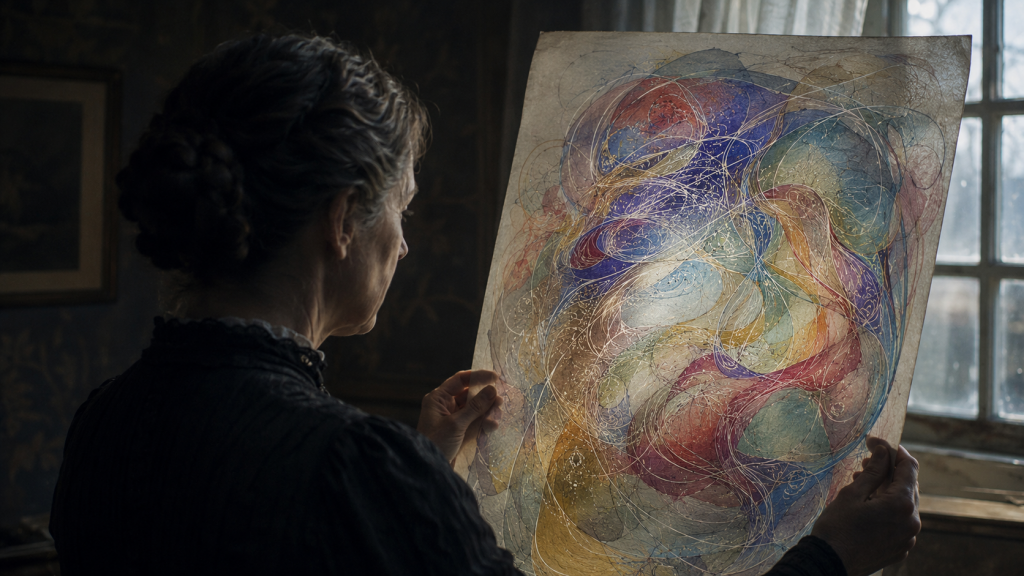
To modern eyes, the mature spirit drawings can resemble abstract art, microscopic life, or maps of energy.
Dense ribbons coil across the paper. Transparent washes overlap, while delicate threads of white gouache drift through darker layers.
They were made with extraordinary control. Houghton used watercolor, gouache, and ink, sometimes laboring for months over one sheet.
Through the 1860s, the work moved far beyond her early floral forms. That appearance was wildly unusual in Victorian Britain.
Gallery visitors expected recognizable scenes, but Houghton offered works titled The Eye of God and The Spirit of Peace, yet most contained no conventional image to guide the viewer.
They weren’t “abstract” in her understanding. She saw them as representations of realities invisible to ordinary sight.
4. Her Invisible Circle Included 70 Archangels
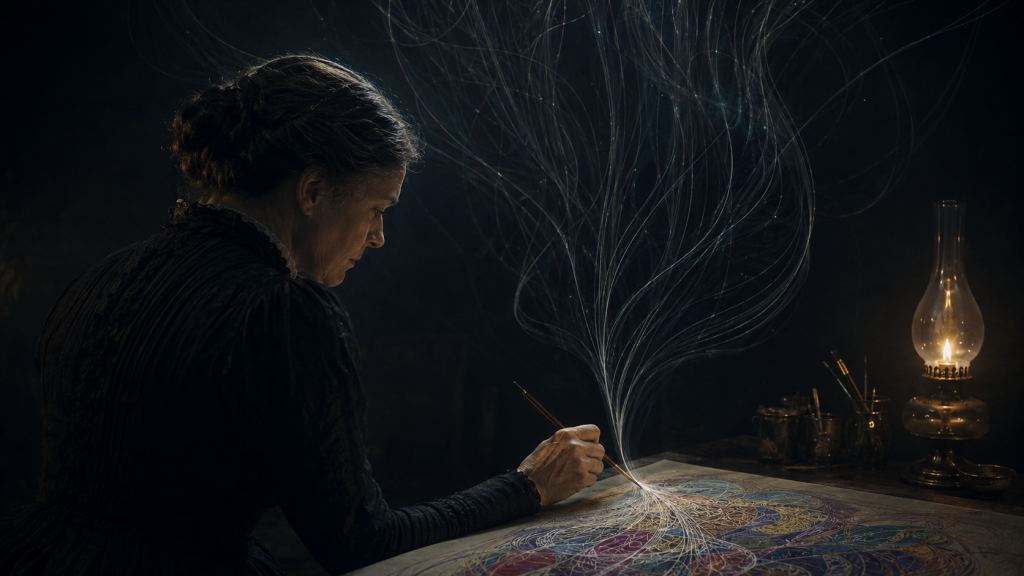
Houghton didn’t present herself as the sole author. On the backs of her works, she credited deceased relatives, spirit guides, and earlier artists.
Titian and Correggio appeared among those she believed had guided her, alongside Henry Lenny and her family.
And then there were the archangels. Houghton wrote of being placed in the charge of 70 archangels, and historical accounts describe a sacred body of drawings made under their guidance.
The number refers to this larger group within her spiritual practice.
It doesn’t establish that all 70 participated in every painting; individual inscriptions can attribute a work to particular beings or to a smaller group.
None of this can be verified as supernatural contact, of course. What can be seen, however, is how seriously and consistently Houghton recorded the experience.
She believed beings on another plane communicated through her color and line.
5. Every Color Carried a Message
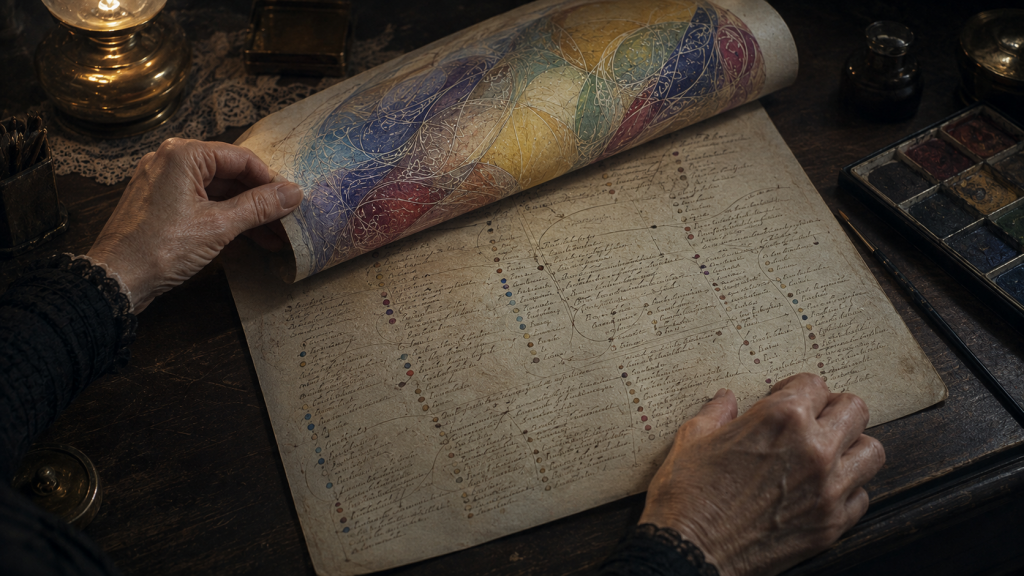
The paintings may appear spontaneous, but Houghton developed a detailed symbolic language.
Yellow could signify God the Father, faith, or wisdom. Blue was linked with God the Son, hope, and truth, while red carried associations with the Holy Spirit, charity, and love.
Her system became remarkably precise. Shapes, directions, density, and the relationships between lines also carried spiritual meaning.
In her portraits of a person’s spirit, closely gathered lines could suggest the strength of a bond.
Much of that meaning lives on the reverse.
Houghton covered the backs with titles, explanations, dates, accounts of guidance, and automatic writing.
The front might look like a cosmic storm. Turn it over, and you find something closer to a key, though it never unlocks the whole image.
6. London Didn’t Know What to Make of Her
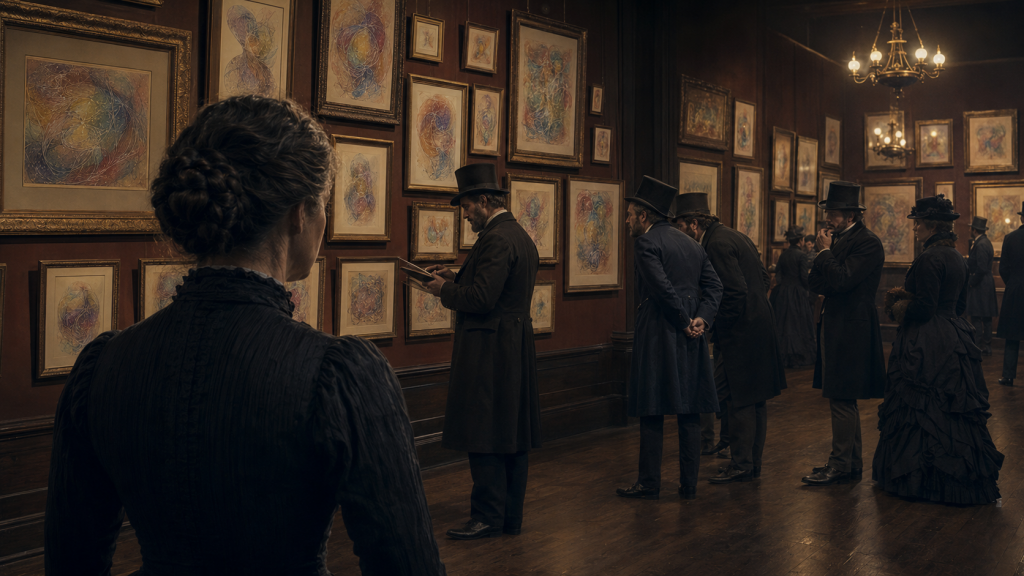
In 1871, Houghton took a huge personal risk.
She rented the New British Gallery at 39 Old Bond Street and mounted Spirit Drawings in Water Colours: 155 works tracing ten years of development. She also produced an elaborate catalogue to help visitors understand the show.
The response was a strange mix of wonder, confusion, and ridicule.
One paper called it the most astonishing exhibition in London. The Daily News compared the pictures to tangled colored wool and treated them as artistic aberrations.
Some artists and members of the clergy were more receptive, but admiration didn’t translate into commercial success.
The show nearly bankrupted her. Houghton had spent heavily to place her spiritual mission before the public, yet her hope of popularizing spirit drawing went unrealized.
She continued working afterward, though the exhibition remained her only major solo statement during her lifetime.
7. The Woman Art History Almost Forgot
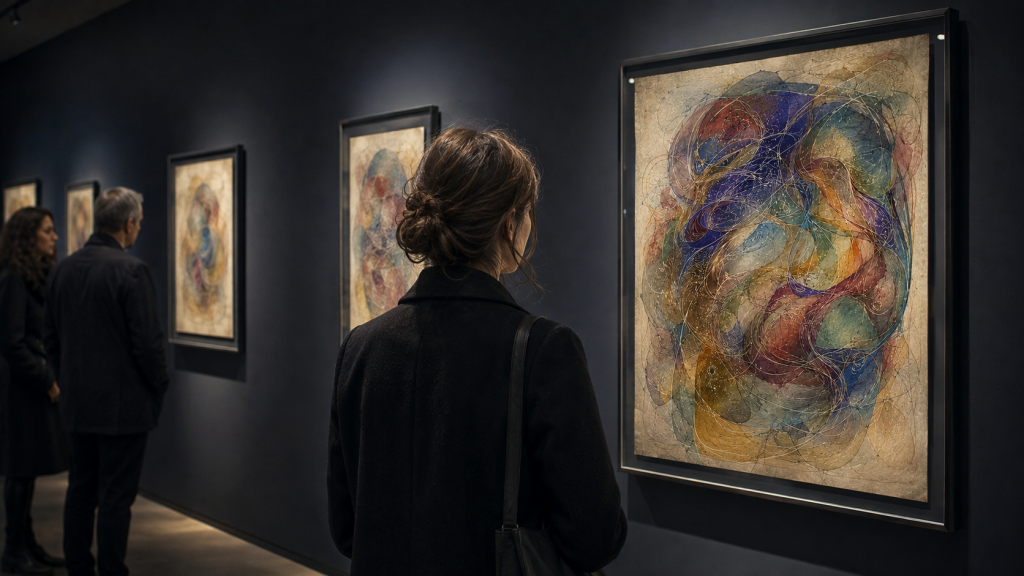
Houghton died in 1884, and most of her drawings vanished from view. Fewer than 50 are known today, held largely by Spiritualist organizations in Melbourne and London.
For generations, her work sat outside the main story of modern art.
That changed through new scholarship and exhibitions. The Courtauld Gallery’s 2016 show brought more than 20 spirit drawings together and gave British audiences their first substantial encounter with them in almost 150 years.
Houghton was again discussed beside later experiments in abstraction.
Her mature work predates Wassily Kandinsky’s celebrated abstract paintings by roughly half a century. Still, calling Houghton “the first abstract artist” remains debatable.
She didn’t set out to free art from representation. She believed she was representing a realm that couldn’t be seen with physical eyes.
That tension is part of her power. You can view the drawings as mediumistic records, radical Victorian paintings, or both at once.
Houghton gave authorship to the unseen, yet the remarkable visual language that emerged through her hand was unmistakably her life’s work.
