
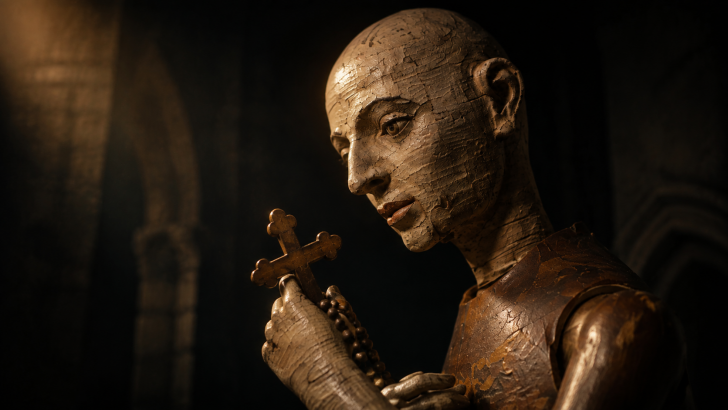
The monk is just about 16 inches tall.
When you wind a key inside it, the figure comes to life—walking, turning its head, raising a cross, beating its chest, and silently moving its mouth in prayer.
This small wooden friar is around 450 years old, and its hidden mechanical parts still work today.
1. The Monk Still Moves After 450 Years
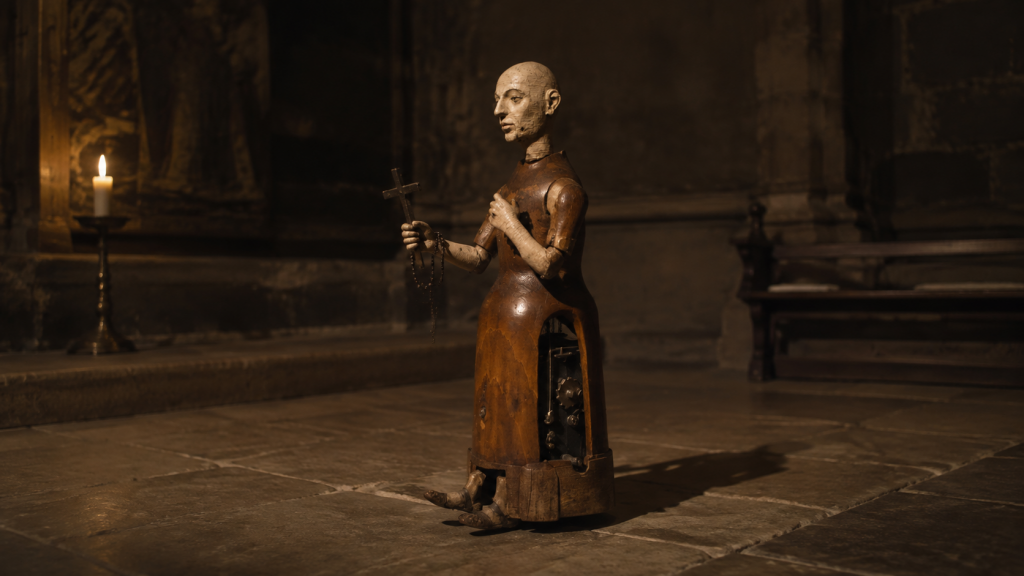
At rest, the monk looks like an old religious figure.
Its face is thin and very serious. Dark robes cover most of its body, leaving only its head, hands, and small feet visible. One hand holds a rosary and a wooden cross.
Then it starts to move.
The monk rolls forward as its feet shift under its robe. Its head turns side to side, and its eyes seem to scan the room.
Its mouth opens and closes.
One arm beats its chest. The other lifts the cross toward its face, pauses, then lowers it again. Every so often, the monk bows and presses the cross to its lips.
The figure is now kept at the Smithsonian’s National Museum of American History. According to the museum’s record, the body is made of wood, while the inner clockwork is iron.
The clothing, however, is newer. The robes were added in the 1970s, but the body and mechanism date back to the 1500s.
The word robot didn’t exist then. Technically, the monk is an automaton—a machine made to perform set movements once wound up.
But when it moves, that difference hardly seems to matter.
2. Its Movements Form a Complete Prayer
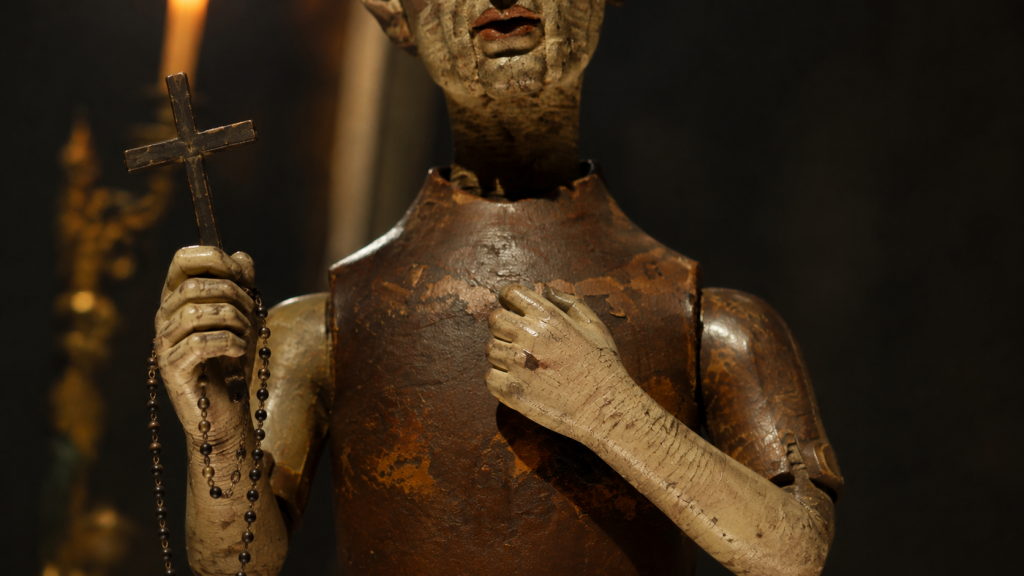
The monk doesn’t just walk or wave its arms. Instead, it performs a full act of Catholic prayer.
It beats its chest in a gesture known as mea culpa, a sign of asking forgiveness and showing humility. At the same time, its other hand lifts a rosary and cross.
As the cross rises, the monk’s eyes seem to follow it. Its mouth opens and closes as if it’s speaking, though no sound comes out. Then it leans forward and gently kisses the sacred object.
All of this happens as one continuous ritual.
Hidden wheels move the monk across the floor. After a short distance, it turns and keeps going in a slow, looping path, still praying as it travels.
A Smithsonian demonstration shows just how carefully these motions were designed.
The monk doesn’t move like a modern machine made for speed or efficiency. Instead, it moves slowly, almost deliberately.
The goal of its maker wasn’t just to prove a machine could walk.
It was to recreate the feeling of devotion itself.
3. A Desperate King May Have Inspired It
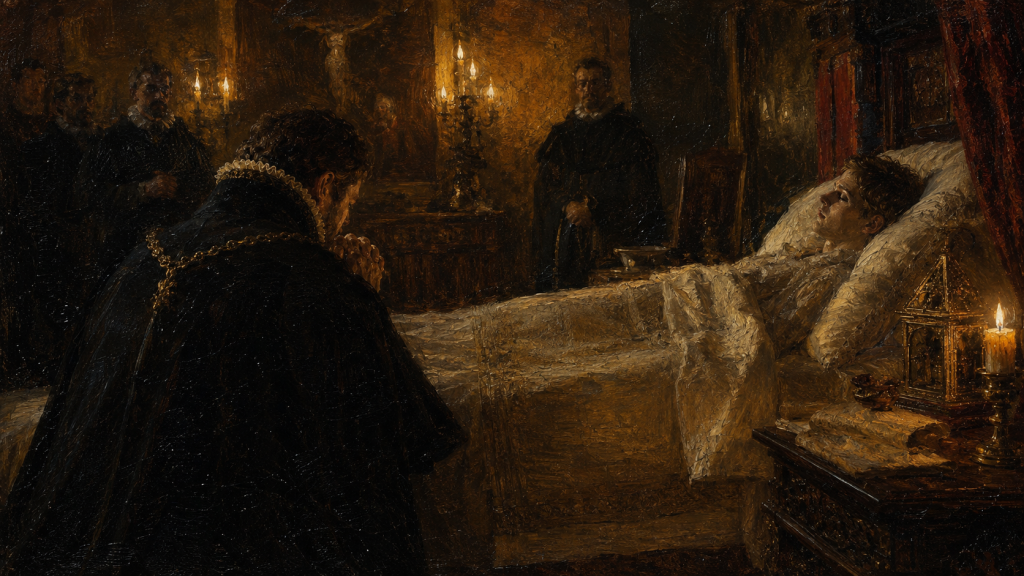
The most well-known story about the monk starts with a royal accident.
In 1562, Don Carlos, the 17-year-old son of Spain’s King Philip II, fell down a staircase and hit his head.
His head swelled. He got a high fever, lost his sight, and became confused and delirious. Doctors even removed part of his skull to ease the pressure, but no one knew if he would survive.
With medicine running out of options, the royal court turned to a dead Franciscan friar named Diego of Alcalá.
Diego was believed to have worked miracles after his death. His preserved body was brought to Don Carlos, and the prince was placed nearby while prayers were said for his recovery.
Then something unexpected happened—Don Carlos got better.
According to legend, King Philip II had promised a “miracle for a miracle” if his son lived.
To honor that promise, he’s said to have ordered a mechanical figure of Diego that could pray endlessly, without ever getting tired.
It’s a striking tale, but it’s still just a story.
Researcher Elizabeth King explored the monk’s history in her detailed study, Clockwork Prayer. She found records confirming Don Carlos’s accident, the use of Diego’s remains, and the prince’s recovery.
What she didn’t find, though, was any solid proof that Philip actually commissioned this specific automaton.
4. The Machine Was Linked to a Renaissance Genius
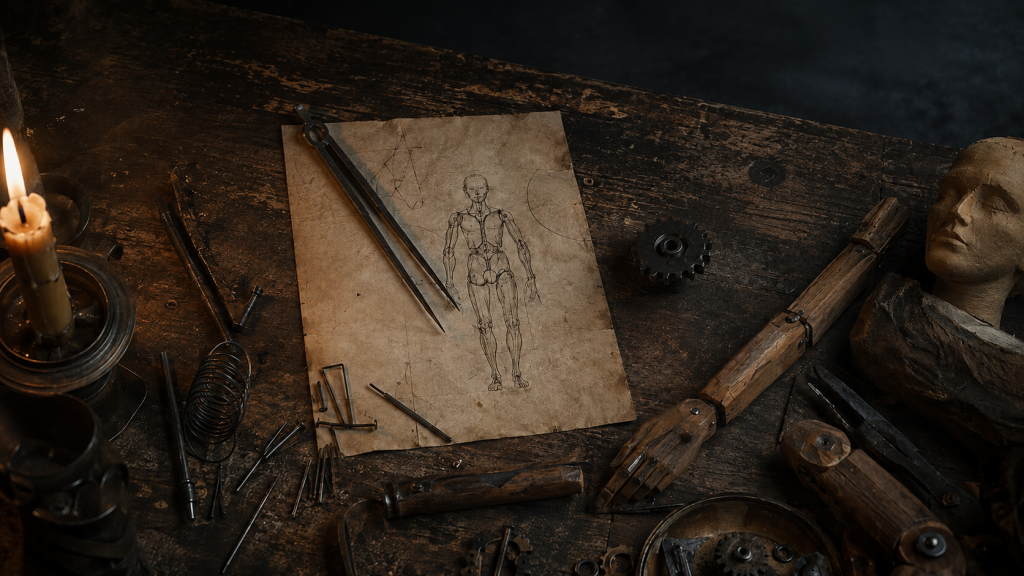
Tradition says the monk may have been made by Juanelo Turriano. He was born in Italy and later worked for the Spanish court.
Turriano was one of the most famous engineers of his time. He built complex clocks, created machines for Emperor Charles V, and even designed a huge water system for the city of Toledo.
He was also known for building mechanical figures, so it’s easy to see why his name comes up.
The monk’s craftsmanship fits what you’d expect from a top court engineer, and its age lines up with Turriano’s lifetime.
Researchers have also compared it to other Renaissance automata, including a mechanical woman that could play a stringed instrument.
But looking similar doesn’t mean he made it.
There’s no signature inside the monk, no payment record, and no letter linking it to Turriano.
So while his name is often mentioned, it doesn’t solve the mystery.
5. Iron Gears Create the Illusion of Devotion
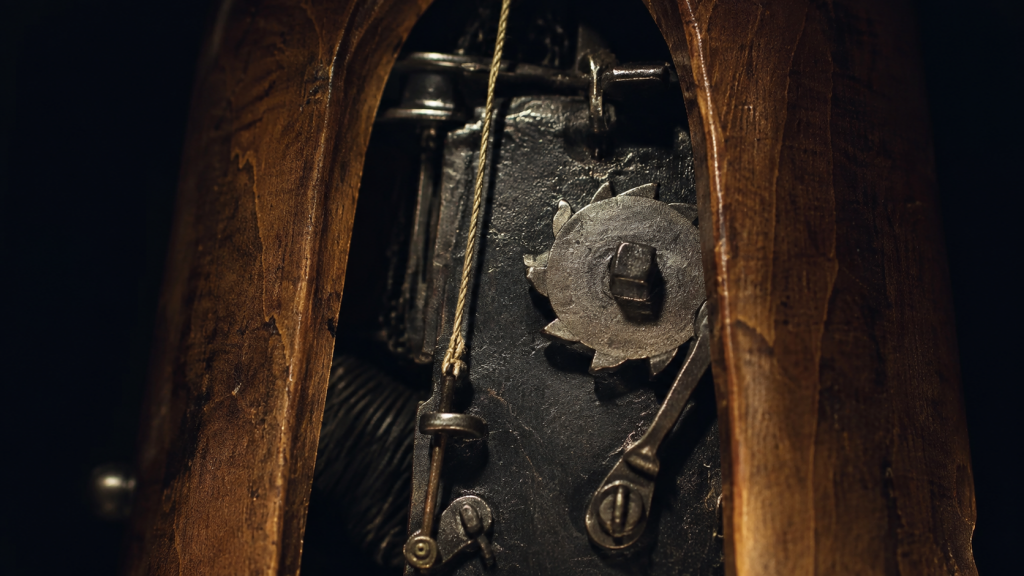
Beneath the cloth is a tight set of iron parts.
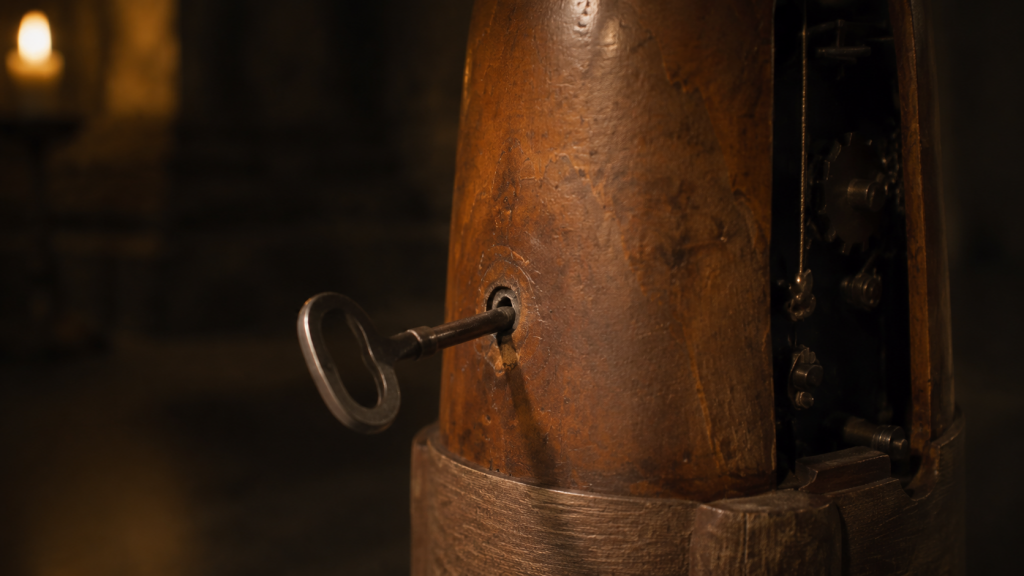
A key winds the monk’s spring, storing the energy it needs to run. Once released, that spring powers a network of wheels, cams, cords, and levers.
Each piece has its own job. Three hidden wheels move the figure across the floor, while its feet step under the robe, making it look like the monk is walking on its own.
Other parts control the arms, head, mouth, and eyes. They all have to work together so the figure can beat its chest, lift the cross, turn its head, and change direction at the same time.
The build also helps experts date it. Most of the mechanism is iron instead of brass, and the parts are held together with pins rather than screws.
Conservators say that matches clockwork made in the late 1500s.
From the outside, it looks like one simple prayer. In reality, it’s a chain of separate mechanical actions. The movement is so well done that the monk seems entirely focused on the cross it holds.
Its devotion is an illusion—but an incredibly precise one.
6. Much of Its Past Remains Uncertain
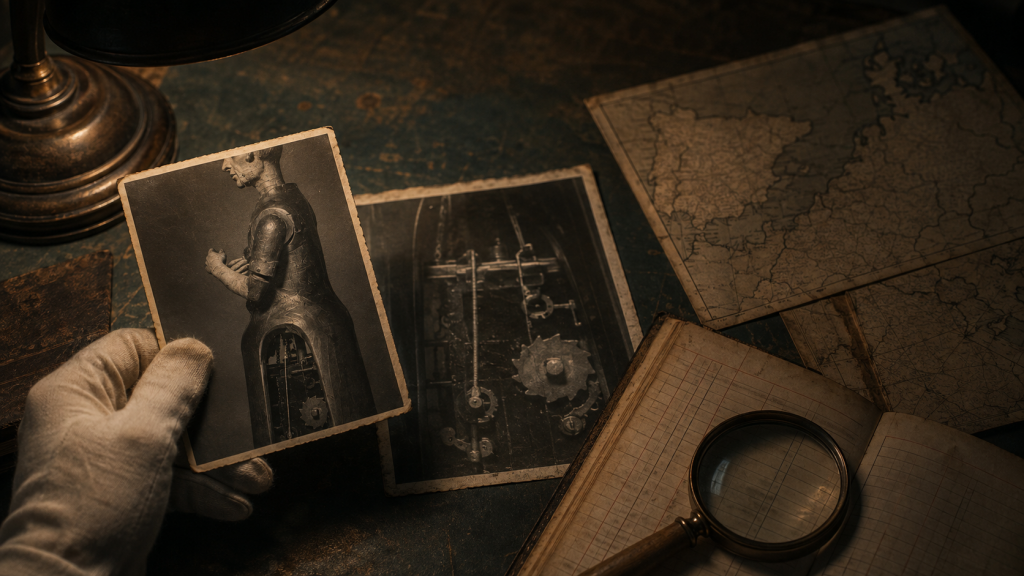
The Smithsonian dates the monk to the mid-1500s, but its exact origin isn’t clear. It may have been made in Spain or southern Germany.
Its early history is even harder to trace. The figure only shows up in European sales catalogues in the 1970s before arriving at the Smithsonian in 1977. Before that, its trail is mostly lost.
Researcher Elizabeth King couldn’t find any mention of the mechanical monk in royal records from Philip II or Charles V. She also didn’t find any documents linking it to the engineer Juanelo Turriano.
Even what the figure represents is still up for debate. It may depict Diego of Alcalá, who was made a saint in 1588. Some people have compared its face to later images of him, but there’s no solid proof.
So the most famous parts of the story—the sick prince, the king’s vow, the saint, and the brilliant engineer—are still just theories, not facts.
The object itself is real. The machinery is real. And you can still watch it pray. But why it was built has been lost to time.
7. Can a Machine Perform an Act of Faith?
The monk doesn’t understand the cross it kisses. It can’t feel guilt when it strikes its chest, and it doesn’t know the words its wooden mouth seems to form.
Still, every movement was carefully designed.
A maker studied the language of prayer and turned it into iron. The angle of the arm, the motion of the jaw, the tilt of the head—all of it had to be planned before the machine could act.
Repetition wouldn’t have made the prayer feel any less real. Rosaries already helped people count prayers, bells marked sacred hours, and worshippers often asked religious communities to pray for them again and again.
The mechanical monk simply gave that repetition a body.
Maybe it was meant as a royal offering. Or maybe it showed people how a penitent should behave.
We may never know for sure.
And that uncertainty may be why the monk still feels so powerful. It sits in a strange space between religious object, machine, and something that almost feels alive.
Eventually, the spring runs down. The hidden gears slow. The monk lowers its cross, closes its mouth, and becomes just wood again.
Then someone winds the key, and the prayer starts all over.
