

For thousands of years, people have trusted bells to do what words and walls could not; to mark the line between ordinary and sacred.
Romans hung bells on their doors. Egyptian priestesses shook rattles at storms and gods.
Medieval bishops baptized giant bronze bells like newborn children.
Villagers rang them against witches, and the witches kept bells of their own!
Let’s explore the simbolismo of bells in church rites and pagan magic!
1. The Sound That Opens Doors

A bell is a voice, and voices carry intention. A struck bell sends out a clear note that cuts through any other noise, so magicians and priests across cultures treat it as a threshold sound.
It announces a beginning, an ending, and a change of state.
Folk tradition went even further. Bells were named and inscribed with words.
People spoke of like living beings.
Old European belief held that spirits hate loud, piercing noise, and this is called sympathetic magic. We fight the invisible with something sharp.
Bells also join opposites. Their sound is airy, yet their body is metal, so they stand between earth and sky, matter and spirit.
Even the fairies wore bells on their clothes.
The ringing could mean warning, warding, waking, and welcoming.
2. Baptized Bronze
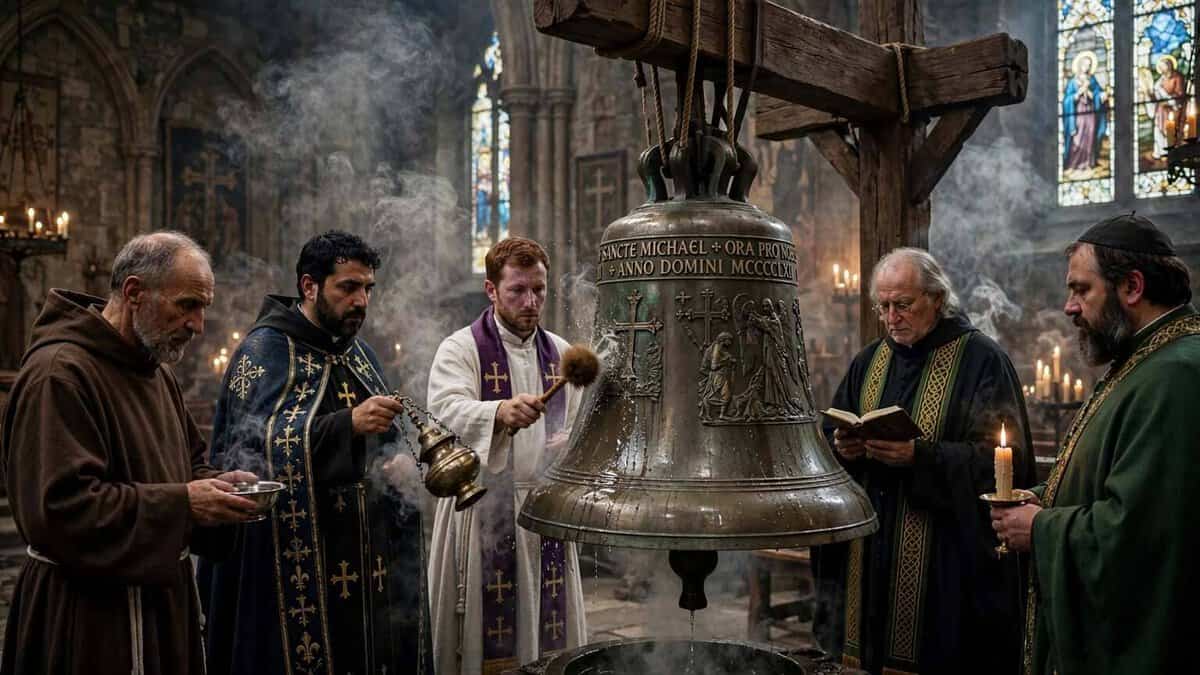
Medieval Christians actually baptized seus church bells!
Since about the 11th century, at least in France, a bishop washed the new bell with holy water and salt, anointed it with oil, marked it with a cross, and gave it a name.
Godparents stood beside it while candles burned around the bronze like a christening party.
The prayers asked that its voice would send demons running and call the faithful to worship.
French folk belief claimed that unbaptized bells got knocked down by the devil.
Irish tradition treasured holy handbells that belonged in a bishop’s kit.
Official theology called the ceremony a sacramental, not a true baptism.
Still, popular imagination focused on the magic of this rite.
3. The Roman Wind-Chime Spell
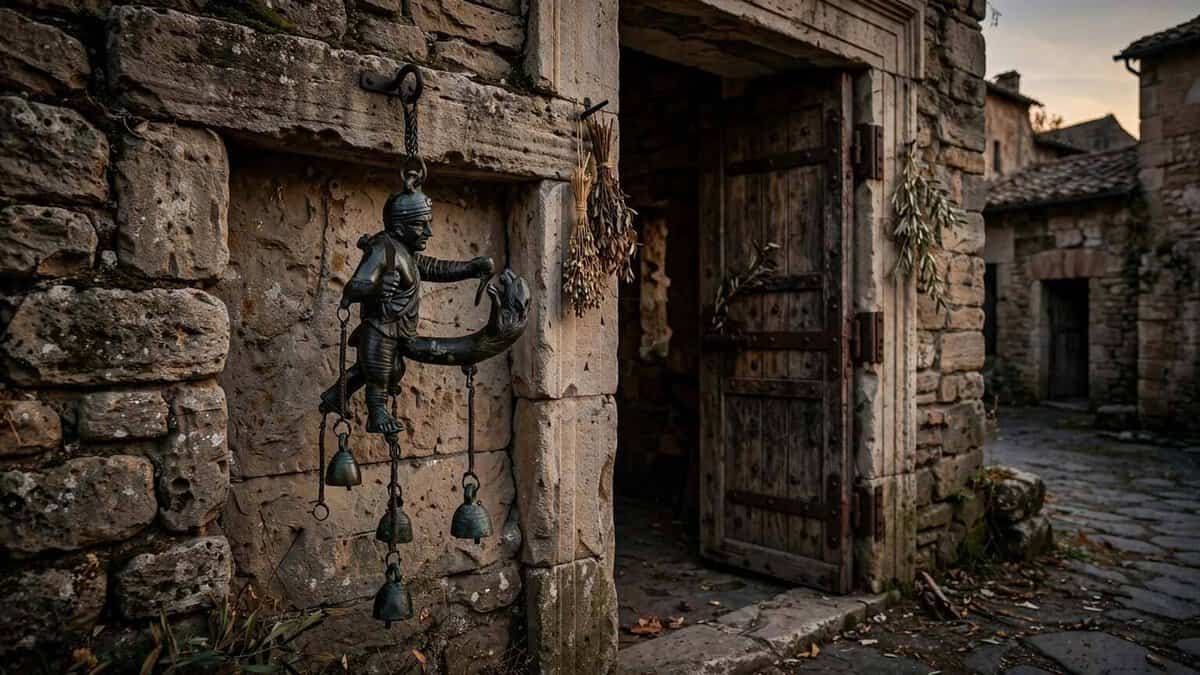
The Romans used a bronze tintinnabulum, which is a cluster of little bells hanging from a figure. Romans treated it like an evil eye charm.
They would hang it near the entrance of their home or shop, where the breeze can reach it, and let the wind do the casting.
No incantation was required.
The Metropolitan Museum calls these chimes doubly protective, because the guardian figure is backed up by the ringing of the bells.
Archaeologists in Serbia recently unearthed one at Viminacium, in the debris of a large house, proving that this magic traveled all across the empire.
The bells provided motion and voice.
A figure is just a watcher. However, with bells, it startles lurking spirits with noise every time the wind blows.
It’s a spell that keeps working day and night, protecting people even in their sleep.
4. The Spell Against Set

Ancient Egypt had the sistrum. It’s a hooped frame strung with metal discs, crowned with the face of Hathor.
A priestess would shake it during temple ceremony or procession, and the shimmering rattle was believed to drive off evil forces.
In some traditions it was also shaken to hold back the flooding of the Nile and to chase away Set, the god of storms and disorder.
Other myths say its magic soothed raging deities, calming the furious Eye of Ra.
So, the sistrum banished the hostile and appeased the powerful.
Its shape even resembles the ankh, the sign of life, so each shake is a blessing for the living.
5. The Golden Hem Spell

The magic of this spell is wearable!
Em Exodus, the High Priest’s robe has a hem fringed with golden bells alternating with pomegranates of blue, purple, and scarlet wool.
The text says the bells must sound whenever he enters or leaves the Holy Place, so that he will not die.
Jewish tradition understood that the tinkling announced he was alive and moving inside the sacred chamber, and silence would have told everyone something had gone wrong.
So the bells were a spell of safety. They allowed the priest to cross a dangerous threshold and live.
The same spell might help you deal with everyday fears. Ring a bell whenever you have to do something that scares you!
The bells bring us the courage to cross!
6. Brass Kettles for the Dead

Ancient Athens had a rite for the moment of death that sounds quite dramatic.
Athenians beat on brazen kettles when someone died, to scare away the Furies, the vengeful spirits who might endanger on a passing soul.
Bronze and noise were at the core of this magic, timed to the exact moment of crossing.
This was the very instinct that later produced the passing bell, and it shows how old the idea is!
The brass provides noise with authority. A kettle was a household object, so every home owned a ready banishing tool, and its ringing turned any home into a guarded gate.
The dead are not sent away alone. The living build a wall of sound around them, just long enough for the soul to cross over.
7. The Passing Bell Spell
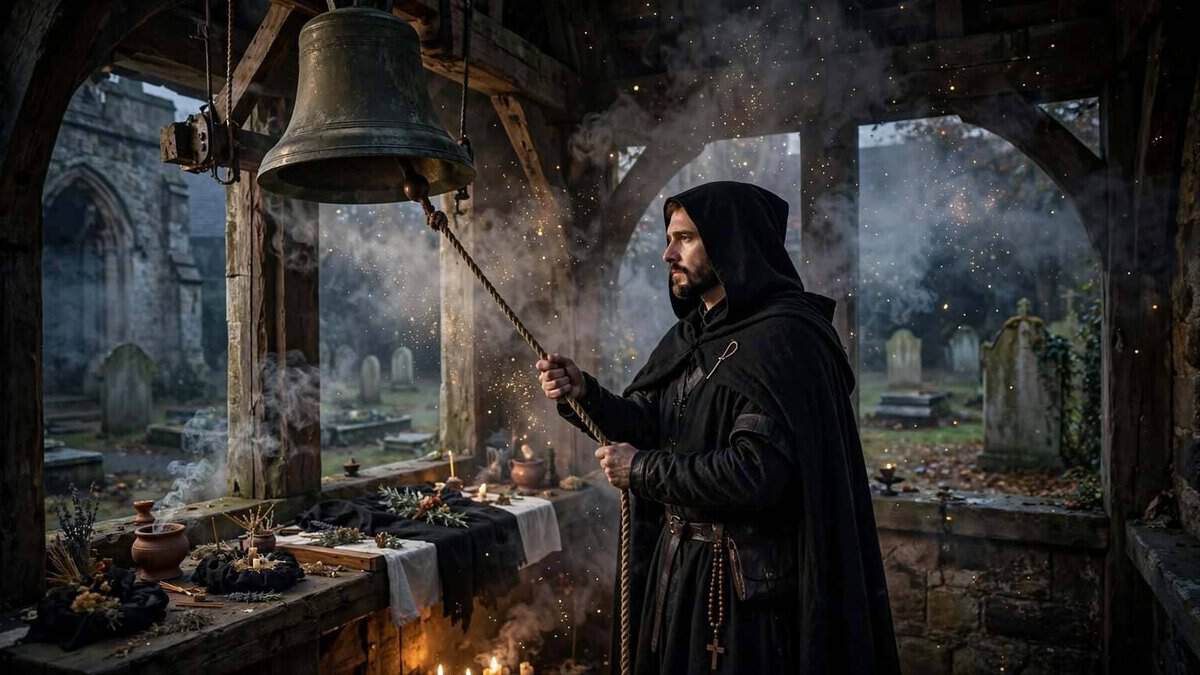
In medieval England and later, they had the passing bell, tolled for a person on their deathbed.
One purpose was to call neighbors to pray. The other was to drive away evil spirits lurking in the room, waiting to attack the departing soul.
Spirits fear bells, so the ringing gave the soul a head start.
And the bigger the bell, the stronger the magic! Its sound traveled farther, pushing the shadows farther back and gathering more prayers.
In Lancashire, villagers rang a merry peal after the burial to encourage angels and discourage evil spirits, a custom that lasted into the 19th century.
The bell creates distance. It builds a holy sound the unseen can’t cross.
8. The Storm-Breaking Spell

In medieval belief, storms were stirred by dark spirits in the air, so the cure was to out-shout them!
Church bells were rung at full volume when the clouds rolled in.
Pope Urban II approved a prayer for bishops to say when blessing bells, asking that their sound might scatter hail and wind and strike down the evil spirits of the air.
Many bells wore the inscription Fulgura frango, meaning I break the lightning.
The bell contributes force here. Its magic is meant to tear through the storm.
The practice turned dangerous, though, since ringers in towers were struck by lightning.
Charlemagne reportedly tried to forbid it, and in 1783 several European rulers did.
9. Saint Agatha’s Night Ringing

In France, on the night of Saint Agatha, bells were rung to scare off a witches said to be running around in the dark.
Bells were also rung at certain times of the year to guard the whole parish from the evil spells of the devil and of magicians.
Here the bell sets a boundary. Its sound spreads over fields and rooftops, shielding the community.
The protective power was believed to reach cowbells, too, thought to keep off disease, lightning, and curses.
The great bell guards the village, the small bell guards the animal, and between them nothing is left unprotected!
10. Reading the Bells at a Birth

Not every bell spell is about banishing. In Côtes-d’Armor, in Brittany, the bells could be read like an oracle.
After a first child was born, the new mother listened to the ringing and tried to fit the words of a song to the melody she seemed to hear in it.
If she could make the words fit, the omen was good and the child would live.
If the music resisted her, the sign was dark.
The bells have a voice for the unseen. Their sound is rich in overtones, so the ear can find phrases inside it.
That’s pure divination magic!
Try listening that way to any bell you can hear, and see if it speaks to you!
11. Bell, Book and Candle

In medieval excommunication, a bell was tolled, the Bible was read, and a candle was snuffed out, each act marking a person cut off from the church’s light.
Over time the phrase stuck in the language of curses and magic.
A tale in Halliwell’s collection of old English superstitions has a priest threatening to denounce a thief by bell, book, and candle.
The bell summons attention and makes the sentence public.
The book speaks the law, and the candle darkens at the end.
The bell is the voice of the whole community saying that the matter is important.
If you want to borrow it for your own life, ring a bell to close a chapter.
Say what’s finished, put out a flame, and sit with it in silence.
12. Saint Fillan’s Healing Bell

Our last spell is a cure.
In his Statistical Account of Scotland, Sir John Sinclair noted a bell in Saint Fillan’s Chapel, said to heal depression and madness.
Holy bells like this were treated as medicine for the mind.
Another legend tells of Saint Odoceus, who, thirsty and without a cup, shaped a bell from butter and drank from it. The bell turned to gold and kept its healing power!
The bell becomes a vessel of blessing that people could touch and hear.
When your thoughts get too much, one clear tone can pull you back to center.
Many modern witches hang little bells on their doors for protection and space clearing, and the Museum of Witchcraft and Magic keeps a string of small brass bells filed under spells and charms!

A little Aquarius, devoted to writing and embroidery. Through my writing, I hope to empower readers to align with their true selves and navigate life’s mysteries with confidence.