
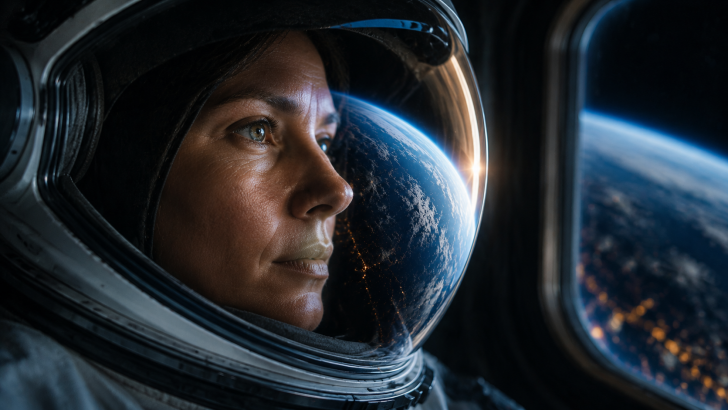
From orbit, Earth is no longer a map.
It becomes a bright, moving world surrounded by darkness, with everyone you have ever known living beneath one impossibly thin atmosphere.
For some astronauts, seeing it this way produces more than wonder. Familiar divisions lose their authority, the individual self feels smaller, and the planet suddenly appears alive.
This is known as the overview effect.
1. Earth Doesn’t Look the Way Astronauts Expect
Astronauts spend years preparing for spaceflight.
They learn how to operate complex machinery, respond to emergencies, and function inside an environment that could kill them within moments.
But training can’t fully prepare them for the view through the window.
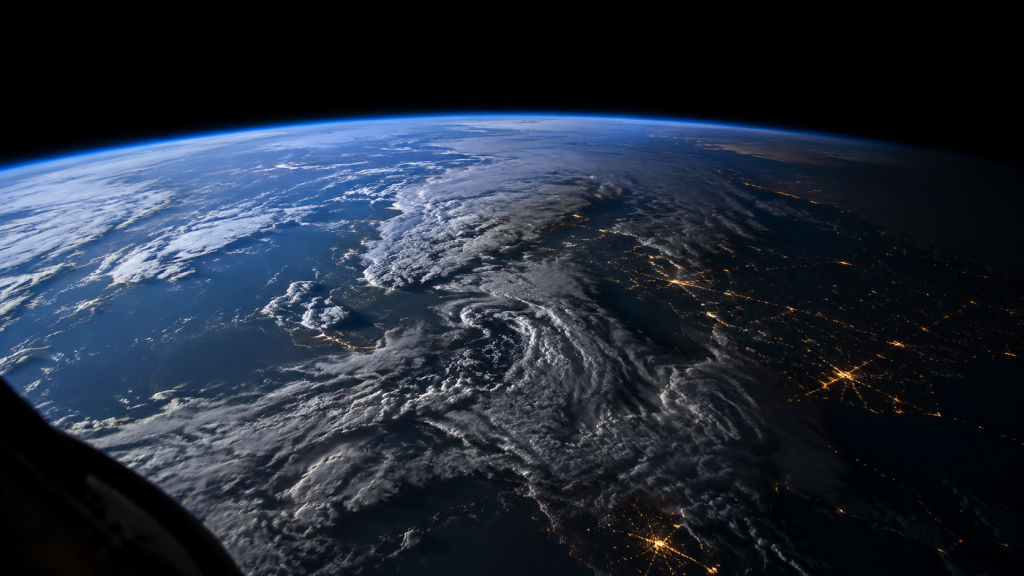
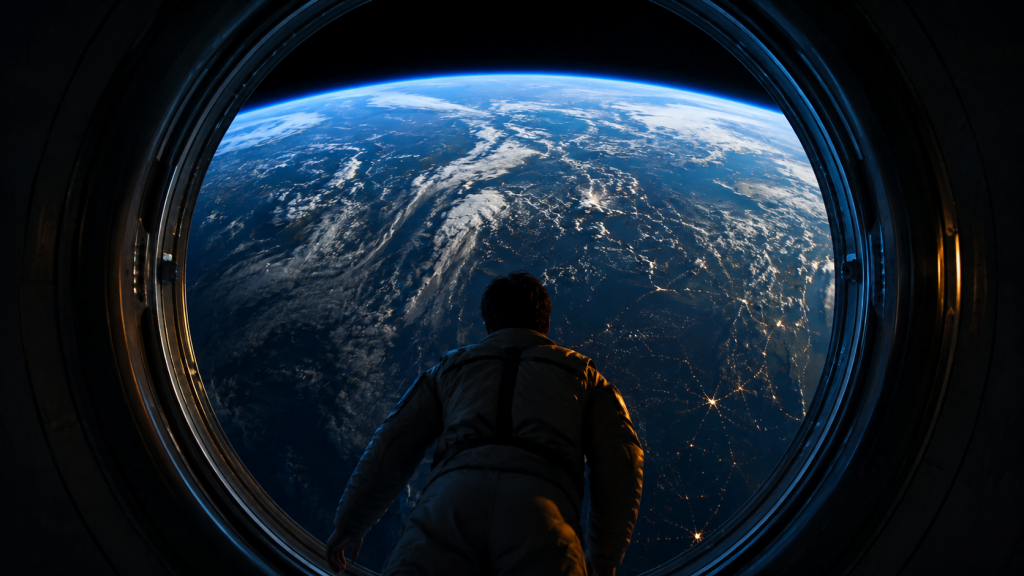
From the International Space Station, Earth fills much of the sky. Oceans move beneath enormous weather systems. City lights appear and disappear as the station repeatedly crosses between day and night.
Then there is the atmosphere.
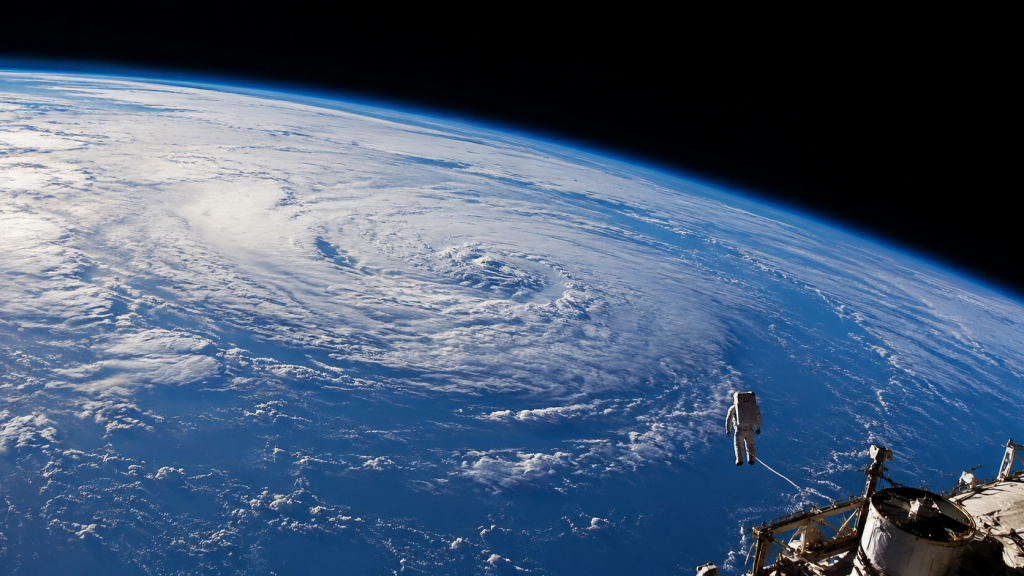
From the ground, the sky seems endless. From orbit, it becomes a narrow band of blue light clinging to the planet’s edge. Beyond it lies a darkness unlike anything naturally visible on Earth.
Astronaut Christina Koch has described seeing that thin line and realizing that everyone she knew was being sustained beneath it. Outside was a universe almost entirely hostile to human life.
The contrast changes the meaning of the view.
Earth looks exposed, and once that becomes visible, it can be tricky to return to thinking of the planet as an unlimited background to human life.
2. The Planet Suddenly Becomes One Thing
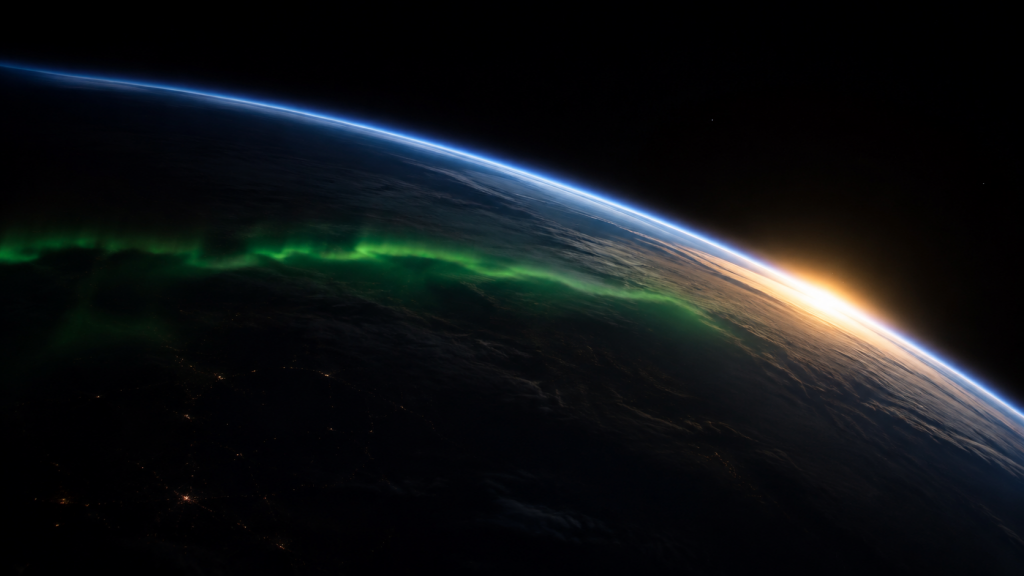
Political borders don’t appear on the daylight side of Earth.
There are mountains, rivers, coastlines, and clouds, but nothing marking where one country ends and another begins.
Divisions that shape daily life on the ground seem to dissolve when viewed from several hundred miles above it. And that absence can feel almost unsettling.
Former NASA astronaut Nicole Stott once recalled waiting to see her home state of Florida from space. But when the moment arrived, Florida no longer felt separate.
It had become one familiar part of a much larger home.
“We’re all earthlings,” she later said while describing the realization. Her experience became less concerned with where she lived and more concerned with what she lived on.
Still, the view doesn’t make human problems disappear.
At night, differences can become more visible. Astronaut Reid Wiseman has described seeing uneven patterns of development in city lights.
Space doesn’t reveal a world without suffering. It reveals how closely that suffering is contained.
Every conflict is unfolding inside the same narrow layer of life.
3. The Feeling Eventually Received a Name
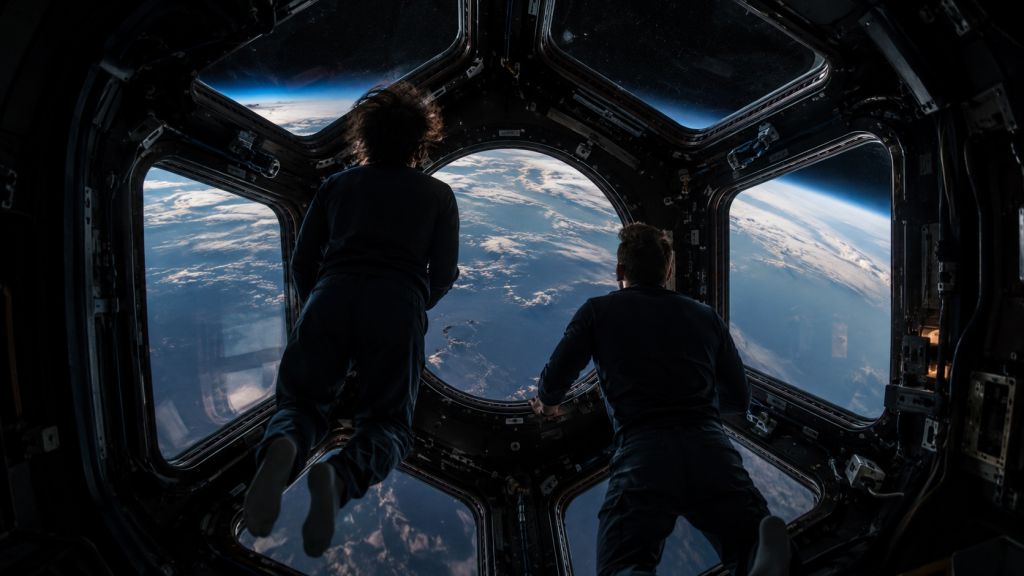
Astronauts had been describing these experiences for decades before anyone gave the pattern a name.
That changed with writer and space philosopher Frank White.
The idea came to him during an airplane flight across the United States. Looking down at the landscape, White imagined living in a settlement somewhere between Earth and the Moon.
From there, the planet would always be visible as one complete world. Its unity wouldn’t be a philosophical idea that required explanation. It would be part of everyday experience.
White began interviewing astronauts to learn whether distance had genuinely changed how they understood Earth.
Those conversations formed the basis of his 1987 book, The Overview Effect: Space Exploration and Human Evolution.
The phrase described the shift in awareness that could occur when someone saw Earth from outside its familiar surface.
White found that the change didn’t always happen at once.
Some astronauts experienced an immediate emotional impact, while others absorbed the meaning gradually after months of watching the planet below them.
4. Astronauts Struggle to Describe What Changed
One of the earliest and most famous examples arrived during Apollo 8.
On Christmas Eve in 1968, Bill Anders photographed Earth rising above the gray lunar horizon. The image showed the planet at a distance no human crew had previously reached.
Anders later observed, “We came all this way to explore the Moon, and the most important thing is that we discovered the Earth.” The photograph became known as Earthrise.
Apollo 14 astronaut Edgar Mitchell described something more expansive during his return from the Moon. Earth, the Moon, and the surrounding universe seemed to belong to a single unfolding system.
His reaction developed into a deep interest in consciousness and humanity’s place in the cosmos.
Closer to Earth, Nicole Stott watched storms move between continents and realized that weather didn’t belong to one location.
A system leaving Florida continued across the ocean, connecting places that felt unrelated from the ground.
Other astronauts have focused less on cosmic unity and more on responsibility.
The atmosphere appears so thin that protecting it can begin to feel personal. The planet is no longer an abstract environmental cause. It is a visible life-support system with nothing available to replace it.
The details vary, but the movement is often similar. Attention moves away from the astronaut alone and toward the larger world holding everyone and everything together.
5. Awe May Explain Part of the Experience
Psychologists often connect the overview effect with awe.
Awe tends to emerge when people encounter something so vast that their existing understanding can’t easily contain it. The mind has to make room for what it is seeing.
Earth from space creates this reaction on more than one level.
The planet is physically immense, but it appears small against the surrounding universe.
At the same time, the astronaut understands that this distant sphere contains nearly every human life, memory, language, and civilization.
Researchers studying astronaut accounts have suggested that the overview effect combines awe with self-transcendence—a temporary loosening of the boundaries around the individual self.
A person may feel smaller without feeling unimportant. The sense of belonging simply expands.
Separate research into awe has found that it can reduce self-focus and encourage greater concern for others.
That work wasn’t conducted on astronauts, so it can’t completely explain what happens in orbit.
It does, however, offer a useful clue. Awe appears capable of changing how people place themselves within a larger whole.
There are limits to what researchers can conclude. Very few humans have seen Earth from space, and much of the evidence comes from personal recollections.
6. Spiritual Doesn’t Necessarily Mean Religious
Astronauts often reach for spiritual language because ordinary words feel too small.
They describe unity, transcendence, or the sensation of touching a reality larger than themselves. Some connect the experience with an existing religious faith.
Others don’t.
A spiritual experience can involve a changed sense of identity without introducing any belief.
The view may make an astronaut feel deeply connected with humanity, conscious of life’s rarity, or newly aware of belonging to the natural world.
Even the word casa begins to change.
Prior beliefs still matter, of course. Culture, personality, and the circumstances of the mission influence how each astronaut interprets the experience.
The view doesn’t provide a new religion.
But it does give astronauts an unfamiliar perspective, and each person must find language capable of carrying it.
7. The View Can Follow Astronauts Home

Returning to Earth doesn’t always imply a transformation.
Astronauts still come home to ordinary responsibilities and the same complicated world they left behind.
But the perspective remains.
For Nicole Stott, the realization that Earth is a shared life-support system became central to her work as an artist and advocate. Other astronauts have become more involved in conservation or education.
Researchers have also tried to recreate parts of the experience through virtual reality.
Simulated journeys can generate awe and a stronger sense of connection with nature, although evidence that they produce lasting behavioral change remains mixed.
A perfect substitute may be impossible.
Still, smaller changes in perspective can happen without a spacecraft. A mountain, a dark sky, or an image such as Earthrise can briefly interrupt the scale of everyday concerns.
Humanity spent most of its history looking upward and wondering what might be waiting in space, and when people finally traveled there, many found themselves looking back.
And the most affecting thing they saw was the world they had left behind.
