
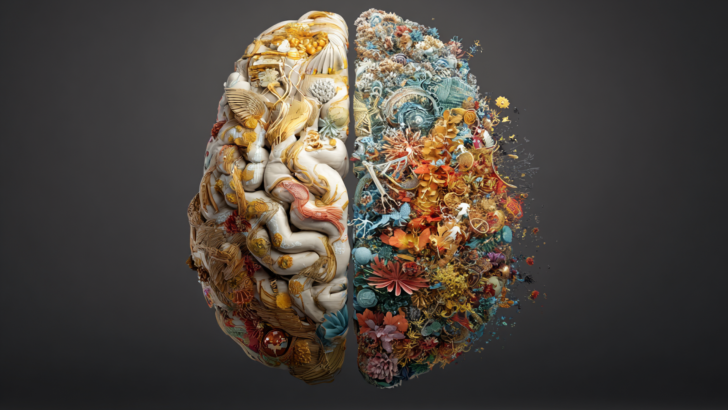
Right-brain vs. left-brain thinking is often discussed in psychology. Everybody uses both thinking types to some degree, but nearly everyone tends to have one or the other as a primary thinking style.
The left brain uses logic, structure, and data, while the right brain favors creative, intuitive, and broader thinking.
There is no need for an assessment, as most people can determine their most used thinking style by simply responding honestly to one question.
1. The Question: How Do You Start A Task?

When you get a job to do, do you
- think it through with a detailed plan of various steps to follow, or
- are you someone who jumps right into it and figures it out as you go?
If you follow lists, organized structure, and clear order, then you are most likely leaning toward the lado esquerdo of your brain.
If you use intuition, create on the fly, and adjust your decisions as you progress, you have a tendency to favor the lado direito of the brain. This starting point shows what your mind prefers to do with uncertainty, pressure, and creativity in daily life.
2. If You Plan First, You May Be Left-Brain Oriented

Having structure feels safer to left-brain thinkers. Planning reduces anxiety and clarifies things. You also prefer logic, systems, and predictable results.
Schedules and routines, as well as clear rules, may appeal to you; problem-solving for you feels good when you use steps to find a solution.
You usually process your emotions internally or through logical thinking, so you probably are creative, but you place more trust in an ordered way of thinking than you do in gut feelings.
3. If You Dive In First, You May Be Right-Brain Oriented

Right-brained people are intuitive and rely on momentum for their ideas. They are hands-on learners. When there are no rules, it’s easier to create because there is more space for creativity.
Right-brained people process their emotions more powerfully than left-brained people do, and they usually go with their gut instincts. For right-brained thinkers, the act of creating is more exciting than creating a plan to create something.
There is no lack of discipline in these individuals; instead, they receive inspiration first and use logic afterwards to achieve success.
4. How You Handle Problems Reveals More

Analytical (left-brain) thinkers approach problems sequentially, searching for the causes of the problem, the patterns, and the solutions they would provide.
Imaginative (right-brain) thinkers approach problems intuitivamente (emotionally and/or visually), imagining the results or possibilities.
The left-brain thinker places greater emphasis on physically presenting accurate information, while the right-brain thinker values insightful information more.
There is no better way; however, they will have different priorities on how they will accomplish the same task. Your usual reactions to problems will be indicative of the side you trust most when you are under pressure.
5. Your Communication Style Is A Clue

Left-brain thinkers communicate directly with facts and clarity. Right-brain thinkers communicate through emotional, metaphorical, and visual methods, using storytelling, images, and tone.
This can be seen in the way you explain a concept or resolve a conflict.
Your method of communication is influenced by the organization of thoughts in your brain and may affect how others perceive your level of intelligence and personality traits.
6. How You Make Decisions Says A Lot

When making a decision, left-brained thinkers rely on facts, logic, and measurable results, whereas right-brained thinkers base their decisions on feeling, intuition, or gut instinct.
Neither way is inherently better than the other, but it shows how someone balances those three elements (risk, emotion, and control) in daily living.
7. Stress Brings Out Your Dominant Side

When stressed, you will see that whether you are a left-brain thinker or a right-brain thinker, the way that you think naturally under pressure is what you are going to fall back on.
If you are a left-brain thinker, you are likely to be more rigid and controlling under stress, whereas if you are a right-brain thinker, you are likely to become more emotional and all over the place.
Because of this, if you try to understand how you react when you are under stress, it helps to notice which side of your brain is dominant when you become uncomfortable.
8. Most People Are A Blend, With A Dominant Side

Most of us are not uniquely right- or left-brained but a combinação of both sides, with one side being dominant; however, through life experiences, professions, and stressors, the balance can change over time.
The most important thing is to be aware of oneself instead of just putting labels on oneself. When you know where you naturally gravitate, it allows you to work with your brain versus working against it.
Being aware of your thought processes enhances your decision-making ability, your creativity, and how you accept who you are.

Born and raised in Bosnia and Herzegovina. Ever since I was a little girl, my imagination knew no bounds. I remember vividly how I’d scribble down short stories, each page bursting with adventures and characters conjured up from the whimsy of my mind. These stories weren’t just for me; they were my way of connecting with my friends, offering them a slice of my fantasy world during our playtimes. The joy and excitement on their faces as we dived into my fictional realms motivated me to keep writing. This early passion for storytelling naturally evolved into my pursuit of writing, turning a childhood hobby into a fulfilling career.