
Ask someone what angels carry, and there’s a good chance they’ll say a harp.
But the Bible offers a much stranger collection.
Its angels appear with swords, staffs, trumpets, bowls, and objects capable of sealing entire groups of people.
Most of these objects aren’t accessories, and they don’t tell us what angels ordinarily look like. They reveal what a particular angel has been sent to do.
Here are nine things angels actually carry in the Bible—and the stories hidden inside them.
1. A Sword Even a Donkey Saw
One of the Bible’s most memorable angelic weapons appears during Balaam’s journey to Moab.
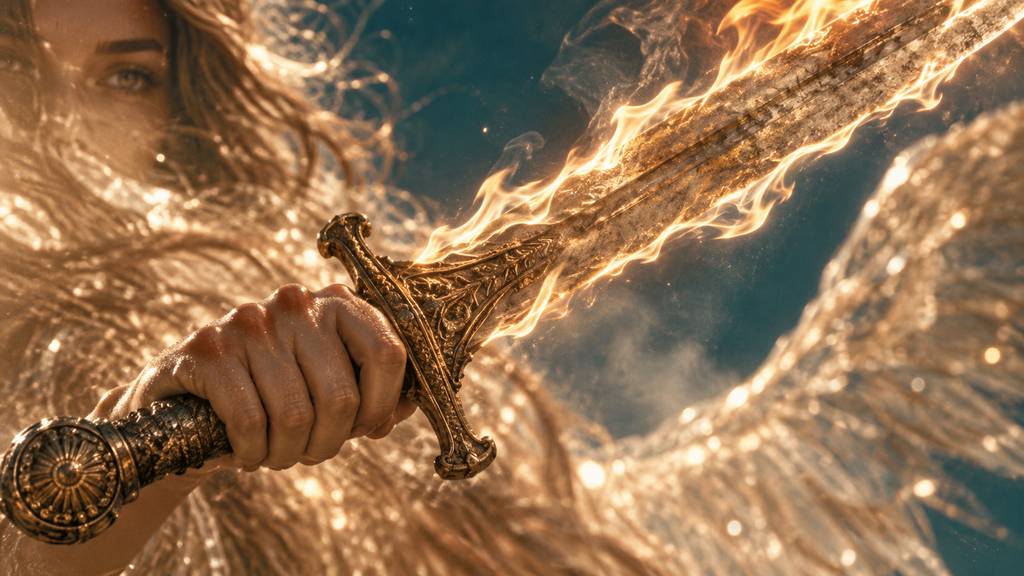
Balaam is riding his donkey when the animal suddenly leaves the road. She can see what her rider can’t: the angel of the Lord standing ahead of them with a drawn sword.
Balaam beats the donkey and forces her onward, only for the angel to block them again.
Eventually, God opens Balaam’s eyes, and he finally sees the armed figure who has been waiting in his path.
The sword isn’t decorative. The angel tells Balaam that his reckless journey has made the angel his adversary—and that the donkey’s evasions saved his life.
The celebrated seer can’t see the danger in front of him, while the stubborn animal recognizes it immediately.
Here, the angel’s sword marks a boundary Balaam is approaching without understanding.
2. A Staff That Drew Fire From Stone
Gideon encounters an angel while secretly threshing wheat inside a winepress, trying to keep the grain hidden from Midianite raiders.
The angel calls this frightened, concealed man a mighty warrior.
Understandably, Gideon needs reassurance.
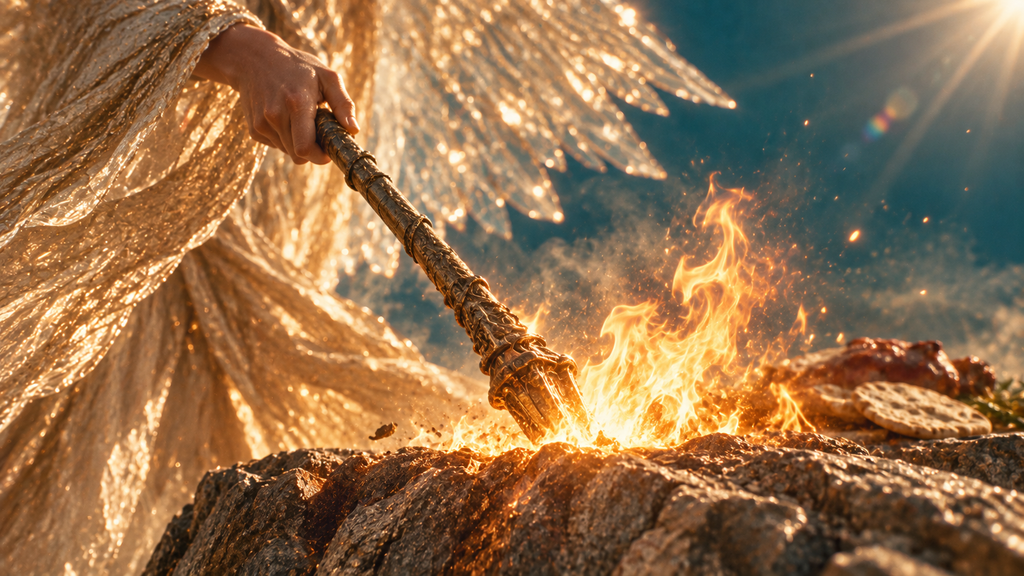
He prepares meat, broth, and unleavened cakes and places them before his visitor. The angel tells him to set the food on a rock and pour the broth over it.
Then something extraordinary happens.
According to Judges 6, the angel reaches out with the tip of the staff in his hand and touches the offering. Fire erupts from the rock, consumes the food, and the angel disappears.
The staff looks ordinary until it becomes the point where the visible world meets divine power.
Gideon asked for proof, but the angel was carrying it in his hand.
3. The Seal of the Living God

In Revelation, four angels stand at the corners of the Earth, holding back destructive winds.
Before those winds are released, another angel rises from the east, carrying the seal of the living God.
The angel orders the others not to damage the Earth, sea, or trees until God’s servants have been marked on their foreheads.
A seal in the ancient world could identify ownership, confirm authority, or secure something against interference. Revelation draws on all of those associations.
The mark separates God’s servants from the forces of destruction surrounding them.
The passage has inspired centuries of debate over the identity of the 144,000 who are sealed. But the object in the angel’s possession already tells us something essential.
Before judgment advances, God knows precisely who belongs to Him.
4. Seven Trumpets That Break Heaven’s Silence

When the seventh seal is opened in Revelation, heaven becomes silent.
Then seven angels standing before God are given seven trumpets. Each blast announces another stage of judgment.
In Revelation 8, the first four trumpets bring devastation upon the land, sea, rivers, and sky. Later blasts release even stranger terrors.
Biblical trumpets frequently gather people, announce danger, accompany battle, or mark a moment when God is about to act. The angels of Revelation carry that old symbolism into an apocalyptic vision.
They receive the trumpets, wait for the appointed moment, and then announce what follows.
And even at the edge of catastrophe, the angels remain messengers.
5. A Golden Censer Filled With Prayers and Fire
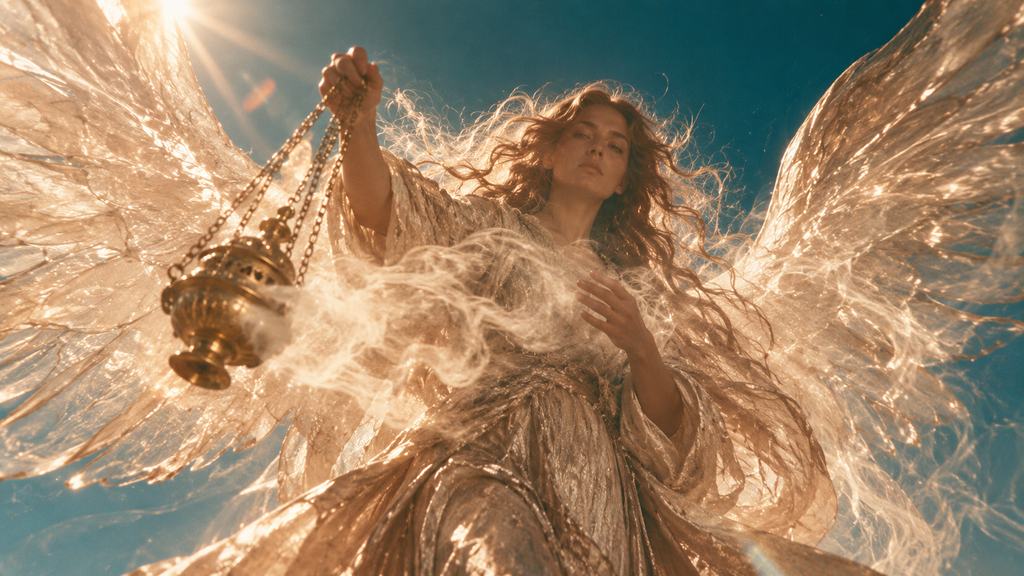
Before the trumpets begin, another angel approaches the heavenly altar carrying a golden censer.
Incense is added to it along with the prayers of God’s people. The smoke rises before God from the angel’s hand.
For a brief moment, the scene feels quiet and priestly. Then it changes.
The angel fills the same censer with fire from the altar and throws it down upon the Earth. Thunder, lightning, rumblings, and an earthquake follow.
That makes the censer one of the most complicated objects an angel carries anywhere in Scripture.
In Revelation 8, it holds both the prayers rising from a suffering world and the fire that returns to it.
The prayers have reached the altar—and the silence following them doesn’t last forever.
6. A Little Scroll That Had to Be Eaten
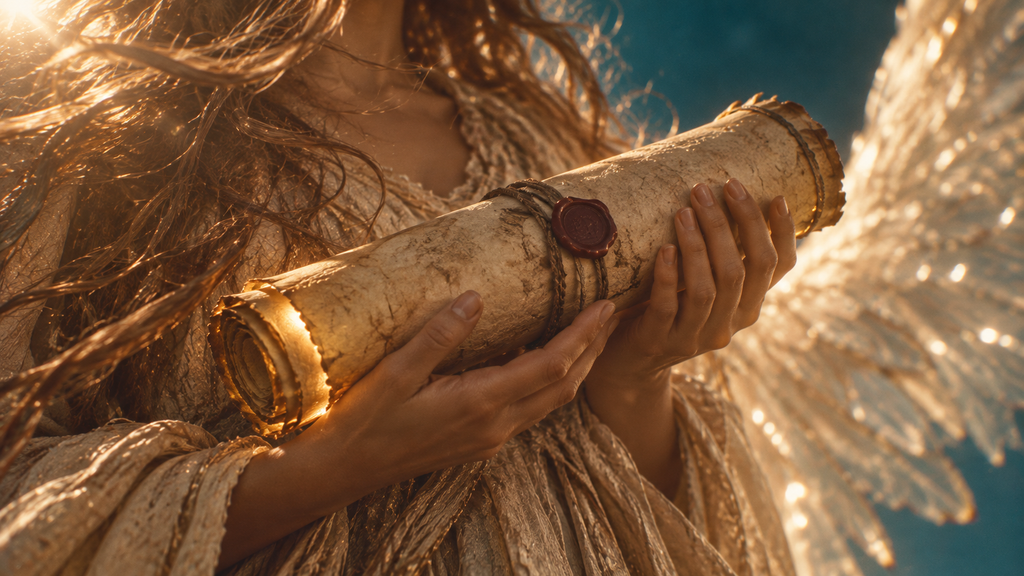
The angel in Revelation 10 is anything but little.
He descends wrapped in a cloud, with a rainbow over his head. His face resembles the sun, and his legs look like pillars of fire. He places one foot on the sea and the other on the land.
Yet in his hand lies something surprisingly small: an open scroll.
John is told to approach the angel and take it.
The angel then tells him that he must eat the scroll. It will taste sweet in his mouth but turn bitter in his stomach.
And that’s exactly what happens.
The small scroll in Revelation 10 isn’t just information to be read and set aside. John has to take the message into himself before he can continue prophesying.
The angel carries a word that will become part of the person receiving it. Its sweetness and bitterness can’t be separated.
7. A Sickle for a Terrible Harvest
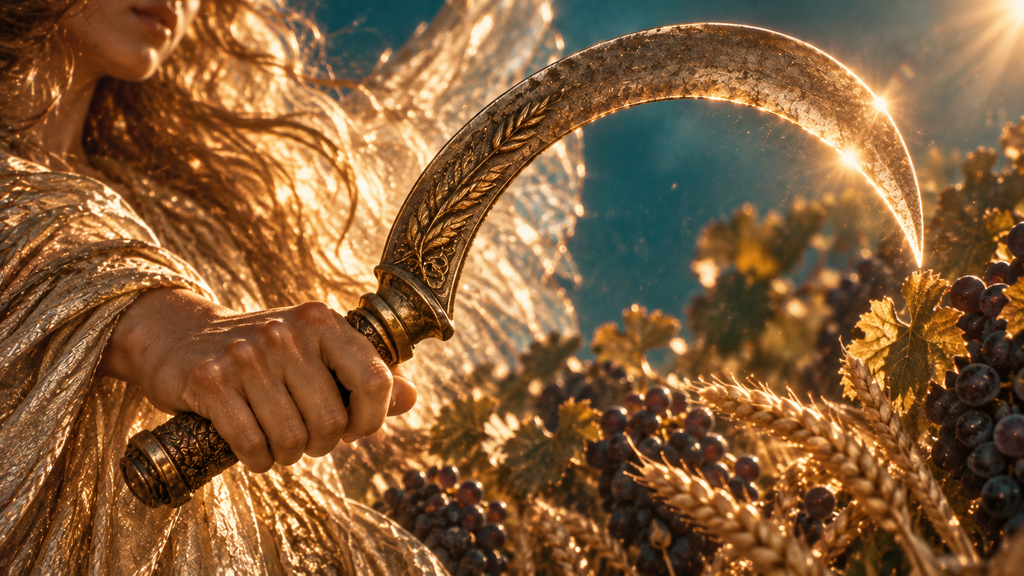
Revelation borrows one of the most peaceful images in the ancient world—a ripe harvest—and turns it into a vision of judgment.
First, someone resembling a son of man appears with a golden crown and a sharp sickle. Then an angel comes out of the heavenly temple carrying another sickle.
A second angel announces that the grapes of the Earth are ripe.
The first angel swings the blade, gathers the clusters, and throws them into the great winepress of God’s wrath.
A harvest happens only after a long season of growth, when something has finally reached maturity. That’s what makes the sickle so frightening.
The angel appears when the time for waiting has ended.
8. Seven Golden Bowls Filled With Wrath
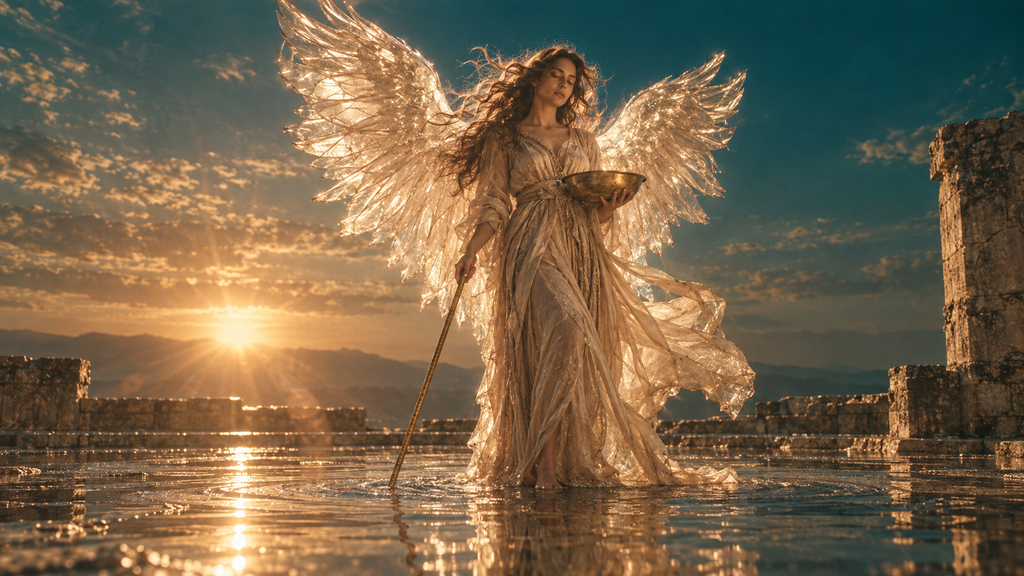
The next objects are beautiful on the outside and horrifying within.
Seven angels emerge from the heavenly temple dressed in bright linen with golden bands across their chests. One of the four living creatures then gives them seven golden bowls.
The bowls are filled with God’s wrath.
In Revelation 16, the angels pour them one by one upon the Earth, sea, rivers, sun, throne of the beast, Euphrates, and air.
The resulting plagues complete the cycle of judgment.
These angels come from the temple in brilliant clothing, carrying vessels made of gold. So the contrast is the point.
Revelation refuses to let beauty become a simple synonym for comfort.
The golden bowls belong to the order of heaven, but what they carry exposes everything on Earth that has set itself against that order.
9. The Key to the Abyss

Near the end of Revelation, an unnamed angel descends from heaven carrying the key to the abyss. A heavy chain is also in his hand.
He seizes the dragon—identified as the Devil and Satan—binds him, throws him into the abyss, and locks it.
Throughout Revelation, the dragon has terrified the world, deceived nations, and made war against God’s people. Yet in Revelation 20, his imprisonment doesn’t require an army of angels.
One unnamed messenger carries the necessary authority.
The key doesn’t belong to the angel by nature. Like the trumpets, bowls, and seal, it has been entrusted to him for a particular act.
That may be the clearest pattern connecting everything on this list. Biblical angels rarely carry ornaments. They usually carry assignments.
What the angel carries often tells us why heaven sent him.
