

Some of the strangest heavenly figures associated with the Bible do not look remotely human. They look like wheels.
The Ophanim are famous today for descriptions of enormous wheels covered with eyes, often appearing in artwork and videos about so-called “biblically accurate angels.”
Their origins can be traced primarily to the extraordinary visions of the prophet Ezekiel. But calling them angels requires some explanation.
Ezekiel does not introduce a species of angel called the Ophanim in the straightforward way modern descriptions sometimes suggest.
Instead, he sees mysterious wheels beside four living creatures supporting a vision of God’s heavenly throne.
Later Jewish mystical and angelological traditions developed the Ophanim into a more recognizable category of heavenly beings.
Here are six things to know about the mysterious Ophanim.
1. The Ophanim Come From Ezekiel’s Vision of God’s Throne
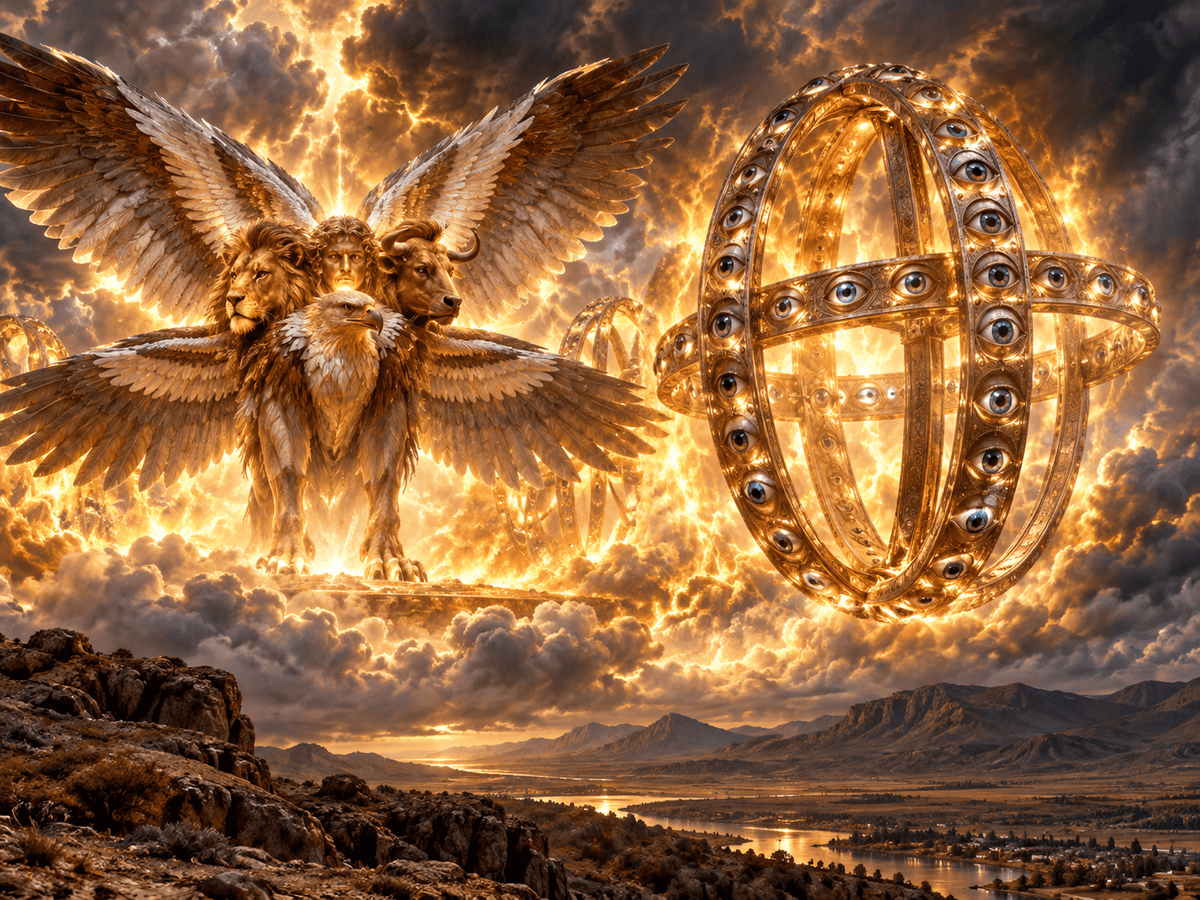
The imagery behind the Ophanim appears immediately in the Book of Ezekiel.
Ezekiel describes seeing an enormous storm cloud, fire, four extraordinary living creatures, brilliant heavenly objects, and something resembling a throne above them.
Beside the living creatures are mysterious wheels. These wheels are not introduced as random supernatural objects moving independently through heaven.
They belong to a larger vision centered on the appearance of God’s glory. Later in Ezekiel, the living creatures are identified as cherubim.
The wheels move beside them as part of an extraordinary heavenly structure that later interpreters sometimes describe as God’s throne chariot.
This context is important. Modern artwork often isolates an Ophanim and portrays it floating alone as a gigantic collection of rings and eyes.
Ezekiel originally presents the wheels as parts of something much larger and more mysterious.
2. Their Name Simply Means “Wheels”

“Ophanim” sounds like the name of an exotic species of celestial being. Its basic meaning is much simpler.
The Hebrew word ophan means “wheel,” while ophanim is its plural form.
This is why many Bible translations simply describe “wheels” when presenting Ezekiel’s vision.
The term later became associated with a particular category of heavenly beings.
This distinction helps explain why someone reading Ezekiel for the first time may wonder where the famous angels called Ophanim have gone.
They are looking for a proper name, while the translation may simply say “wheels.”
Their development into a clearly defined heavenly order belongs largely to later traditions interpreting the strange objects Ezekiel described.
The name itself therefore preserves their most obvious characteristic.
Before the Ophanim became an angelic category, they were the mysterious wheels beside the cherubim.
3. Their Rims Are Described as Being Full of Eyes

The detail that makes the Ophanim unforgettable is their eyes. Ezekiel describes the rims of the wheels as being full of eyes all around.
The prophet does not provide a simple explanation for what every eye represents.
The eyes can suggest awareness, watchfulness, or the all-seeing nature of divine knowledge.
Modern artists have taken the description even further, producing spectacular images of enormous interlocking rings containing dozens or hundreds of eyes.
These illustrations can be visually impressive, but they should not automatically be treated as exact biblical portraits.
Ezekiel gives readers a visionary description rather than a technical diagram.
Still, the eyes clearly contribute to the overwhelming character of the scene. These are not ordinary wheels.
They belong to a heavenly vision where familiar earthly objects suddenly behave as though they are alive.
4. The Famous “Wheel Within a Wheel” Allowed Extraordinary Movement

Ezekiel describes the construction of the wheels with one of the Bible’s strangest phrases.
Their appearance was something like a wheel within another wheel. Exactly how this should be visualized is uncertain.
One popular interpretation imagines two wheels crossing each other, allowing the structure to travel in multiple directions.
Modern illustrations sometimes transform the description into elaborate spheres made from several rotating rings.
Ezekiel emphasizes the unusual movement more than the exact engineering.
The wheels could travel in the direction the living creatures moved without needing to turn around first.
When the creatures moved, they moved. When the creatures stopped, they stopped. When the creatures rose, the wheels rose with them.
The text explains their remarkable coordination by saying that the spirit of the living creatures was in the wheels.
5. Ezekiel Does Not Actually Call the Ophanim “Angels”
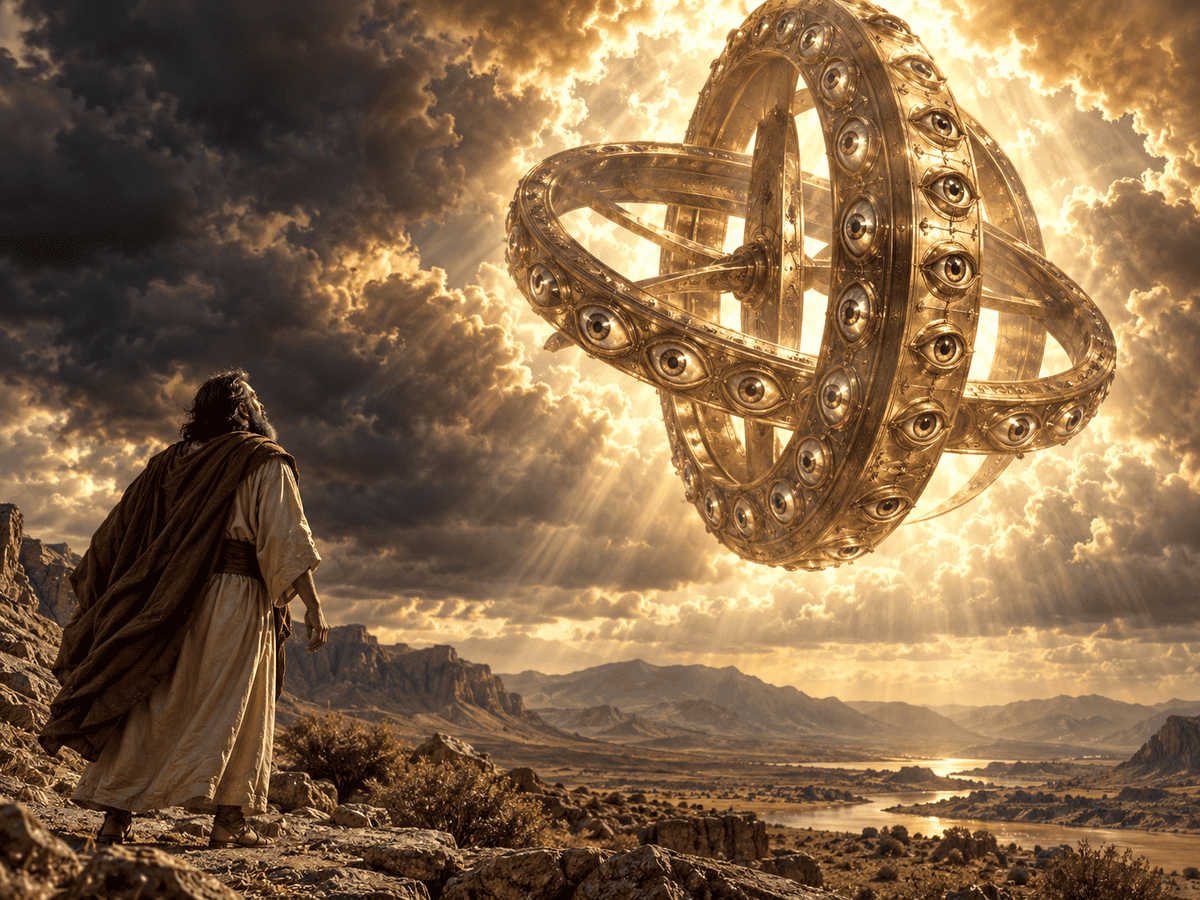
This is where the popular phrase “biblically accurate angel” becomes complicated.
Ezekiel never simply says, “I saw angels called Ophanim.” He describes wheels.
Their later classification as celestial or angelic beings developed as Jewish thinkers and mystical traditions created more detailed understandings of the heavenly hierarchy.
So are Ophanim angels? In later angelology, they can certainly be described as a class of heavenly beings.
But if the question is whether Ezekiel explicitly identifies his mysterious wheels as ordinary angels, the answer is no.
The famous internet image of an Ophanim therefore combines genuine biblical imagery with later interpretation.
6. Later Traditions Turned Them Into a Powerful Order of Heavenly Beings

Ezekiel leaves his mysterious wheels largely unexplained. Later religious traditions did not.
Jewish mystical writings developed increasingly elaborate descriptions of the heavenly realm, including different groups of celestial beings surrounding God’s throne.
The Ophanim gained a more recognizable identity within these traditions.
Medieval Jewish thinkers also included Ophanim in discussions and classifications of angels.
Maimonides famously listed Ophanim within a hierarchy of angelic beings, although his philosophical understanding of angels should not simply be equated with modern fantasy-like images.
Christian angelology developed somewhat differently.
The order known as the Thrones has sometimes been associated with the wheel imagery surrounding God’s throne.
This long history explains why the Ophanim can simultaneously be biblical and not quite match the way they are described online.
Their wheels and eyes come from Ezekiel. Their identity as a defined angelic order developed more clearly afterward.
That combination of scripture, interpretation, and mystery is exactly what has made the Ophanim some of the most fascinating heavenly beings associated with the Bible.

自出生以来,我一直感觉到自己与神灵有着紧密的联系。作为一名作家和导师,我的使命是帮助他人在最黑暗的时刻找到爱、幸福和内心的力量。