
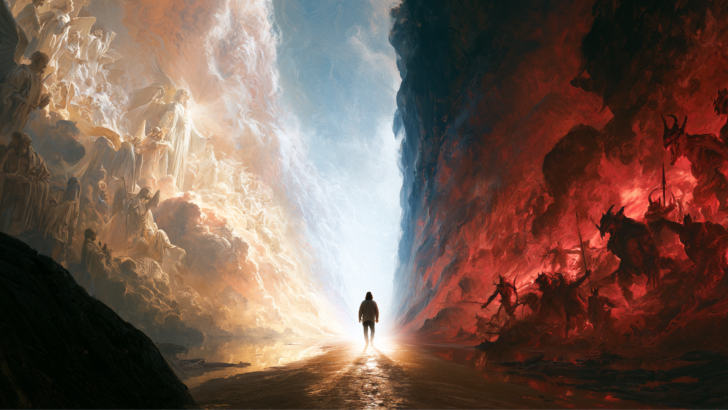
There have been various hypotheses regarding what happens after death. A number of religions endorse their interpretations of heaven and hell. In that context, other groups and thinkers also present totally different ideas.
However, none of these ideas is scientifically substantiated. But still, they illustrate a person’s unquenchable thirst for knowledge about life and the afterlife.
Below are two of the ideas that postulate an afterlife that is totally different from the idea of being rewarded or punished.
1. Reincarnation: Returning In Another Life

The first idea is reincarnation. Many religions teach that after a person vanishes from the realm of the living, his/her soul continues to reincarnate.
This means that instead of reaching its final resting place, the soul is born anew, that is, reincarnated in another body. While the ultimate aims differ across religions, most of them suggest that the purpose of rebirth is spiritual growth.
Even though reincarnation has no scientific ground, the stories told by individuals identifying themselves as reincarnations continue to puzzle researchers and spark their interest.
2. A Realm Of Reflection Before Moving On

Another theory suggests that before entering a new life, the soul goes through the stage of reviewing its past lives. Unlike the judicial approach, this stage is considered to be more about comprehension and healing.
Several people who have experienced near-death have mentioned that they came through some sort of retrospective experience when they could feel what their behavior evoked in other people.
These statements are still personal statements instead of scientific evidence, but they serve as motivation to many in pursuit of the idea of self-awareness after death.
3. Becoming Part Of A Universal Consciousness
Certain schools of thought, especially contemporary philosophers and spiritual thinkers, state that a person’s consciousness gets absorbed into higher universal consciousness with a diminishing sense of personal presence.
As the notion of merging of consciousness is supported by certain philosophies and mystical schools, the idea remains popular and accepted among those who believe consciousness to be independent of the physical body and the reality of individual experiences.
4. Remaining In A Spirit World Close To Earth
Numerous native traditions and systems of beliefs are based on the idea of ancestors living in a spirit world that exists close to living humans.
These systems of beliefs presume that deceased relatives are still present, only they do not live in heaven or hell, but somewhere nearby, being able to influence their descendants through symbols, dreams, and events.
Different cultures have developed their own explanations of this phenomenon, which remains largely unexplained by science.
5. Consciousness As A Different Dimension

Numerous scientists and philosophers ponder whether consciousness could be associated with dimensions we know not too much about.
Although the ideas are merely speculative, they may inspire thinking of death as a step into another dimension.
Concepts from modern physics are often applied to the theories, although it seems clear that these ideas are well ahead of the evidence available today.
6. A Shared Dreamlike Reality
Some mystical authors consider the afterlife to be a dreamlike state based on the memories, feelings, and expectations of a person.
Consciousness creates the environment based on thoughts and convictions instead of physical processes. The ideas are drawn from Buddhist philosophy and other traditions, but the interpretations vary.
The science of psychology recognizes the incredible potential of the human mind in dreams, but does not provide any proof that the activities in the mind continue after death.
7. Simply Returning To The Universe
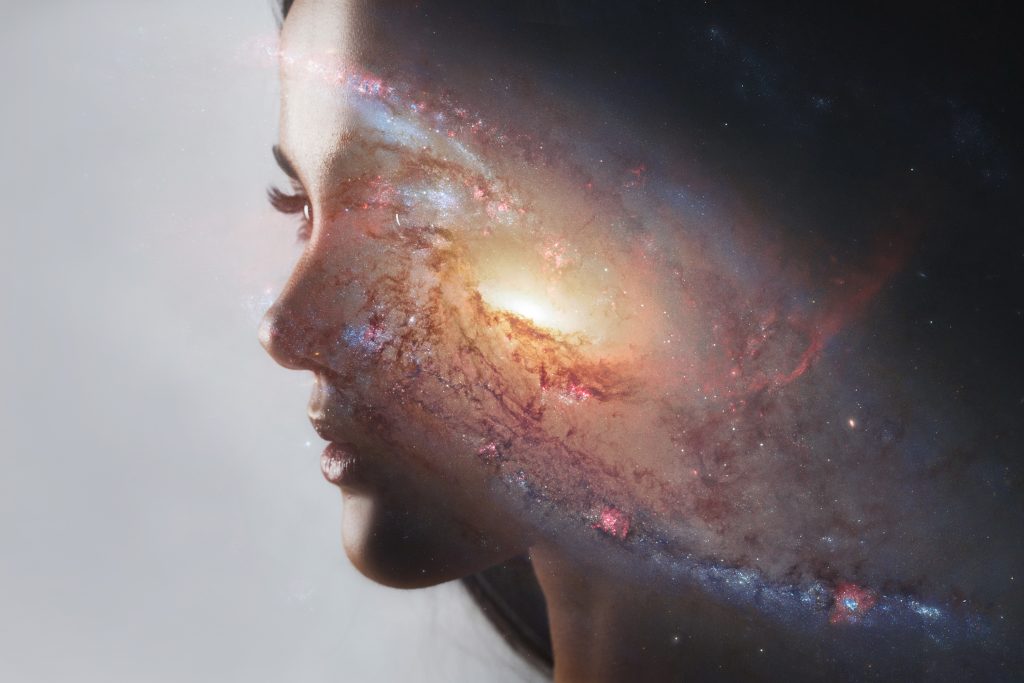
Some individuals believe in a rather naïve idea that there is no afterlife in a spiritual sense. They accept death as the reunion with the universe.
In essence, all atoms that make up the human body become part of the stars, oceans, forests, and new life forms. The idea that nothing is wasted makes many people happy.
This view is scientific and proposes that matter can be recycled, but it does not say anything about the survival of consciousness.
8. The Simulation Theory Possibility
A contemporary philosophical theory claims that reality may be a sophisticated simulation.
In that case, death may signify moving from one level of existence to another rather than reaching an afterlife in the same sense as it is believed.
While some philosophers and scientists speculate about the possibility of simulation theory, there is no evidence that human beings live in an invented parallel reality.
9. Existing Outside Of Time
Some philosophers posited that time after death might not be the same as in life. If consciousness exists independently of the physical body, it might exist in a state when past, present, and future merge together.
This notion has been presented in different mystical traditions, claiming that eternity is different from the endless passing of time.
These are only suppositions, and, as of now, there is still no means to prove them scientifically.
10. Returning To A Source Of Pure Light
According to some modern spiritual movements and various near-death experience accounts, the afterlife does not represent a certain physical destination, but rather a return to an overwhelming source of light, love, and awareness.
Here, the individual may go through a period in which his/her unique identity still exists prior to merging with a larger spirit in which all life comes from. Supporters see it as more of a homecoming than a judgment.
Although no scientific evidence proves this, this viewpoint is one of the more common alternatives to the traditional concepts of heaven and hell.
11. A Mystery Beyond Human Understanding

The last theory persists the longest and suggests that if there is an afterlife, it is definitely more advanced than any of human minds could ever imagine.
Every culture has its own understanding of what happens after death, yet the afterlife may be based on principles unknown to humanity.
Some philosophers, like Kant, believed that we have limitations in our understanding of what lies beyond human life and that we may never even begin to comprehend what awaits us after our journey here on earth ends.

Born and raised in Bosnia and Herzegovina. Ever since I was a little girl, my imagination knew no bounds. I remember vividly how I’d scribble down short stories, each page bursting with adventures and characters conjured up from the whimsy of my mind. These stories weren’t just for me; they were my way of connecting with my friends, offering them a slice of my fantasy world during our playtimes. The joy and excitement on their faces as we dived into my fictional realms motivated me to keep writing. This early passion for storytelling naturally evolved into my pursuit of writing, turning a childhood hobby into a fulfilling career.