
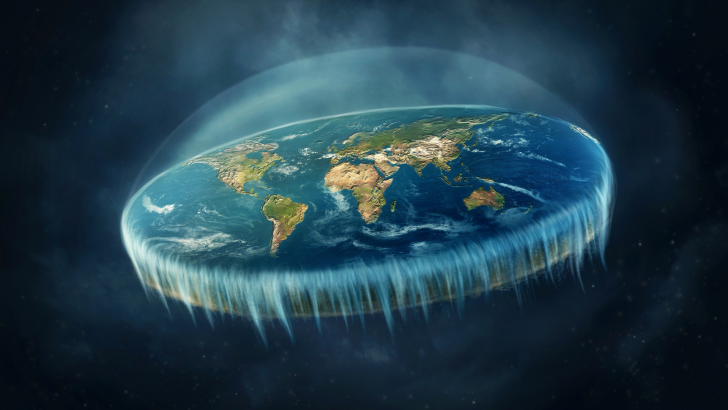
The flat Earth theory is gaining increasing attention today on YouTube, Internet forum sites, and other social networking outlets.
For many, the flat earth theory appeals to their rebellious nature by challenging authority figures while exposing them to possible secrets of the universe.
The motivation for questioning the publicly accepted theories is a natural desire to question the world around us, but many times, there is little support to back up those claims.
Upon further examination of the claims made in support of the flat Earth theory, we can see that there are still questions that remain to be answered.
1. Inconsistent Explanations for Day and Night

Flat Earth theory’s understanding of how day and night occur has been explained, but it has more than one flaw.
There are several variations of the flat Earth theory regarding how the Sun moves around the Earth, including that the Sun is moving away from the Earth and then moving toward the Earth, or that a small Sun is moving around the Earth in circular or elliptical orbits.
These theories cannot easily explain why we see both the sunrise and sunset occur as gradual and predictable events throughout the globe.
Furthermore, the flat Earth theory does not easily explain how night happens at the same time throughout multiple areas of the planet. In real life, people in many parts of the Earth actually see the same pattern of daylight that supports the consistent geometry of the Earth.
2. Problems Explaining Gravity Without Clear Alternatives
Supporters of the flat Earth theory dismiss gravity but do not propose a viable alternative explanation. Some of their explanations include that everything is moving continually upward, while others exclude gravity from consideration and rely only on density and buoyancy.
Density and buoyancy could not account for the consistent rate at which all objects fall at all places on Earth. There are no current explanations for how the planets move, what causes tides, or how things on Earth operate uniformly.
Density can account for the reason something can float, but it cannot account for any downward force acting on that object.
The absence of a clearly defined mechanism leaves both density and buoyancy incomplete as explanations for downward motion. A replacement solution to gravity would need to provide an equivalent measure of force, predictability, and ultimately, the same characteristics as gravity.
3. Flight Routes That Don’t Match Flat Maps
There is also another large gap in the theory when we evaluate flight paths on Earth. Long-haul flights appear to follow routes that would be effective on a globe but appear crooked or inefficient on flat maps.
Pilots and airline companies utilize actual numbers when calculating fuel efficiency and don’t employ some kind of mysterious knowledge in doing so.
When looking at the time/distance to travel from one point to another using both theories, the mathematical calculations consistently align with the globe model and do not align with the flat Earth model.
Flat Earth theorists often assume some kind of conspiracy when explaining these consistent results. When real-world travel data continually supports one of these models over the other, this undoubtedly raises significant questions about the validity of the flat Earth theory.
Navigation in the real world relies on accuracy rather than belief systems.
4. Contradictions in Star and Sky Observations
Star movement reveals challenges that flat Earth belief systems fail to resolve. The constellations seen in the night sky from one hemisphere are not all available to view from another hemisphere, as some stars are only visible in the southern hemisphere (if in Australia, for example), and others are only visible in the northern hemisphere.
Flat Earth explanations use very large perspective distortions to explain star movement, and very few of these make sense scientifically. Time-lapse photography has proved that stars rotate about fixed points in the sky in different directions depending on location.
The patterns that occur as a result of this movement of stars are consistent and easily replicated. The flat Earth model relies too heavily on optical illusions and vague or confusing explanations that constantly change in order to address these questions.
5. Reliance on Conspiracy to Fill Missing Answers
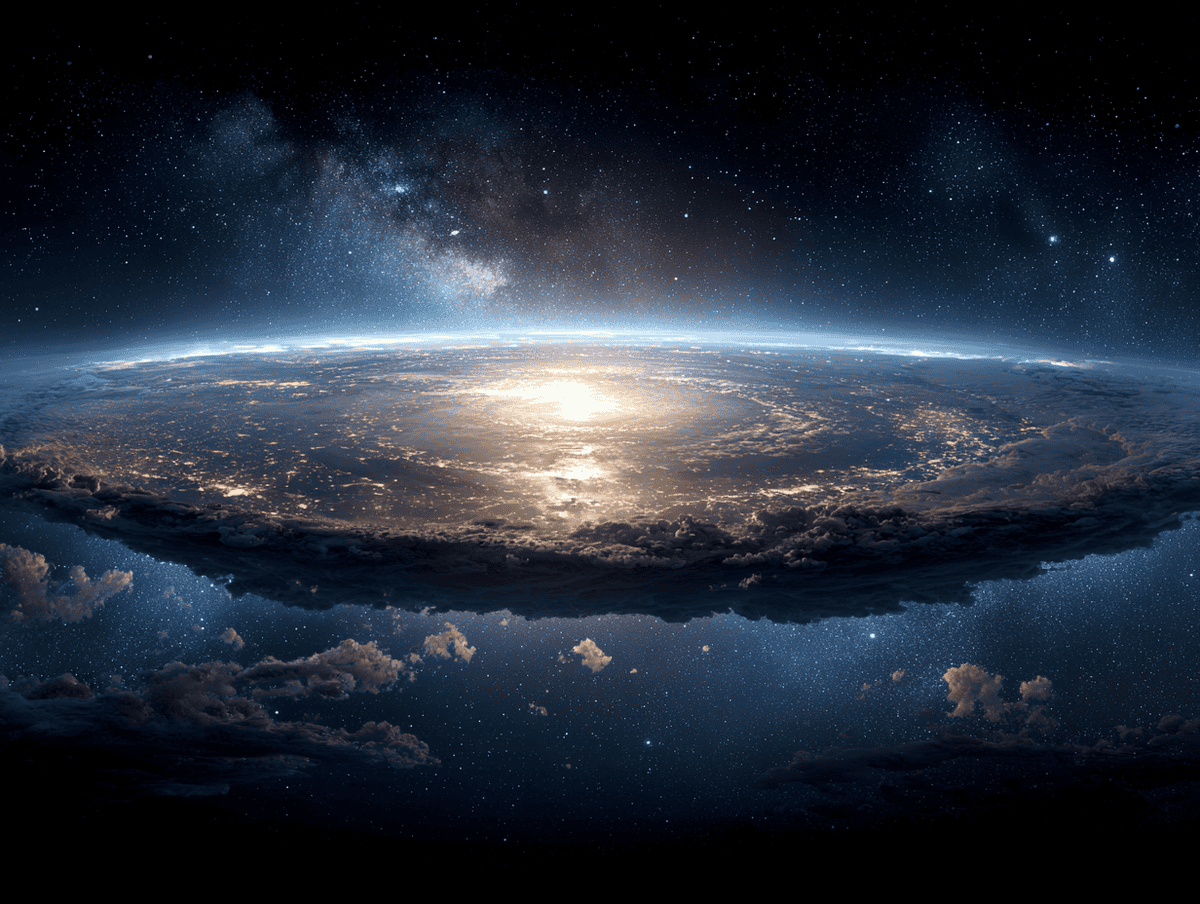
Flat Earth theory often uses conspiracy as an explanation for missing information. Because of this, there is a tendency to assume that the truth about the Earth is being hidden by some kind of coordinated effort between the various elite groups.
This is problematic because a conspiracy cannot be evidence. A theory that relies exclusively upon secrecy to explain contradictions cannot be testable.
An explanation must provide evidence and, therefore, cannot depend upon the assumption that a global conspiracy exists among millions of individuals. When a belief relies solely on the idea of everyone lying, that belief has no scientific proof.
6. Experiments That Don’t Support the Claims
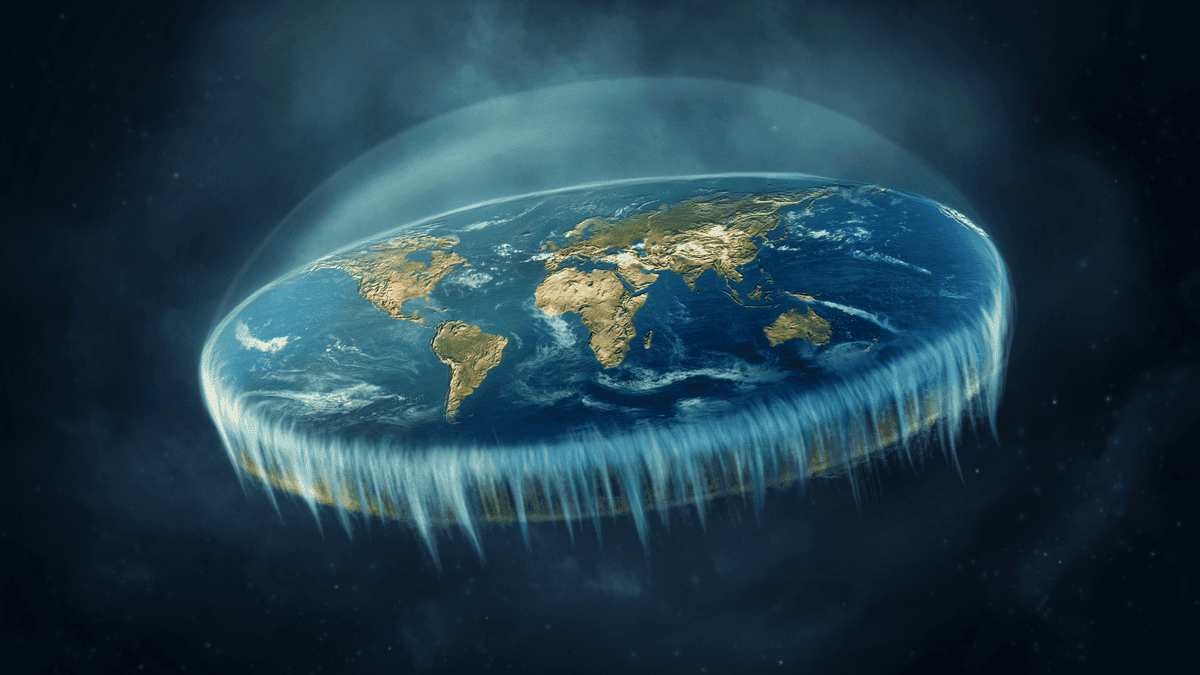
Many Flat Earth advocates conduct experiments in an attempt to validate their theories about the Earth, but many of these tests either ultimately show no correlation with their theory or actually show support for a round Earth.
Most people ignore or reinterpret these tests when the results do not match what they were originally expecting. One of the fundamental aspects of a scientific experiment is to accept whatever conclusion is reached through science, even if it does not support an individual’s belief.
The more tests you perform that demonstrate evidence supporting a spherical Earth, the less credible you become if you continue to discount those findings.
Every scientific theory should evolve as new data is presented. When evidence is only accepted when it fits into someone’s theory, it raises the question of whether that person is being objective.

Born and raised in Bosnia and Herzegovina. Ever since I was a little girl, my imagination knew no bounds. I remember vividly how I’d scribble down short stories, each page bursting with adventures and characters conjured up from the whimsy of my mind. These stories weren’t just for me; they were my way of connecting with my friends, offering them a slice of my fantasy world during our playtimes. The joy and excitement on their faces as we dived into my fictional realms motivated me to keep writing. This early passion for storytelling naturally evolved into my pursuit of writing, turning a childhood hobby into a fulfilling career.