
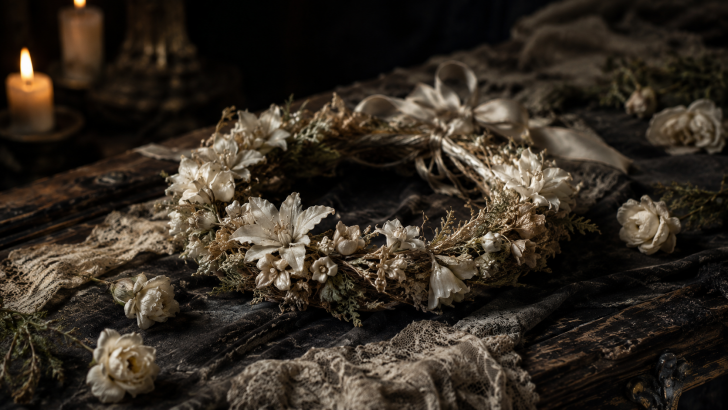
A funeral with a crown sounds like something reserved for a king. But across parts of Europe, ordinary people were once given crowns when they died unmarried.
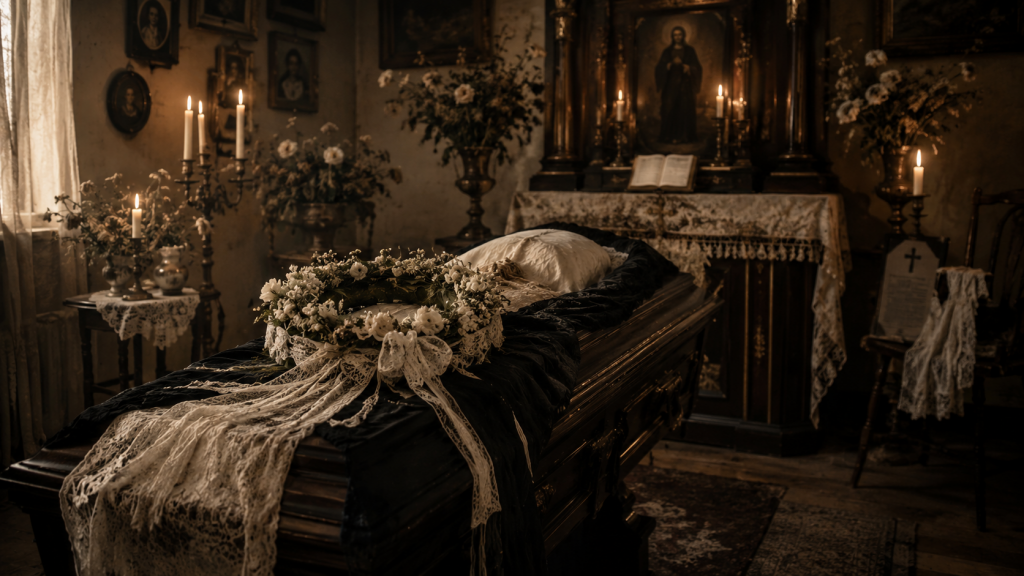
Some were placed on the dead, while others rested on the coffin or were carried in the funeral procession.
The custom could make a burial look strangely similar to a wedding, and that resemblance was very deliberate.
1. The Crown Was Often Reserved for People Who Died Unmarried
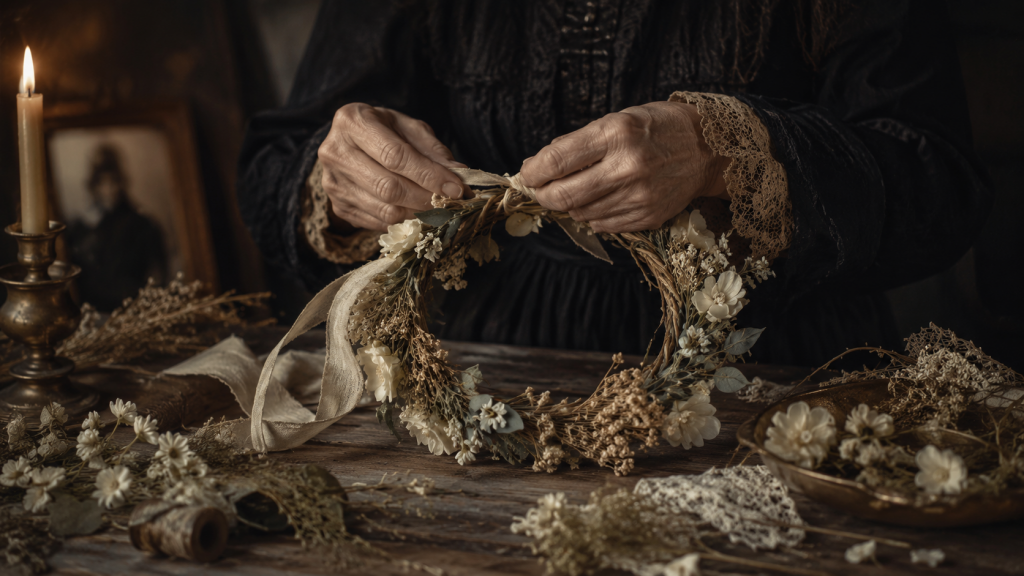
The custom is especially well documented in German-speaking Europe, where the objects became known as Totenkronen, or death crowns.
Archaeological evidence suggests they were being used in Christian burials by the 1500s, and the tradition became particularly visible during the 17th and 18th centuries.
These crowns were commonly associated with unmarried adults.
Children and teenagers could receive them too, while a few local traditions included other people under special circumstances.
The rules were never identical everywhere. In fact, customs could differ considerably between neighboring communities. And Germany wasn’t the only place with something similar.
Funeral crowns and related customs appeared elsewhere in Europe, including parts of Britain.
What connected many of them was the unusual importance placed on dying before marriage.
2. Marriage Was Seen as a Major Stage of a Complete Life
To understand the crown, it helps to forget modern attitudes toward being single for a moment.
In early modern European communities, marriage could mark one of the biggest transitions in a person’s life. It changed someone’s place within the household and the wider community.
A young person who died before reaching that stage had died before completing something society expected to happen.
Researchers have found particularly strong links between death crowns and the crowns or wreaths used during weddings.
The resemblance sometimes went far beyond a general similarity.
Funeral crowns could copy the form and materials of bridal crowns so closely that the connection was obvious.
In other words, the crown gave the deceased something they had never received while alive.
3. The Funeral Could Become the Wedding They Never Had
This is where the tradition becomes especially strange to modern eyes.
Some historians use the German term Totenhochzeit, meaning roughly “death wedding,” for customs that blended funeral and wedding imagery.
The deceased could symbolically receive the bridal or wedding honor that death had prevented them from experiencing in life.
There was also a Christian layer to the tradition.
Some surviving memorial texts describe deceased girls as brides of Christ.
Crowns could also represent virtue and the hope of eternal life, so historians caution against reducing the entire custom to one explanation.
Still, the lost marriage could be stated surprisingly clearly.
One recorded Moravian saying was spoken as a crown was thrown into the grave. In essence, it told the dead person that what had been denied in life was now being given in death.
The funeral was completing an interrupted life story.
4. A Crowned Funeral Could Be an Extraordinary Sight
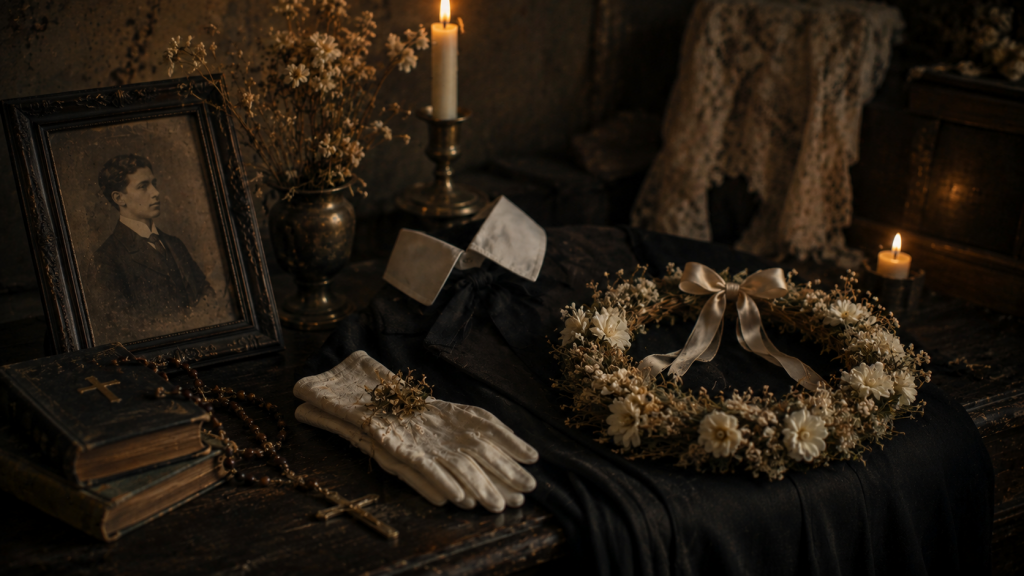
There wasn’t one standard ceremony. In some places, a personal crown was put directly on the head of the deceased. Elsewhere, it might be attached to the cloth covering the coffin.
A crown could also be carried to the grave or displayed on a special cushion.
Some communities borrowed even more from weddings. A decorated structure known as an Ehrenpforte, or gate of honor, could be erected at a cemetery.
Similar decorations were normally connected with weddings, but here they appeared at the burial of someone unmarried.
A remarkable version of the tradition survived in the English village of Abbotts Ann.
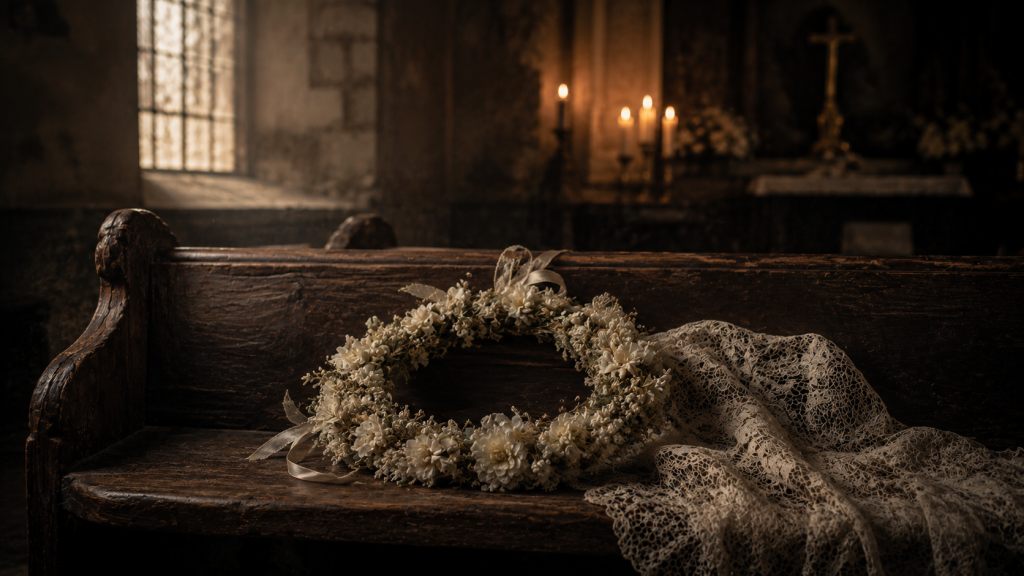
There, a “Virgin’s Crown” was carried in the funeral procession by two young girls dressed in white. The crown was later hung inside the church.
The surviving crowns commemorate both males and females, showing once again that these customs weren’t limited simply to young brides who died before marriage.
5. Some Death Crowns Became Surprisingly Elaborate
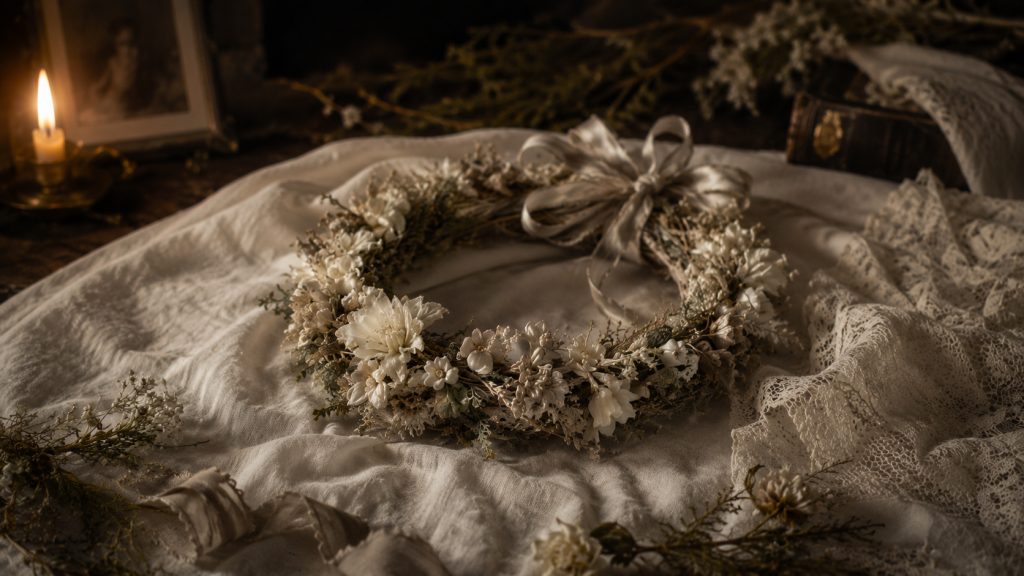
A death crown always look like a simple wreath of flowers.
Surviving examples show remarkable craftsmanship. Some were built around wire frames and decorated with imitation pearls or other ornaments.
Reusable crowns could be made from metal and finished to look far more expensive.
And eventually, expense became a problem.
By the 18th century, authorities in some areas were trying to control how much families spent on funeral displays.
Some families even went into debt trying to provide a suitably impressive death crown.
In 1733, a ruler in Franconia ordered communities or churches to acquire crowns that families could rent for funerals. So a crown might appear at several funerals over its lifetime.
It’s an unexpectedly practical detail behind a ceremony that otherwise seems almost dreamlike.
6. Some Crowns Stayed in the Church After the Funeral
The crown’s story didn’t always end at the grave.
A reusable crown could simply be returned after the burial.
But personal crowns were sometimes brought back to the church and displayed as memorials to the dead.
In the Baroque period, examples were mounted on decorated boards. Later, some were protected inside wooden boxes with glass fronts.
The German town of Kamenz, for example, preserved a particularly large collection of death crowns and related memorial objects.
At Abbotts Ann in England, Virgin’s Crowns still hang high inside St Mary the Virgin. The oldest surviving example there dates to the 18th century.
7. The Tradition Slowly Became Harder to Understand
Death crowns began disappearing from many areas during the 19th century, although the timing varied enormously.
Some were removed during church renovations, while others simply deteriorated.
Certain clergy objected to the decorations filling church interiors, while regulations against lavish funerals had already been attacking the custom for generations.
Changing social attitudes mattered too.
As marriage stopped functioning in quite the same way as a compulsory marker of a completed life, the original logic behind crowning an unmarried corpse became less clear.
In some places, versions of the custom survived surprisingly late.
The surviving crowns now look deeply unusual because the social world that made sense of them has largely disappeared.
But that is precisely what makes them so fascinating.
A crown on a coffin once communicated something people around it could immediately understand.
Someone had died before reaching an important moment in life, and the community was giving that missing moment a place in their funeral.
