
Humans have written most of history, but we have never been the only ones making it. Animals have carried military messages, crossed battlefields, delivered lifesaving medicine, traveled into space, and even helped scientists completely rethink what was possible in biology. Some became famous because of extraordinary circumstances, while others were simply in the right place at the right time — with considerably fewer opportunities to complain about their working conditions.
From a horse that carried one of history’s most famous conquerors to a sheep that changed the future of genetics, these animals left behind stories that sound almost too strange to be true. And unlike many historical legends, several of these tales come with remarkably solid documentation.
1. Bucephalus, the Horse Who Carried Alexander the Great
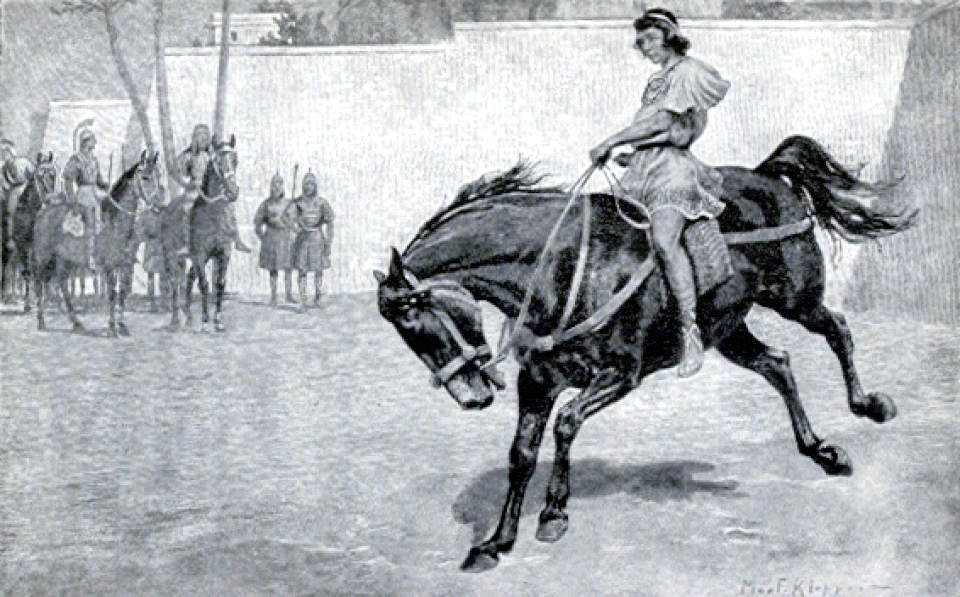
Bucephalus was not exactly the sort of horse you would casually recommend to a beginner. According to ancient accounts, the horse was considered wild and difficult to control when he was presented to Philip II of Macedon, the father of Alexander the Great. The young Alexander supposedly realized that Bucephalus was frightened by his own shadow and managed to calm him by turning him toward the sun. Whether every detail of that famous story is accurate is difficult to establish after more than two millennia, but Bucephalus unquestionably became associated with Alexander and his military campaigns.
Alexander reportedly rode Bucephalus into major battles during his conquests, making the horse an important part of the image of the Macedonian king. Ancient writers claimed that after Bucephalus died, Alexander founded a city named Bucephala in his honor. The horse therefore achieved something most modern pets can only dream about: becoming so important to their owner’s biography that historians still discuss them thousands of years later. Not bad for an animal whose biggest early problem was apparently being a little dramatic about shadows.
2. Hannibal’s Elephants, the Army’s Most Unexpected Tank Unit
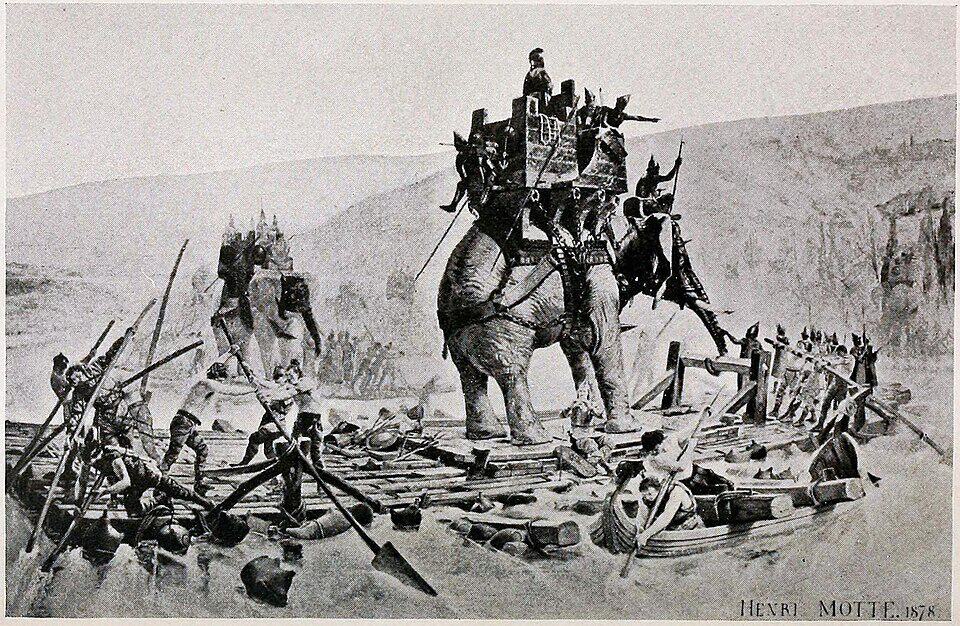
When people picture Hannibal crossing the Alps during the Second Punic War, the elephants are usually the first thing that come to mind. The Carthaginian general famously used war elephants as part of his military forces, and their presence became one of the most memorable elements of his invasion of Italy. Getting elephants across mountainous terrain was an extraordinary logistical challenge, particularly because the Alps were hardly designed with elephant transportation in mind.
The animals were valuable partly because of the psychological effect they could have on opposing armies. Soldiers who had never encountered elephants in battle suddenly had to deal with enormous unfamiliar animals charging toward them. Hannibal’s elephants were not invincible super-weapons, however. Their effectiveness depended on circumstances, terrain, training, and the enemy’s response. Some were lost during the difficult journey, and the surviving elephants did not simply guarantee victory. Still, their role helped make Hannibal’s campaign one of the most remarkable military episodes of the ancient world. Basically, if your invasion plan requires crossing mountains with elephants, you have already committed to making history interesting.
3. Sergeant Stubby, the Dog Who Went to War
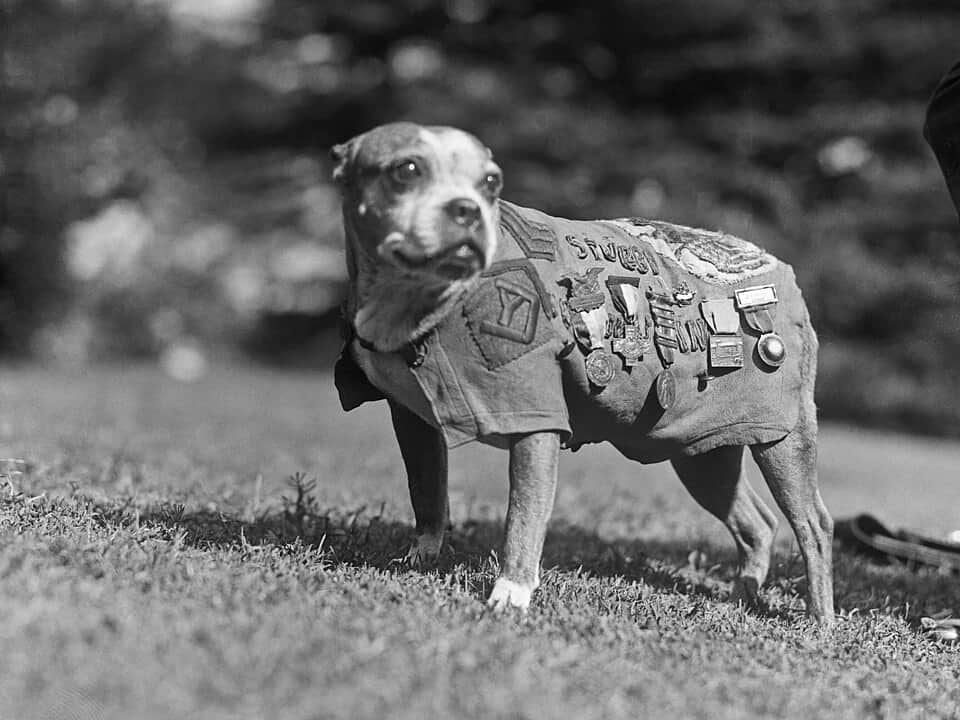
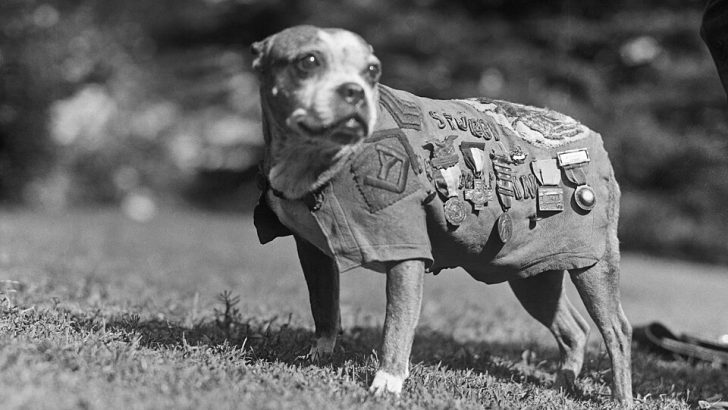
Stubby began his remarkable career as a stray dog who wandered onto the grounds of Yale University while American soldiers were training there during World War I. Private J. Robert Conroy formed a bond with the little brindle dog and eventually smuggled him aboard a troop ship bound for France. Once overseas, Stubby was allowed to remain with the unit and became the mascot of the 102nd Infantry Regiment of the 26th Yankee Division.
Stubby apparently did considerably more than provide emotional support. The Smithsonian records that he became sensitive to poison gas, warning soldiers when attacks were beginning. He was also credited with helping locate wounded soldiers and, during one incident, confronting a German soldier near American lines. Stubby himself was wounded by shrapnel and survived gas exposure. By the end of the war, he had reportedly participated in 17 battles.
After the war, Stubby became a celebrity, met American presidents, and eventually became the mascot of Georgetown University’s sports teams. His story is extraordinary partly because he was never a traditionally trained military dog. He was essentially a stray who wandered into a training camp and decided that the army was his new family. History, apparently, occasionally runs on vibes.
4. Cher Ami, the Pigeon Who Carried a Message Through a Battlefield
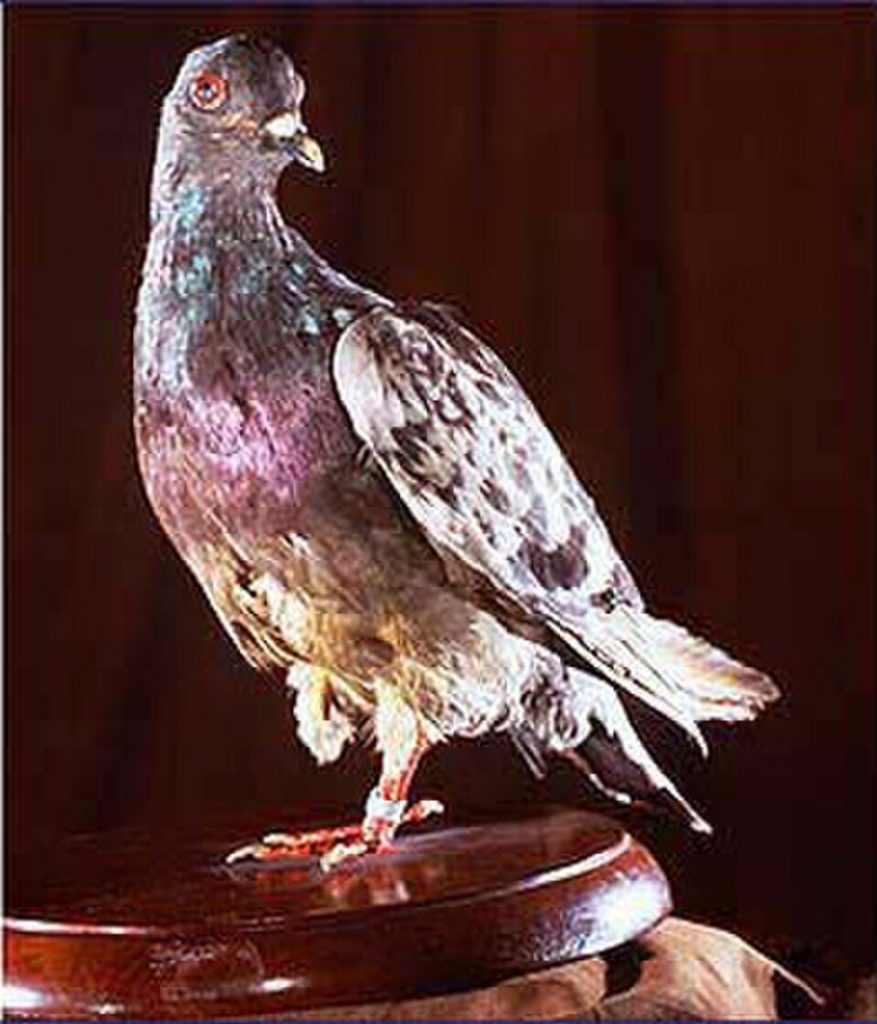
Pigeons were once important military messengers, particularly when telephone lines and human couriers could be disrupted by artillery fire. One of the most famous was Cher Ami, a homing pigeon who served with the U.S. Army Signal Corps in France during World War I. Cher Ami is associated with a famous October 4, 1918 message from soldiers of the so-called Lost Battalion, who had become trapped and were accidentally being shelled by their own artillery.
The bird reached its destination despite suffering devastating injuries. Historical records indicate that Cher Ami had been shot or struck by shrapnel, losing a leg and suffering a serious chest wound. The message he carried helped communicate the soldiers’ position and contributed to efforts to stop the friendly artillery fire and locate the trapped troops. The Smithsonian notes, however, that some elements of the popular Cher Ami story became tangled with later legend, and surviving military records cannot definitively prove every detail traditionally attributed to him.
Cher Ami survived the war but died in 1919 from his injuries. His preserved body was eventually displayed at the Smithsonian. More than a century later, DNA analysis even settled a bizarre historical question: Cher Ami was male, despite conflicting descriptions in old records.
5. Balto, the Sled Dog Who Became a Legend
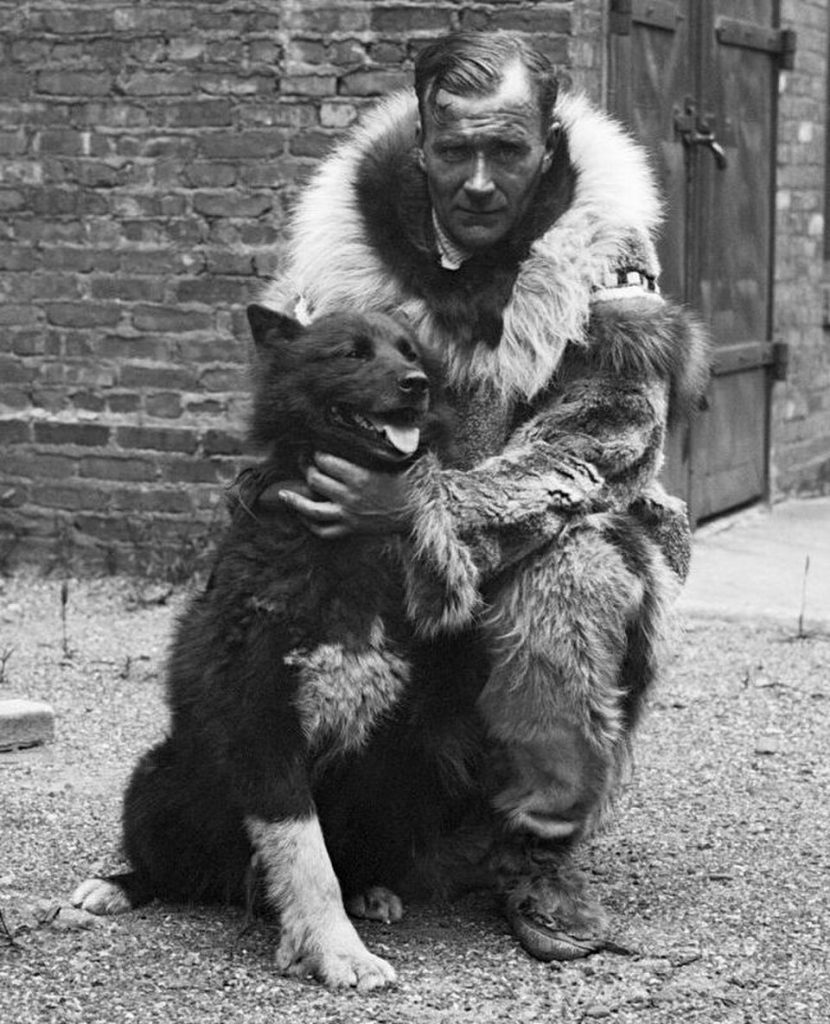
In January 1925, an outbreak of diphtheria threatened the people of Nome, Alaska. Getting medicine there was an enormous problem because winter conditions had made normal transportation extremely difficult. The solution involved a relay of sled dog teams carrying desperately needed diphtheria antitoxin across roughly 700 miles from Nenana to Nome. Twenty teams completed the journey in a little over five days.
Balto became the most famous dog associated with the run because he was the lead dog on the final team, driven by musher Gunnar Kaasen, that arrived in Nome with the serum. His role turned him into an international celebrity. Photographs, newspaper stories and public appearances transformed Balto into one of the most famous working dogs of the era.
There is an important wrinkle to the story, though: another sled dog named Togo, who worked with musher Leonhard Seppala, led the team covering the longest and particularly difficult portion of the relay. The entire operation depended on numerous dogs and mushers, not one canine superhero. Still, Balto’s name became inseparable from the event. He essentially became the canine equivalent of being the person who scores the final point in a team effort — suddenly everyone knows your name, even though you absolutely did not do the whole thing alone.
6. Laika, the Dog Who Became the First Animal to Orbit Earth
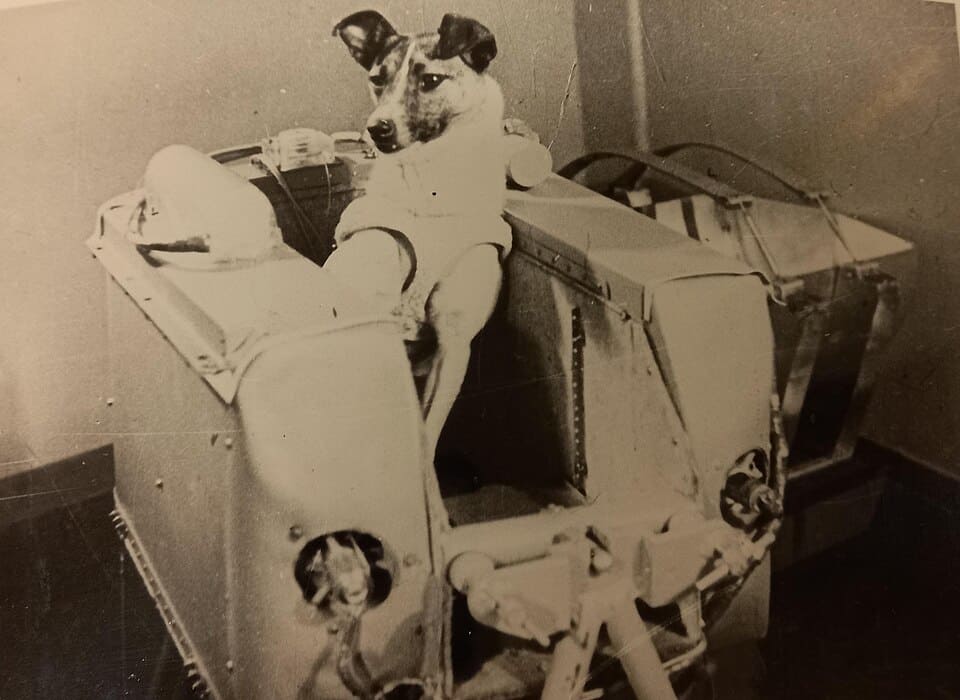
Laika became one of the most famous animals in the history of space exploration when the Soviet Union launched her aboard Sputnik 2 on November 3, 1957. She was the first animal to orbit Earth, making her mission an important milestone in the development of human spaceflight.
Her story is also a tragic one. Sputnik 2 was developed extremely quickly, and engineers had not created a system that could return Laika safely to Earth. NASA’s historical account notes that the spacecraft’s environmental-control system was not designed for a lengthy mission and that Laika likely survived only for a few hours after reaching orbit. The satellite itself remained in orbit until it eventually burned up during reentry in 1958.
Laika’s mission demonstrated both the possibilities and the ethical costs of early space exploration. She did not return home, but her flight contributed to knowledge that influenced later missions involving animals and eventually humans. Unlike the Hollywood version of space exploration, there was no dramatic rescue at the last minute. There was simply a small dog inside an enormous technological experiment that changed history — and a legacy that remains complicated more than half a century later.
7. Ham, the Chimpanzee Who Helped Prepare Humans for Space
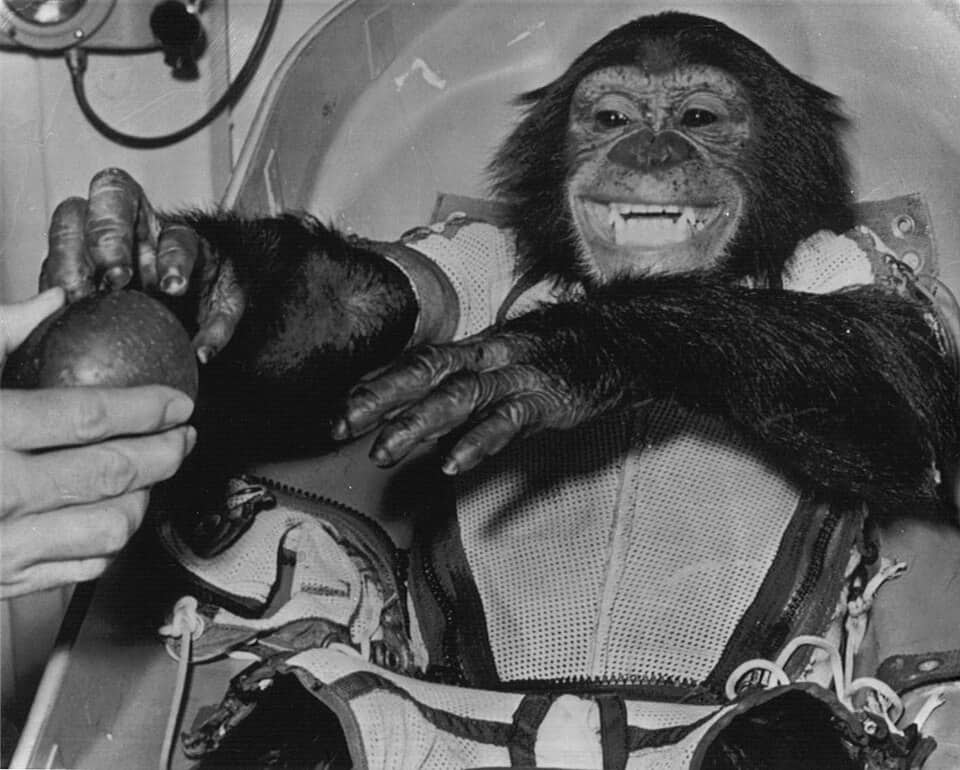
Before humans began flying into space, scientists needed to know whether living creatures could survive the experience and perform tasks during flight. Enter Ham, a chimpanzee who became the first great ape in space when he launched aboard Mercury-Redstone 2 on January 31, 1961.
Ham had been trained to perform tasks by pulling levers in response to signals. His mission wasn’t simply a matter of putting a chimpanzee into a rocket and hoping for the best. Researchers wanted to determine whether an animal could continue responding to instructions while experiencing the strange conditions of spaceflight. During the flight, Ham experienced about 6.6 minutes of weightlessness during a mission lasting roughly 16.5 minutes. He survived the flight and was found to be in generally good condition, aside from fatigue and dehydration.
Just over three months later, Alan Shepard became the first American human in space. NASA’s historical records describe Ham’s mission as an important precursor to Shepard’s flight.
Ham eventually lived for many years after his spaceflight. He may have been the only astronaut whose pre-launch training involved banana pellets and avoiding mild electric shocks. Not exactly the standard astronaut résumé, but certainly memorable.
8. Dolly the Sheep, the Animal That Changed Genetics Forever
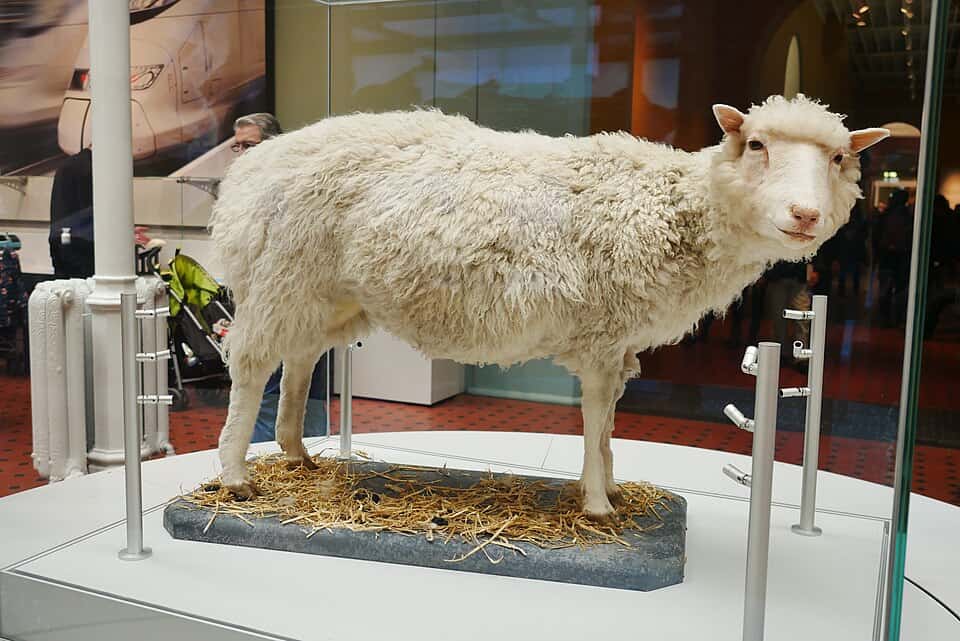
Dolly was born in Scotland in 1996 and became famous in 1997 when researchers announced that she had been successfully cloned from an adult cell. She was the first mammal successfully cloned from a differentiated adult cell, a scientific achievement that challenged assumptions about how specialized cells work.
The science behind Dolly was remarkably sophisticated. Researchers used a technique called somatic cell nuclear transfer, taking the nucleus from an adult mammary-gland cell and transferring it into an egg cell whose nucleus had been removed. Dolly’s existence demonstrated that genetic material from a mature, specialized cell could be reprogrammed to direct the development of an entire animal. Later genetic analysis confirmed that Dolly was indeed derived from the adult donor cell used in the cloning process.
Her birth triggered enormous public debate about cloning, biotechnology and the possibility of cloning other mammals — including humans. Much of the media coverage immediately jumped toward futuristic scenarios, but Dolly’s actual scientific importance was more fundamental: she showed researchers that adult cells retained genetic information capable of producing an entire organism when appropriately reprogrammed. In other words, Dolly did not just become famous for being a clone. She became a biological proof-of-concept with a woolly coat.

Lover of good music, reading, astrology and making memories with friends and spreading positive vibes! 🎶✨I aim to inspire others to find meaning and purpose through a deeper understanding of the universe’s energies.