
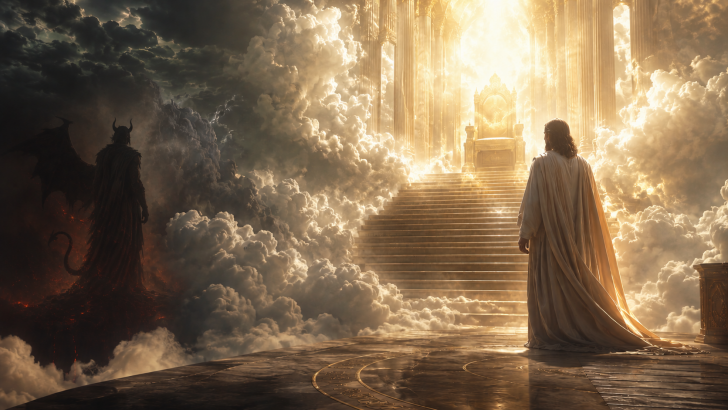
Why did God allow Satan to continue existing after his rebellion? It is one of the most challenging questions many people encounter when reading the Bible.
If God is all-powerful and Satan rebelled against Him, why was Satan not immediately removed?
While Scripture does not provide a single direct answer, it offers several themes that help explain why Satan’s existence continues for a time within God’s larger plan.
The Bible consistently teaches that God remains sovereign and that Satan operates only within limits established by God.
Many theologians have reflected on this question for centuries, drawing insights from passages throughout both the Old and New Testaments.
Here are five important reasons often discussed when exploring why God allowed Satan to exist after his rebellion.
1. To Preserve Genuine Free Will

One common explanation involves the gift of free will. The Bible presents angels and humans as beings capable of making meaningful choices.
Satan’s rebellion demonstrates that created beings can choose to reject God’s will.
If every possibility of rebellion were instantly removed, some argue that genuine freedom would no longer exist in the same way.
Throughout Scripture, God allows individuals to make real choices, even when those choices are wrong. This principle appears repeatedly in human history as well.
People are given opportunities to obey or disobey, trust or reject, follow truth or pursue deception.
Satan’s continued existence serves as a reminder that love and obedience have meaning because they are freely chosen rather than forced.
A world where obedience could never be rejected would look very different from the one described in Scripture.
The Bible repeatedly presents God inviting willing faithfulness rather than demanding robotic compliance from His creation.
2. To Demonstrate the Consequences of Rebellion

The Bible often shows that actions have consequences. Satan’s story becomes a powerful example of what happens when pride and rebellion lead a created being away from God.
Rather than immediately erasing every trace of rebellion, Scripture presents its results unfolding over time.
This allows both angels and humanity to witness the destructive effects of rejecting God’s authority.
Throughout biblical history, pride repeatedly appears as a dangerous temptation. Satan’s downfall serves as one of the clearest examples.
His story illustrates that turning away from God does not lead to greater freedom but ultimately leads to separation, corruption, and judgment.
In this sense, Satan’s existence functions as an ongoing warning about the consequences of rebellion.
The lesson extends far beyond one fallen being. Scripture repeatedly shows how pride can influence nations, rulers, and ordinary people.
3. To Test and Strengthen Faith

Another theme found throughout Scripture is that faith often grows through testing.
The Bible describes believers facing trials, temptations, and spiritual challenges.
While these experiences can be difficult, they frequently become opportunities for growth and deeper trust in God.
The book of Job provides a well-known example. There, Satan is permitted to test Job, but only within limits established by God.
The story emphasizes that God remains in control even when believers face hardship.
Many theologians believe that spiritual opposition can help strengthen faith, perseverance, wisdom, and dependence on God.
Difficult circumstances often reveal the depth of a person’s trust and character.
Just as muscles grow stronger through resistance, many biblical writers describe faith developing through challenges.
Seasons of struggle can deepen spiritual maturity and teach lessons that are difficult to learn during comfort.
4. To Display God’s Justice and Mercy

Scripture frequently emphasizes both God’s justice and His mercy.
Rather than bringing immediate final judgment upon all rebellion, God allows history to unfold according to His purposes.
This period provides opportunities for repentance, redemption, and salvation.
Throughout the Bible, God repeatedly shows patience toward people who have turned away from Him.
His desire is often described as giving individuals time to repent and return.
The continued existence of evil highlights the contrast between God’s goodness and humanity’s need for redemption.
Many Christians believe that God’s plan ultimately demonstrates His justice against evil while also revealing extraordinary mercy toward those who seek Him.
The Bible often portrays God as patient even when humanity repeatedly fails.
This patience allows the story of redemption to unfold and gives people opportunities to respond to His grace and forgiveness.
5. To Fulfill God’s Ultimate Plan and Final Victory

The Bible teaches that Satan’s existence is temporary, not permanent.
Numerous passages describe a future time when evil will be fully defeated, and God’s kingdom will be completely established.
Until that moment, history continues moving toward God’s intended conclusion.
Scripture consistently presents God as sovereign over all creation.
Even when evil appears powerful, it never operates outside God’s ultimate authority.
The final chapters of the biblical story point toward complete restoration, justice, and victory over sin and evil.
Many theologians believe Satan’s continued existence serves a role within that larger story, ultimately highlighting God’s power, wisdom, and triumph.
The Bible repeatedly assures believers that evil does not have the final word. From Genesis to Revelation, Scripture presents a story moving toward restoration.
The eventual defeat of evil highlights God’s authority and reinforces the biblical promise that darkness will not prevail forever.

I always felt a strong connection to the Divine since my birth. As an author and mentor, my mission is to help others find love, happiness, and inner strength in the darkest of times.