
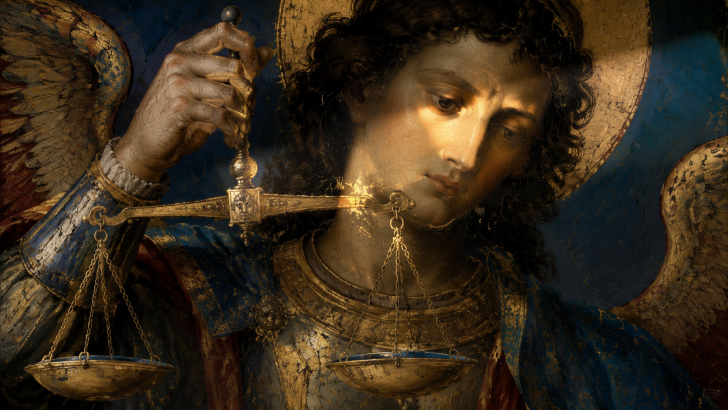
Michael is usually easy to recognize by his armor, wings, sword, and the dragon underfoot.
But in some of the most haunting Christian artworks, the sword isn’t his only weapon.
He’s also holding a small set of scales.
1. The Scales Weigh Souls, Not Gold
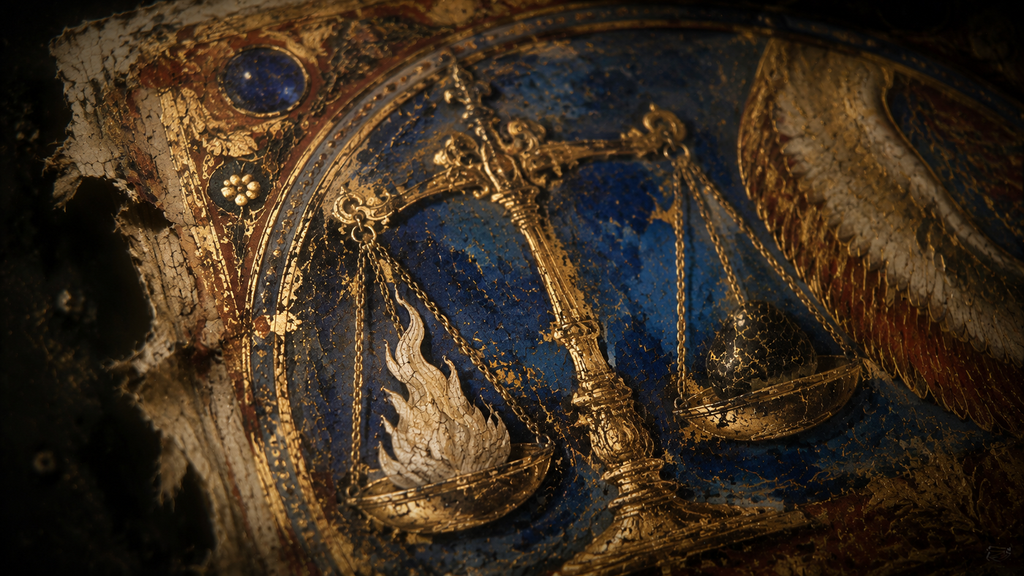
First, the scales are a picture of judgment.
In Western Christian art, the scene is often called psychostasis, a Greek word for the weighing of souls.
Michael holds the dead in the moment when their earthly story is being measured.
The pans don’t always contain the same thing. In one painting, you might see a tiny human figure in each pan. In another, the figures stand for virtues and sins.
Often, the lower pan represents the condemned soul, while the lighter one rises toward salvation.
Michael is frequently shown weighing souls at the Last Judgment, sometimes with tiny figures representing the dead inside the pans.
And notice how physical the idea becomes. Invisible qualities—mercy, cruelty, faith, selfishness—are turned into a balance you can actually see.
2. The Bible Gives Michael a Battle
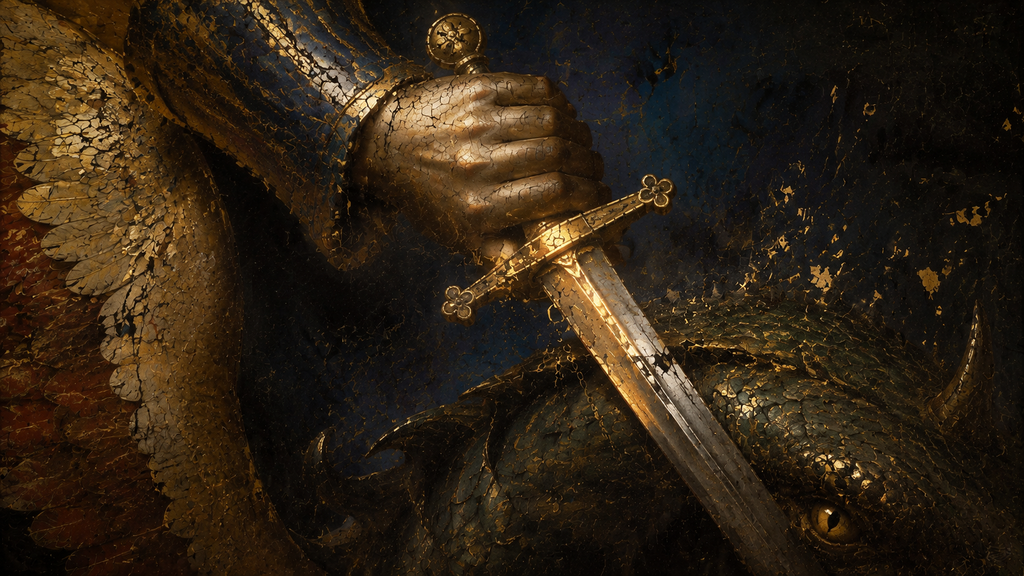
The Bible never explicitly says Michael weighs souls.
In Daniel, he appears as a great prince who protects God’s people. In Revelation, he leads the angels into battle against the dragon.
Those are the scenes that gave artists their warrior Michael.
The Book of Daniel presents Michael as a protector, while Revelation describes him fighting the forces of evil.
The biblical Michael is a defender, commander, and rescuer. The weighing role came later, through Christian interpretation, funeral traditions, sermons, and art.
Neither the Bible nor early Christian writings directly connect Michael with weighing souls, even though weighing was already being used as a metaphor for divine judgment.
But the connection made sense.
If Michael could fight evil in heaven, protect people in crisis, and stand against the devil, he could also be imagined as the one guarding a soul at the most frightening threshold of all: death.
3. The Idea Was Older Than Christianity
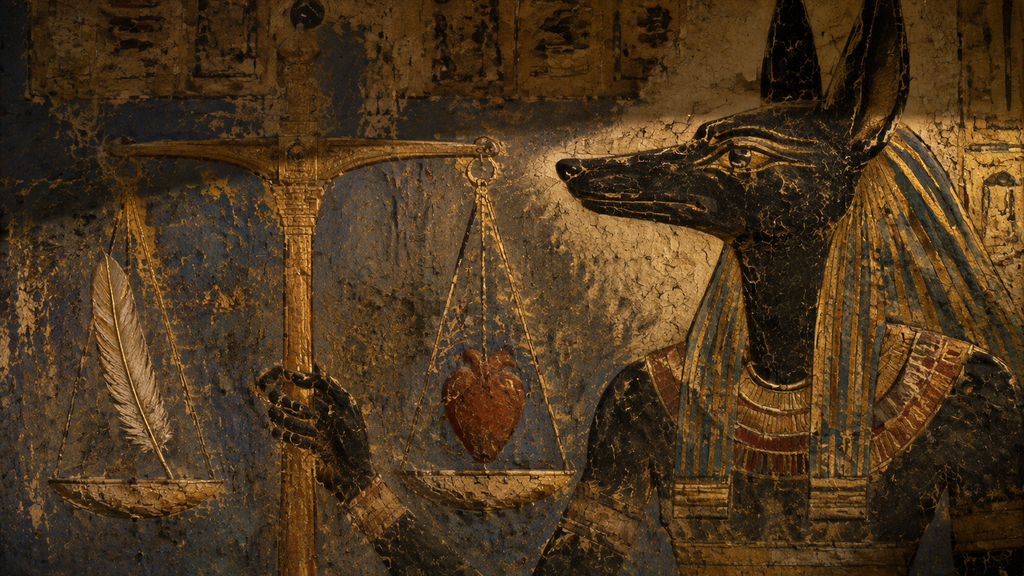
In ancient Egyptian funerary art, Anubis appears beside a balance while a dead person’s heart is weighed against Maat, the principle of truth, justice, and cosmic order.
A surviving Book of the Dead papyrus at the Metropolitan Museum shows the scene in remarkable detail. Anubis watches the scales, Thoth records the result, and Osiris waits as judge.
Both figures stand beside a set of scales. Both operate at the border between life and whatever comes after. And both turn moral judgment into an image of weight.
Still, historians don’t agree on one direct line of transmission. Some see older traditions influencing Christian art, while others think the scales developed from the Christian idea of divine justice itself.
So there probably isn’t one simple answer.
The symbol may have traveled across cultures, changed shape, and eventually found a new guardian.
4. Medieval Artists Gave Michael a New Job
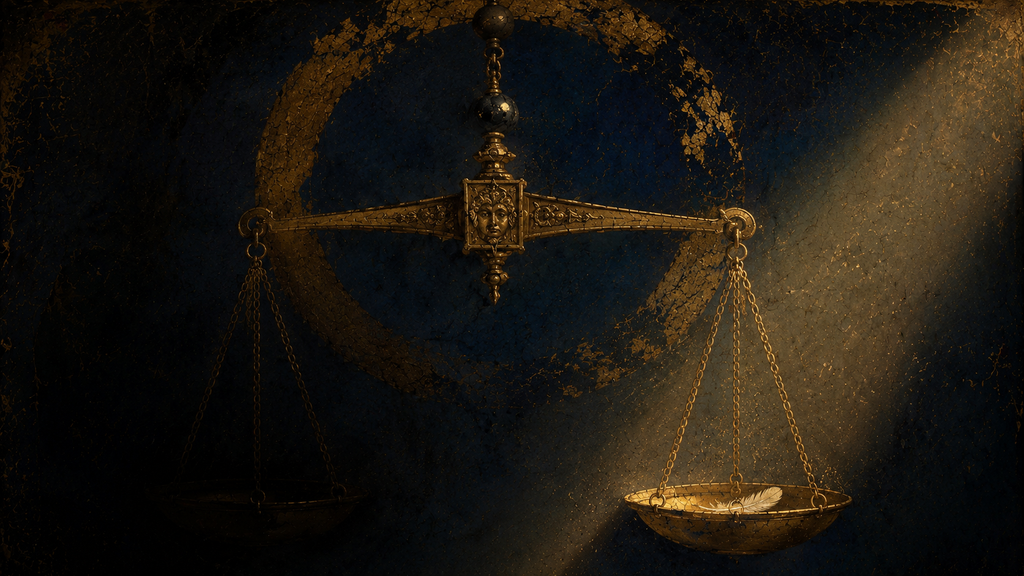
By the early Middle Ages, Michael had become more than the angel who defeated the dragon.
He was also a protector of the dying and a guide for souls leaving the body.
One of the earliest surviving images of Michael with scales appears on the tenth-century Muiredach’s Cross in Ireland.
By the twelfth and thirteenth centuries, the image had become much more common in Western Christian art.
Michael gradually became associated with the scales, the afterlife, and the role of a guide for souls.
The image appeared in Last Judgment scenes, church sculpture, manuscript pages, and paintings meant to be seen by people thinking about death.
Medieval churches weren’t only places to worship. They were also places where people confronted illness, funerals, burial, and the possibility of judgment.
Michael’s balance gave all of that a face—and a name.
5. The Devil Is Usually Trying to Cheat
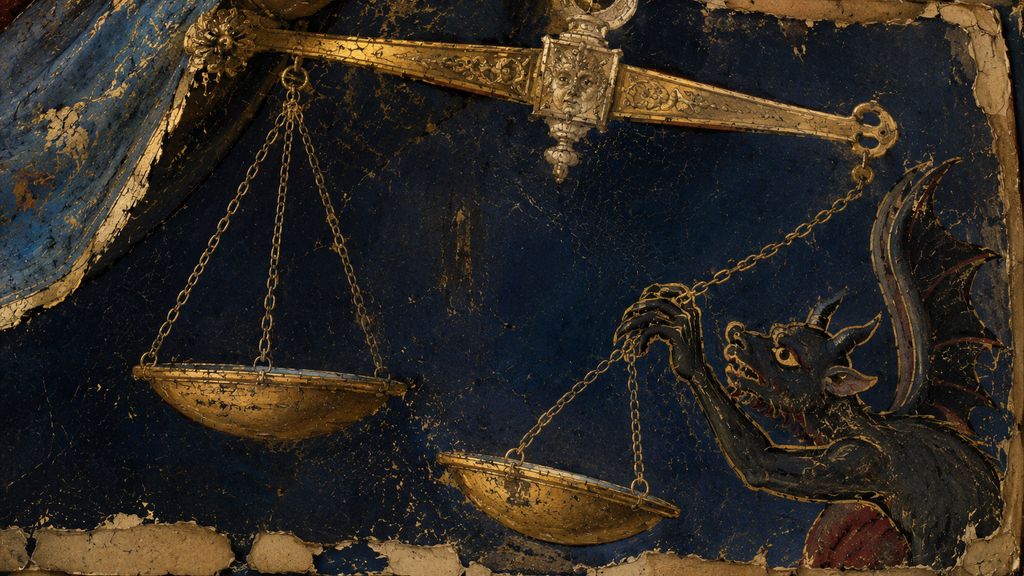
Look closely at medieval versions of the scene and you’ll often find the devil crouched beneath the scales, pulling at a chain or trying to drag one pan down.
Michael’s purpose is to stop evil from tampering with them.
Without the devil, the image would be a calm lesson about fairness. With him, judgment becomes a struggle. The soul isn’t just being measured. Something is trying to steal it.
Michael’s sword and scales work as a pair. The sword represents his victory over evil, while the balance represents the justice he protects.
And the scales aren’t always perfectly neutral. Some artists tilt them dramatically, making you stare at the result and wonder which way the unseen weight will fall.
6. Michael Isn’t the Final Judge
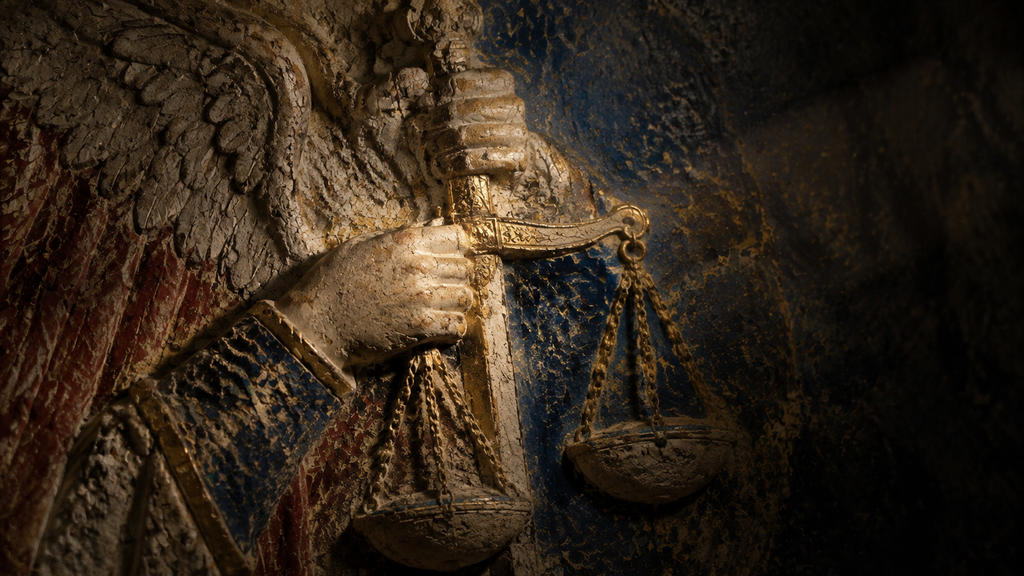
Michael may hold the balance, but he isn’t replacing Christ.
In the classic Last Judgment, Christ remains the central judge. Michael appears below or near him as the heavenly agent who carries out—or visually explains—the sorting of souls.
So the balance isn’t a picture of Michael making an independent decision.
It’s a way of showing divine judgment in action. Christ is the source of the verdict, while Michael is the figure who brings that verdict into the visible world.
That also explains why artists liked placing him between heaven and earth.
He could look upward toward the judge and downward toward the souls. One hand in the realm of divine authority. The other near the dead.
7. The Scales Were Meant to Frighten You—and Comfort You
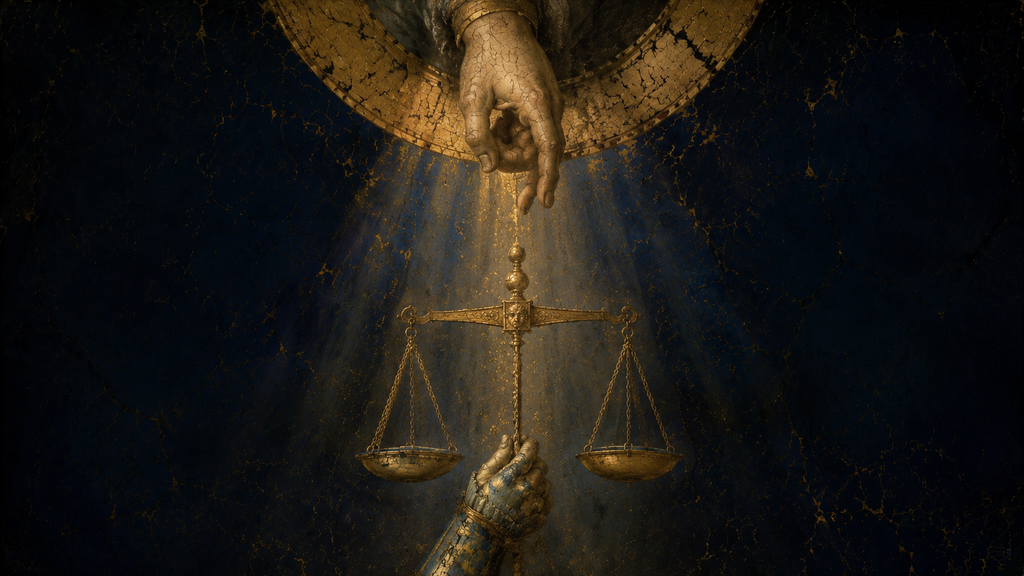
To modern eyes, the idea can sound like a simple judgment, with good deeds on one side, bad deeds on the other, and Michael waiting to see which way the balance tips.
But medieval artists were compressing a huge religious idea into one unforgettable object.
The scales said that your choices mattered.
The sword said evil wouldn’t be allowed to rig the result.
And Michael’s presence suggested that the final moment, terrifying as it was, wouldn’t be abandoned to chaos.
That’s why the image still works. You don’t have to share every medieval belief to feel its power. The scale shows that every life has meaning and every choice matters.
And for a figure usually shown in the middle of battle, that’s what makes the scales so powerful.
Michael isn’t only fighting for heaven. He’s standing beside the soul, making sure the truth can be seen.
