

Love was never a simple emotion in Greek mythology. Love also had a darker side.
It could inspire extraordinary courage, bring gods and mortals together, and create bonds powerful enough to challenge death itself.
Some mythological figures became so consumed by desire that they ignored warnings, betrayed their families, or tried to control the people they claimed to adore.
Others confused admiration with possession and refused to accept rejection.
The ancient Greeks understood that powerful emotions could become dangerous when they overwhelmed reason.
Eros, the god of desire, could influence even the immortals.
Aphrodite could awaken passions that changed entire kingdoms, while jealous gods and desperate lovers sometimes brought suffering upon those closest to them.
These stories reveal what happens when affection becomes possessiveness, longing turns into desperation, and desire becomes more important than another person’s freedom.
Here are ten dark Greek myths about love that turned into obsession.
1. Apollo and Daphne: When Love Became a Relentless Pursuit

Apollo was one of the most admired gods of Olympus.
He represented music, prophecy, healing, and the brilliant light of the sun in later traditions.
Yet even Apollo could lose control when desire entered his heart.
According to Ovid’s famous retelling, the trouble began when Apollo mocked Eros for carrying a bow.
Offended by the insult, Eros decided to demonstrate his power.
He struck Apollo with a golden arrow that awakened overwhelming love.
Daphne, a beautiful nymph devoted to her independence, received a different arrow that made her reject romantic attachment.
Apollo became fascinated with Daphne and began pursuing her.
He praised his divine powers and promised her extraordinary things.
But Daphne wanted nothing from him. She fled through the forest, desperate to escape his attention.
When Apollo continued following her, Daphne called upon her father, the river god Peneus, for help.
Her body transformed into a laurel tree. Apollo could no longer claim her as his beloved, but he declared the laurel sacred to him.
The myth reveals the disturbing difference between love and obsession.
Apollo believed his feelings justified his pursuit. Daphne’s wishes mattered far less to him than his own desire.
Her transformation became the only way to escape.
The laurel later became associated with Apollo, but its origin in this story carries a darker meaning.
It represents a woman whose freedom mattered more than the affection of a powerful god.
2. Narcissus and Echo: The Tragedy of Loving Someone Who Cannot Love You Back

Narcissus was a beautiful young man whose appearance attracted admiration wherever he went.
Many people fell in love with him. But Narcissus rejected their affection.
Among those who suffered was Echo, a mountain nymph who had been cursed by Hera.
Echo could no longer begin conversations freely. She could only repeat the final words spoken by others.
When she saw Narcissus wandering through the forest, she fell deeply in love.
She followed him, hoping for an opportunity to reveal her feelings.
But her curse made communication almost impossible.
When Echo finally approached him, Narcissus rejected her.
Heartbroken, she withdrew into lonely places until only her voice remained.
The story did not end there. Narcissus eventually encountered his own reflection in a pool of water.
Unable to recognize the image as himself, he became captivated by its beauty.
He could not look away. Every attempt to embrace the reflection failed.
His longing became an obsession with something he could never possess.
The myth presents two painful forms of unreturned love.
Echo devoted herself to someone who did not want her.
Narcissus became consumed by an image incapable of returning his affection.
Both were trapped by desire. Their story reminds us that love cannot survive through admiration alone.
It requires recognition, mutual affection, and the freedom to accept another person’s feelings.
3. Medea and Jason: When Betrayed Love Became Revenge

Medea was a powerful sorceress and the daughter of King Aeëtes of Colchis.
Her life changed when Jason arrived seeking the Golden Fleece.
With divine influence contributing to her feelings, Medea fell deeply in love with the Greek hero.
She helped Jason complete the dangerous tasks required to obtain the fleece.
Her magical knowledge protected him from extraordinary threats.
But helping Jason came at a terrible personal cost. Medea abandoned her homeland and broke ties with her family.
She placed her future in Jason’s hands. For a time, they lived together and raised a family.
Then Jason decided to marry Glauce, the daughter of the king of Corinth.
He hoped the marriage would improve his political position.
For Medea, the betrayal destroyed everything she believed they had built.
In Euripides’ tragedy, her grief and anger grow into a devastating desire for revenge.
She becomes determined to punish Jason, regardless of the consequences.
Her actions destroy the family she once struggled to protect.
Medea’s story is among the darkest portrayals of love in Greek literature.
Her devotion begins with extraordinary sacrifice. But when that devotion is betrayed, it becomes inseparable from rage.
The tragedy reveals how dangerous love can become when someone allows betrayal to consume their entire identity.
Medea refuses to remain powerless. Yet the revenge she chooses brings destruction rather than peace.
4. Phaedra and Hippolytus: The Forbidden Desire That Destroyed a Family

Phaedra was the wife of Theseus, the legendary king of Athens.
Her life became tragic when she developed an overwhelming attraction to Hippolytus, Theseus’s son from an earlier relationship.
Hippolytus was devoted to Artemis and rejected the romantic and sexual world associated with Aphrodite.
His devotion angered the goddess of love. Phaedra struggles against her feelings.
She understands that her desire threatens her marriage, reputation, and family.
For a time, she tries to keep the secret hidden. But the situation becomes impossible to control.
When Hippolytus learns of her feelings, he rejects the idea of a relationship. Phaedra fears the shame that may follow.
The tragedy develops through secrecy, accusations, and terrible misunderstandings.
Theseus eventually believes that Hippolytus has wronged his wife.
His anger leads him to call upon Poseidon for punishment. The consequences are devastating.
This myth shows how obsession can become destructive even when the person experiencing it recognizes the danger.
Phaedra does not celebrate her feelings. She fears them.
But divine interference, shame, and the inability to communicate honestly turn the situation into a family tragedy.
Her story is a warning about desire that grows stronger than judgment.
5. Hades and Persephone: When Desire Became Possession

The story of Hades and Persephone is one of the most famous relationships in Greek mythology.
Persephone was the daughter of Demeter, the goddess of agriculture.
She spent her early life among flowers and fertile landscapes.
But Hades, the ruler of the Underworld, desired her as his queen.
In the Homeric Hymn to Demeter, Zeus allows Hades to take Persephone without her mother’s knowledge.
While Persephone gathers flowers, the earth opens, and Hades carries her into his kingdom.
Demeter searches for her daughter and refuses to restore the earth’s fertility while Persephone remains missing.
The consequences spread across the mortal world.
Eventually, an agreement allows Persephone to return to her mother for part of the year.
But because she has eaten pomegranate seeds in the Underworld, she must also spend part of her existence with Hades.
Later interpretations sometimes portray Hades and Persephone as a devoted royal couple.
Yet the ancient hymn begins with abduction and the denial of Persephone’s choice.
Hades desires a wife and uses his divine authority to obtain one.
Demeter’s grief reveals the suffering caused by that decision.
The myth explores the difference between having power over someone and receiving their willing affection.
Persephone eventually becomes an important queen of the Underworld.
But her original journey begins with a desire that ignores her freedom.
6. Selene and Endymion: The Goddess Who Wanted Love to Remain Frozen in Time

Selene was the Greek goddess of the Moon. Each night, she traveled across the heavens, illuminating the world below.
According to several ancient traditions, she fell in love with Endymion, a beautiful mortal associated with Mount Latmos.
Their story became famous for its connection with eternal sleep.
Endymion was said to remain in an extraordinary sleeping state, preserving his youthful beauty.
Different ancient accounts explain this condition in different ways. Some connect it with a divine gift or choice.
Others emphasize Selene’s visits to her sleeping beloved. The image is haunting.
A goddess who moves endlessly through the night returns to a man who never grows older.
His beauty remains unchanged. But ordinary human life cannot continue in the same way.
The story raises an unsettling question. What happens when someone wants love to remain exactly as it was at the beginning?
Selene’s devotion is often portrayed romantically.
Yet the eternal stillness surrounding Endymion gives the myth a darker quality.
Real relationships change as people grow, age, and experience new things.
Endymion’s unchanging beauty represents the dream of preserving a perfect moment forever.
Selene’s story shows how the desire to prevent change can become inseparable from the fear of losing someone.
7. Zeus and Io: The Desire That Turned a Woman’s Life Upside Down
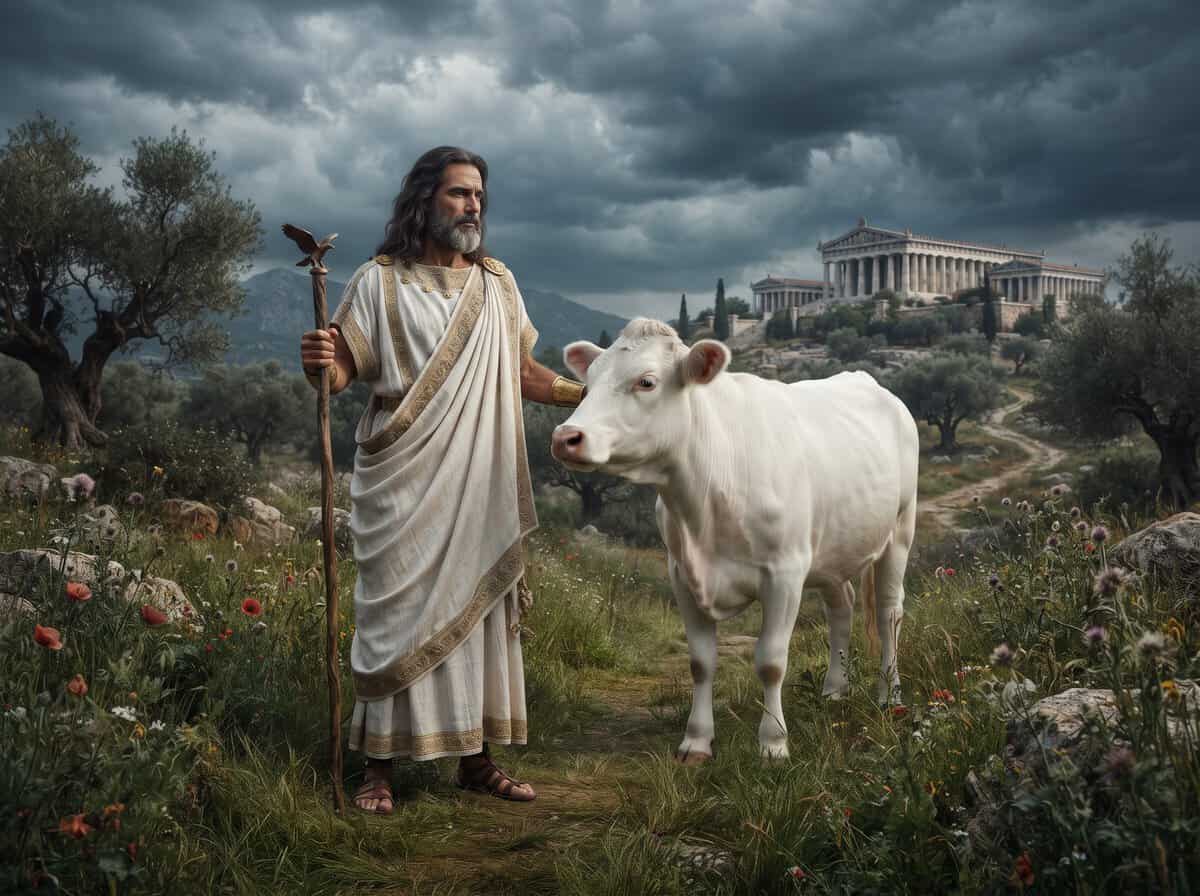
Zeus was notorious for pursuing women who attracted his attention.
One of the most troubling stories involves Io, a young woman associated with the goddess Hera.
Zeus became attracted to Io and sought a relationship with her. But his desire placed her in danger.
Hera, Zeus’s wife, was deeply suspicious of his behavior.
In one famous version, Zeus transforms Io into a white heifer in an attempt to conceal her identity.
The transformation does not protect her from Hera’s attention.
Hera demands the animal and places Io under the watch of Argus, a guardian with many eyes.
Even after Argus is removed, Io’s suffering continues.
She is forced to wander across distant lands, unable to return to her former life.
Her journey becomes one of the most memorable examples of a mortal suffering because of divine desire.
Zeus possesses enormous power. But Io has little control over what happens to her.
The myth reveals how obsession becomes especially dangerous when one person holds far more power than another.
Zeus’s attraction begins the story. Yet Io is the one who experiences the consequences.
Her transformation and wandering show that being desired by a god was not always a blessing.
Sometimes it meant losing the life one already had.
8. Galatea and Polyphemus: The Cyclops Who Could Not Accept Rejection

Polyphemus is best known as the terrifying Cyclops encountered by Odysseus.
But Greek and Roman literature also preserves a very different story about his romantic obsession.
Polyphemus falls in love with Galatea, a beautiful sea nymph.
He attempts to win her affection through songs, promises, and extravagant descriptions of his possessions.
He praises his strength and imagines the life they could share.
But Galatea loves another. Her beloved is Acis, a handsome young man.
Polyphemus becomes increasingly jealous. He cannot understand why Galatea prefers someone else.
His pride makes rejection especially difficult to accept.
In Ovid’s version of the story, jealousy drives Polyphemus toward a terrible act against his rival.
The love triangle ends in tragedy. Galatea’s affection does not change simply because Polyphemus demands it.
The Cyclops has physical strength and impressive possessions.
But none of these qualities give him the right to choose whom Galatea loves.
His obsession reveals the danger of treating affection as something that can be earned through pressure or claimed through power.
The story is especially dark because Polyphemus initially expresses his feelings through poetry and promises.
Yet when his wishes are denied, that apparent tenderness gives way to possessiveness.
His tragedy is not that Galatea refuses him. It is that he cannot respect her decision.
9. Aphrodite and Adonis: The Fear of Losing a Beautiful Lover

Adonis was a young man celebrated for his extraordinary beauty.
His appearance attracted the attention of Aphrodite, the goddess of love.
According to different versions of the myth, Persephone also became attached to him.
The two goddesses disputed who should spend time with Adonis.
Their disagreement became serious enough to require divine intervention.
In one tradition, Adonis’s time was divided between Aphrodite, Persephone, and a period left to his own choice.
The arrangement reveals how strongly the goddesses desired his companionship.
Rather than allowing the situation to remain simple, their rivalry turned Adonis into the center of a divine dispute.
Aphrodite’s attachment also carried fear. Adonis enjoyed hunting, an activity filled with danger.
She warned him against pursuing dangerous animals. But he continued hunting.
Eventually, Adonis died following an encounter with a wild boar.
Aphrodite mourned him deeply. His death became associated with flowers and the brief beauty of mortal life.
The myth contains several kinds of longing. There is the rivalry between powerful goddesses.
There is Aphrodite’s fear of losing her beloved. And there is the painful reality that beauty and youth cannot be preserved forever.
Adonis becomes a symbol of the fragility of life. His story shows how love can become tangled with jealousy and inevitable loss.
10. Orpheus and Eurydice: The Love That Could Not Let Go

Orpheus was the greatest musician in Greek mythology.
His songs could charm animals, move trees, and soften even the hearts of supernatural beings.
He loved Eurydice, a beautiful woman who became his wife. But their happiness was tragically brief.
After Eurydice died, Orpheus refused to accept that their story had ended.
He traveled into the Underworld, determined to bring her back. His music moved the rulers of the dead.
Hades and Persephone agreed to release Eurydice under one condition.
Orpheus must walk ahead of her and avoid looking back until they had both reached the upper world.
The journey began. Orpheus moved through the darkness, knowing that Eurydice followed behind him.
But as he approached the end, doubt overwhelmed him. He turned to look.
In that moment, Eurydice was lost to him again.
The story is usually remembered as one of mythology’s greatest examples of devotion.
Orpheus loved Eurydice enough to challenge the boundary between life and death.
Yet his story also reveals the danger of allowing fear to overpower trust.
He could not bear the uncertainty of the journey.
His desperate need for reassurance destroyed the chance he had been given.
Unlike the possessive lovers in other Greek myths, Orpheus did not seek to control Eurydice through cruelty.
His tragedy came from grief, longing, and the inability to trust what he could not see.
That makes his story especially heartbreaking. Sometimes obsession does not begin with jealousy or anger.
It begins with the desperate desire to hold on to someone who has already slipped beyond reach.
And in the myth of Orpheus and Eurydice, one final backward glance becomes the difference between reunion and eternal separation.

I always felt a strong connection to the Divine since my birth. As an author and mentor, my mission is to help others find love, happiness, and inner strength in the darkest of times.