

One of the strangest passages in the Bible appears just before the story of Noah’s flood.
Genesis 6 describes mysterious beings called the “sons of God” who see that human women are beautiful and take wives from among them.
The passage soon mentions the Nephilim and then moves toward humanity’s increasing wickedness and the coming flood.
But who exactly were these “sons of God”? One ancient interpretation understood them as heavenly beings.
This reading became especially elaborate in 1 Enoch, where rebellious angels known as the Watchers descend to earth, take human wives, and produce extraordinary offspring.
Here are five reasons the angels may have taken human wives according to these ancient traditions.
1. They Became Attracted to Human Women

Genesis 6 says that the sons of God saw that the daughters of humans were beautiful and took wives from those they chose.
The emphasis on seeing beauty makes desire the clearest immediate motive in the passage.
In the angelic interpretation, heavenly beings become attracted to mortal women and cross a boundary that should have remained intact.
1 Enoch develops this idea much further. Its Watchers see human women, desire them, and agree among themselves to take wives.
The story therefore portrays their decision as deliberate rather than accidental.
They know what they want and choose to pursue it together. Within this interpretation, the problem is not ordinary human romance.
It is heavenly beings abandoning their proper place because of desire for something outside the order assigned to them.
Their attraction becomes the beginning of a much larger rebellion.
2. They Wanted to Experience Something Belonging to Human Life

Another possible explanation involves the enormous difference between heavenly and earthly existence.
In biblical tradition, marriage, physical family life, and human reproduction belong to the human world.
Jesus later describes angels in heaven as not marrying in passages such as Matthew 22.
From that perspective, the Genesis 6 story can be interpreted as heavenly beings attempting to participate in something that was not intended for them.
They did not merely observe humanity. They entered human relationships.
In 1 Enoch, the Watchers descend from heaven and establish relationships with women on earth, making their rebellion a movement from one realm into another.
This creates an intriguing theme. Their wrongdoing comes partly from refusing limits.
They desire an experience belonging to another order of creation and decide that the boundary should not apply to them.
The result is not the happiness they might have expected. Instead, the ancient story portrays the crossing of that boundary as catastrophic.
3. Their Actions Were Part of a Larger Rebellion

The Watchers tradition does not describe the taking of wives as an isolated mistake.
It becomes part of a much broader rebellion. The angels make a collective agreement before descending.
They then introduce forbidden knowledge to humanity, with different Watchers teaching subjects that the text presents as negative or dangerous.
Their relationships with human women therefore belong to a larger pattern of rejecting heavenly order.
This matters because the story is sometimes reduced to angels simply falling in love. The ancient tradition is considerably darker.
The Watchers knowingly abandon their assigned position and interfere with human civilization. Taking wives is one part of that decision.
Under this interpretation, desire may begin the rebellion, but rebellion quickly becomes something larger than desire.
The angels are no longer behaving according to the boundaries expected of heavenly beings.
They are attempting to create a new existence for themselves on earth.
4. They May Have Wanted to Create Their Own Lineage on Earth
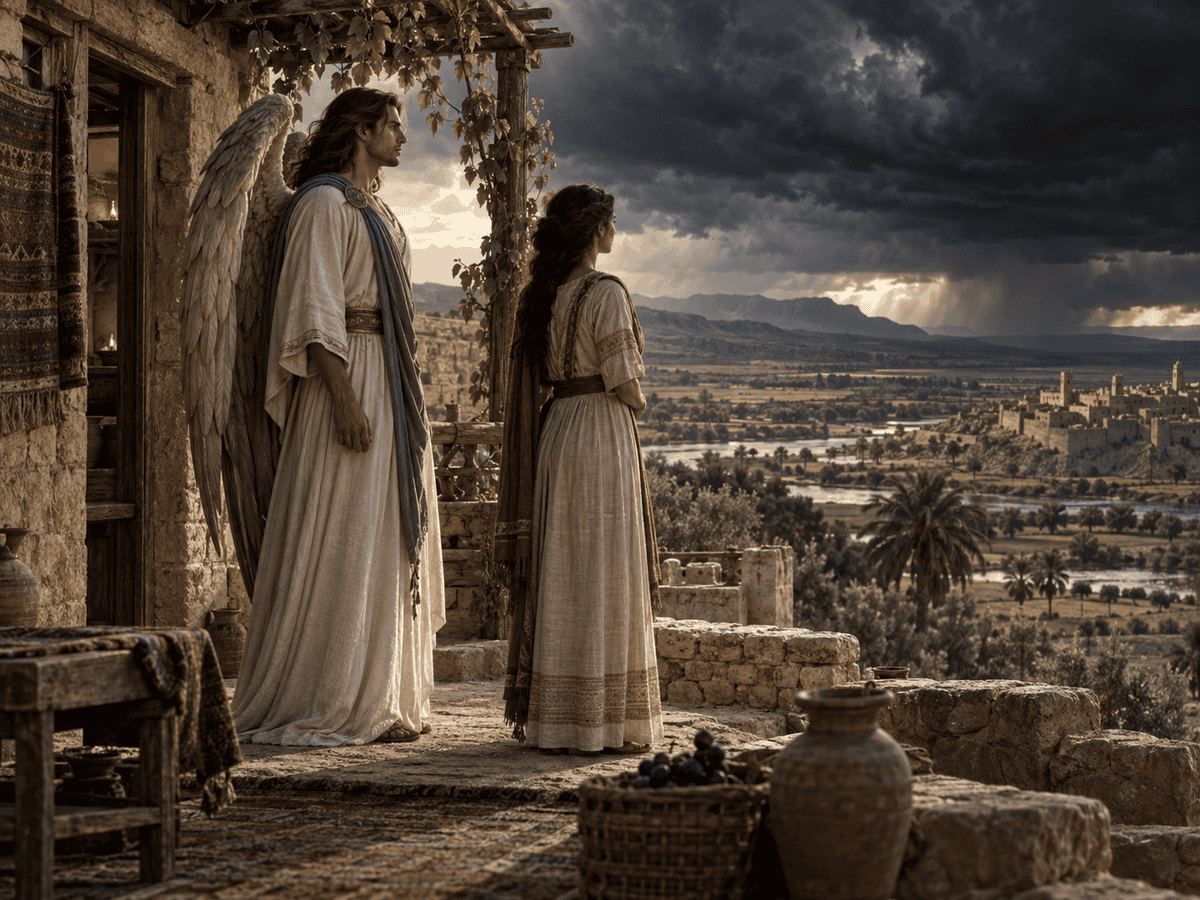
Genesis connects the union of the sons of God and human women with extraordinary figures associated with the Nephilim, although the exact relationship between the groups has been debated.
1 Enoch makes the connection much more explicit. In that tradition, the unions produce giants whose destructive behavior contributes to chaos on earth.
This creates another possible motive behind the Watchers’ decision.
By taking human wives, they establish families and offspring within the human world.
They are no longer temporary visitors. They create a lineage.
The text does not clearly say, “The angels wanted descendants because of this specific reason,” so this remains an interpretation rather than a stated motive.
The Watchers’ attempt to establish themselves within earthly life produces something that the tradition considers deeply unnatural and destructive.
Instead of creating a successful new order, they help throw the existing one into chaos.
5. The Story Warns About Crossing Divinely Established Boundaries

The final reason is less about what the angels consciously wanted and more about what ancient readers could understand from the story.
Genesis repeatedly presents creation through distinctions. Heaven and earth. Land and water.
Different creatures. Humanity with its particular place within creation.
Under the angelic interpretation of Genesis 6, the sons of God violate one of these fundamental boundaries by joining themselves to human women.
Their descendants become destructive, forbidden knowledge spreads, violence increases, and divine judgment follows.
The story therefore works as a warning about beings refusing the limits of their own nature.
Interestingly, Genesis itself remains remarkably brief about the entire event.
It never gives us a detailed conversation explaining what the sons of God thought they would gain.
Most of the elaborate answers come from later interpretation, particularly 1 Enoch.
That mystery may be part of why Genesis 6 has fascinated readers for so long.
If the “sons of God” really were angels, their decision represents one of the Bible’s strangest acts of rebellion:
heavenly beings looking at the human world, desiring part of it for themselves, and crossing a boundary with consequences far greater than they could have imagined.

I always felt a strong connection to the Divine since my birth. As an author and mentor, my mission is to help others find love, happiness, and inner strength in the darkest of times.