

You’ve probably seen it a hundred times – a simple outline of a fish on the back of a car or printed on a t-shirt. You’ve likely seen some people wear it as a tattoo, as well.
But why would a fish represent Jesus?
It’s known as Ichthys, the Greek word for fish, and it’s far more than meets the eye. For early Christians, it was a lifeline in times when they couldn’t let anyone suspect they worshipped Him.
Here’s how a fish became the timeless symbol of Jesus’s love!
1. The Secret Code

Living in the Roman Empire in the first few centuries after Jesus walked the earth wasn’t easy for those who believed in Him.
Being a Christian wasn’t just unpopular; it was dangerous. Being public about your faith often meant a death sentence.
Followers of the early church needed a way to identify each other without attracting attention, so they developed a simple but brilliant solution – a fish symbol.
A believer could casually draw a curve in the dirt with a stick, and another Christian would complete the symbol by drawing a second curve that intersected the first.
Together, they formed a fish.
And if a non-believer happened to walk by, it would look like a random scratch.
This silent code allowed a scattered and terrified community to find safety and share communion in a hostile environment.
2. Decoding Ichthys
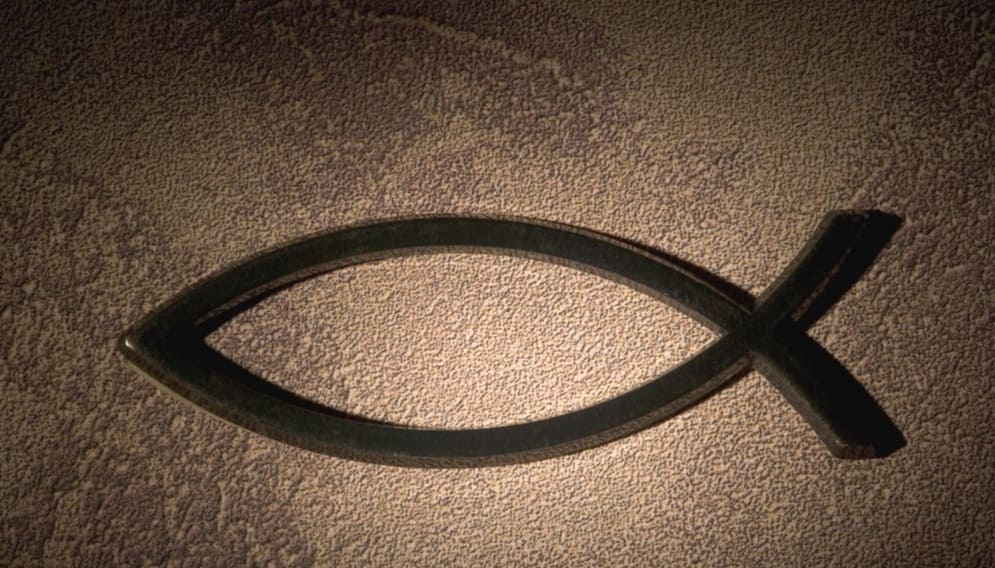
Some think that the fish was chosen mainly because Jesus recruited fishermen as His disciples, but that’s only one part of it.
The real genius lies in the Greek language, which was the common tongue of the Mediterranean world at the time.
The Greek word for fish was Ichthys (ἰχθύς). Early Christians turned this word into an acronym that summarized their entire theology!
Each letter stands for the first letter of a word in the phrase: Iēsous Christos, Theou Yios, Sōtēr.
Translated to English, this means “Jesus Christ, God’s Son, Savior.”
Whenever a believer saw the fish, they were silently reciting the core of the Gospel.
It was a way to preach the sermon without saying a single word.
3. To Be the Fishers of Men

The symbolism of the fish is also rooted in the ministry of Jesus recorded in the Gospels. It connected directly to the daily lives of the first apostles.
Simon Peter, Andrew, James, and John were all working as fishermen on the Sea of Galilee when Christ called them to follow Him.
He used their profession as a metaphor for their new mission, telling them, “Follow me, and I will make you fishers of men.”
Also, Jesus performed miracle after miracle involving fish, like the time He fed five thousand people with five loaves of bread and two small fish.
He also caused Peter to catch a huge amount of fish after a fruitless night at work.
The fish symbol became a reminder of these miracles.
4. A Sign of Baptism

Beyond the miracles and the acronym, the fish became a symbol of baptism and spiritual rebirth.
In the ancient world, water was viewed as the source of life, and for Christians, it was the womb of the church.
Just as a fish can’t survive outside of water, a believer was seen as someone who could only thrive in the spiritual waters of God’s grace.
Tertullian actually said that Christians are “little fishes” born in the water of baptism, following the example of Jesus Christ.
The symbol provided both protection and identity to early believers.
The fish was essentially a declaration that you’ve been born again into a new family.
5. The Link to Jesus’s Name

There is a fascinating and often overlooked linguistic connection that enriches the mystery of this symbol.
The sound of the Greek word links the symbol of fish directly to Christ.
The word Ichthys sounds similar to how Jesus is pronounced in Greek (Iisoús), so there’s a clear phonetic resemblance.
When early Christians spoke about the Ichthys, the sound would echo the name of their Master.
This shows how present the early faith was in the language and culture, ensuring that the name of Christ was always on believers’ lips and in their hearts.
6. The Fish in the Catacombs in Rome

In the underground burial chambers of early Christians in Rome, Ichthys is everywhere.
It’s scratched into walls and tombs, and painted alongside frescoes of loaves and wine. Interestingly, the cross was a rare sight in the early days of faith. Fish was much more common.
This is because the cross was seen as an instrument of torture and execution in Rome, and it wasn’t tied solely to Jesus but to anyone who broke Roman law.
It was a symbol of shame and death. The fish, on the other hand, represented life, abundance, victory, water, miracle, food…
It was a positive, life-affirming symbol that focused on Christ’s power to save rather than the pain He endured.
By marking their graves with the fish, these early believers were proclaiming that even in death, they possessed the eternal life found in Christ.
7. From Fish to the Cross

When Emperor Constantine legalized Christianity in the 4th century, the Christian symbolism began to change.
Once the faith was safe and even popular, there was no need for secret codes. The cross transformed into the central icon of the faith, representing the victory over death and Resurrection.
Churches were built, and crosses were placed on hilltops.
While the fish never disappeared, it has been overshadowed by the crucifix in public worship.
Still, it remains a beloved symbol, a reminder of the era when faith in Jesus was countercultural and dangerous.
8. The Enduring Message of Love

Today, the fish symbol is becoming popular once more, and is typically used to signal “Christian values.”
Businesses and individuals use it to make their beliefs clear right off the bat.
While it has become somewhat commercialized and diluted, it is still a reminder of Jesus’s love and the struggles of early believers.
Every time you see Ichthys, you can remember the boldness of the early church that preserved Christ’s teachings for centuries between His resurrection and the legalization of the faith.

A little Aquarius, devoted to writing and embroidery. Through my writing, I hope to empower readers to align with their true selves and navigate life’s mysteries with confidence.