
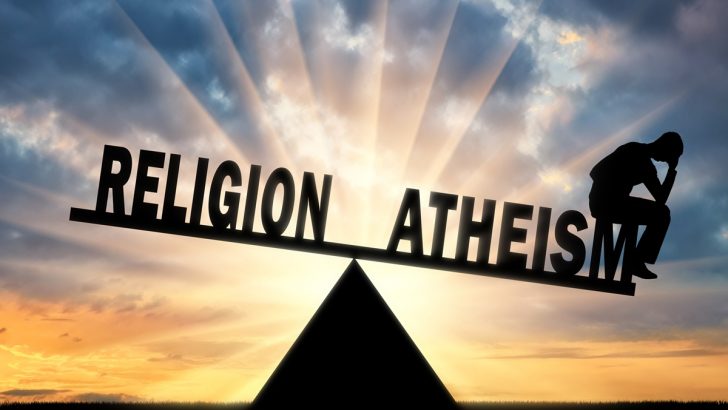
Religion can be one of the most personal topics people discuss. While many conversations between believers and nonbelievers are respectful and thoughtful, there are also certain comments that tend to make atheists sigh internally and prepare for a discussion they’ve had approximately 4,000 times before.
The truth is that atheists are a diverse group. Some are deeply interested in philosophy and theology. Others simply don’t believe in a deity and would rather talk about literally anything else. But regardless of their individual views, there are a few phrases that have become the equivalent of conversational déjà vu.
If you’d like to have better discussions—and avoid accidentally sounding like you’ve copied and pasted your talking points from a 1997 internet forum—here are ten things you probably shouldn’t say to an atheist.
1. “So You Worship Satan?”

This question manages to misunderstand both atheism and Satanism at the same time, which is honestly an impressive achievement.
Atheists don’t believe in God, which also means they don’t believe in Satan as a supernatural being. From their perspective, asking whether they worship Satan is a bit like asking someone who doesn’t believe in unicorns whether they worship evil unicorns.
The confusion usually comes from assuming that everyone falls into one of two categories: Team God or Team Devil. But atheism is simply a lack of belief in gods. It isn’t a rival religion with a dark headquarters hidden inside a volcano.
Most atheists have heard this question enough times to predict it before it’s even asked. While some may laugh it off, others find it frustrating because it suggests their views haven’t been understood at all.
A better approach is to ask what they actually believe rather than assuming they’re part of a supernatural villain origin story.
2. “But Where Do You Get Your Morals?”

Few questions make atheists roll their eyes faster than this one.
The assumption behind it is that morality only exists because of religion. But many atheists base their ethics on empathy, reason, social cooperation, philosophy, cultural values, and a desire to reduce harm.
After all, most people don’t refrain from stealing because they’re worried about being struck by lightning from heaven. They refrain from stealing because it’s wrong, hurts others, and would make society pretty unpleasant.
Atheists often point out that moral behavior existed in human communities long before modern religious institutions. Cooperation and fairness helped people survive and thrive.
The question can come across as implying that atheists are one bad day away from becoming supervillains. In reality, most are just ordinary people trying to be decent humans—exactly like most religious people.
3. “You’re Just Angry at God”

This statement creates a fascinating logical problem.
If someone doesn’t believe God exists, it’s difficult for them to be angry at God in the same way it’s difficult to be angry at a fictional character for raising your taxes.
Certainly, some atheists were raised religious and may have experienced negative encounters with religious institutions. Others may have gone through painful life events that influenced their beliefs. But many simply arrived at atheism after examining evidence and reaching a different conclusion.
Reducing their position to hidden anger often dismisses years of thought and personal reflection.
Imagine spending a decade researching a topic, carefully evaluating arguments, and then being told your entire worldview is actually just a bad mood. Most people would find that a little irritating.
4. “You’ll Believe When Something Bad Happens”

This statement usually sounds less persuasive than the speaker intends.
First, many atheists have already experienced serious hardships. They’ve dealt with loss, illness, heartbreak, financial struggles, and countless other challenges without becoming religious.
Second, difficult experiences affect people differently. Some individuals become more religious during hardship. Others become less religious. Some don’t change their beliefs at all.
The assumption that suffering automatically leads to faith oversimplifies how people process adversity.
It can also come across as oddly competitive, as though someone is waiting for tragedy to arrive and prove a point. That’s not exactly the warmest conversation strategy.
Most atheists understand that life contains both joy and suffering. They simply interpret those experiences through a different worldview.
5. “You Just Want to Sin”

This is one of those statements that sounds dramatic enough to belong in a medieval play.
The idea is that atheists secretly believe in God but reject religion because they want unlimited freedom to behave badly. According to this theory, atheism is essentially a giant excuse to eat extra dessert and commit crimes.
The problem is that most atheists don’t see morality as dependent on religious belief. Many live highly ethical lives, maintain strong personal values, and make responsible choices.
Also, let’s be honest: most “sins” people imagine atheists are desperate to commit are things many religious people struggle with too. Humans are human.
Atheists generally don’t wake up each morning twirling imaginary mustaches and plotting new ways to rebel against cosmic authority. Most are focused on work, family, hobbies, and wondering where they left their phone charger.
6. “Atheism Is Just Another Religion”

This comparison appears frequently, but atheists often reject it for a simple reason.
Religions typically involve beliefs, rituals, sacred texts, institutions, clergy, or systems of worship. Atheism, by itself, is simply a lack of belief in gods.
That’s it.
Two atheists can agree on atheism and disagree about almost everything else—politics, philosophy, ethics, science, economics, and whether pineapple belongs on pizza.
Calling atheism a religion can feel like calling baldness a hairstyle.
While some atheists participate in organizations or communities, atheism itself doesn’t automatically come with ceremonies, doctrines, or weekly meetings in a giant underground lair where everyone discusses science documentaries.
7. “You Must Think You’re Smarter Than Everyone Else”

This stereotype appears surprisingly often.
Some people assume atheists reject religion because they believe they’re intellectually superior. While a few individuals may certainly be arrogant—just like members of every group—atheism itself doesn’t imply anything about intelligence.
There are highly educated religious people and highly educated atheists. There are uninformed religious people and uninformed atheists. Human beings come in endless varieties.
Many atheists are actually reluctant to discuss religion because they don’t want conversations to become arguments about who is smarter.
Disagreement doesn’t automatically equal arrogance. People can look at the same questions and reach different conclusions while still respecting each other’s intelligence.
At least, that’s the ideal outcome when social media isn’t involved.
8. “What If You’re Wrong?”

Atheists hear this question so often they could probably answer it in their sleep.
Most have considered it extensively. In fact, many atheists spent years examining religious claims before reaching their current position.
The question itself isn’t necessarily rude. It becomes problematic when it’s presented as a conversation-ending trump card.
After all, the same question can be asked in reverse. What if a believer is wrong about their specific religion? What if another religion is correct? What if nobody has the complete answer?
Questions about ultimate reality are complicated. Most atheists recognize uncertainty exists and are comfortable acknowledging what they don’t know.
The conversation tends to be more productive when both sides explore questions together rather than treating uncertainty as a weapon.
9. “You’re Going to Hell”

This statement rarely achieves its intended effect.
For one thing, atheists generally don’t believe hell exists. Telling an atheist they’re going to hell is often received with roughly the same level of concern as being told they’re on Santa’s naughty list.
More importantly, it tends to shut down meaningful discussion immediately.
Threats—whether supernatural or otherwise—aren’t usually effective tools for persuasion. They often create defensiveness and resentment instead.
Even many religious people view this approach as unhelpful because it prioritizes fear over understanding.
If the goal is genuine conversation, there are far better ways to discuss beliefs than opening with eternal punishment.
10. “You’ll Change Your Mind Someday”
Could they? Sure. People change their minds about all sorts of things.
But assuming someone’s beliefs are merely a temporary phase can come across as dismissive.
Most adult atheists didn’t arrive at their worldview accidentally. They’ve often spent considerable time thinking, reading, questioning, and evaluating ideas.
Telling them they’ll eventually come around may feel similar to telling a religious person they’ll eventually abandon their faith. Neither statement is likely to be received particularly well.
People deserve the respect of having their current beliefs taken seriously, even when we disagree with them.
The future is unpredictable. Some atheists become religious. Some religious people become atheists. Many remain exactly where they are. The important thing is recognizing that sincere people can hold different views without treating each other as unfinished projects.

Lover of good music, reading, astrology and making memories with friends and spreading positive vibes! 🎶✨I aim to inspire others to find meaning and purpose through a deeper understanding of the universe’s energies.