
Enochian is often called the language of angels, and its story begins with two men in the 16th century.
English scholar John Dee and his associate Edward Kelley recorded words, symbols, and messages they believed angels had revealed to them.
The surviving manuscripts give us a fascinating record of that belief.
They don’t prove where the language came from, but they show why Dee thought it could unlock knowledge hidden from the rest of humanity.
1. It Started With a Scholar and a Scryer
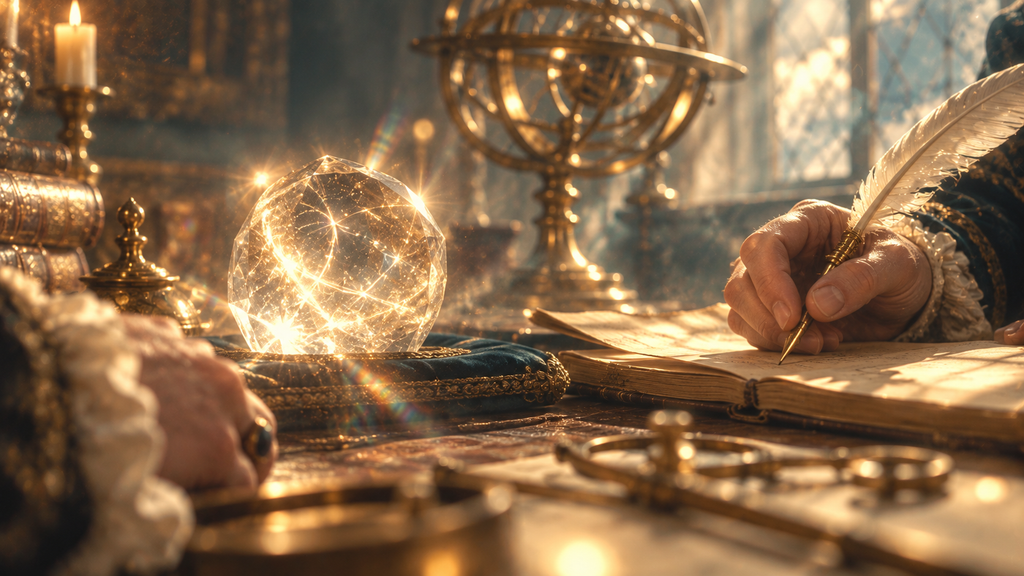
John Dee was a mathematician and natural philosopher who studied how language, numbers, religion, and the natural world fit together.
Kelley took a different role. He was the scryer, gazing into a crystal stone while Dee asked questions and wrote down what he saw and heard.
Their surviving notebooks record angelic conversations from 1581 onward.
In the years that followed, their sessions produced a new alphabet and texts in an unfamiliar language.
Dee believed they were receiving messages from angels, and he treated the records as a serious attempt to gain knowledge from beyond the human world.
2. Dee Thought Language Could Unlock Creation
To Dee, this wasn’t just a strange collection of words.
He believed the first human language had been spoken by Adam before the Fall, and that it expressed God’s creation more directly than ordinary speech.
Recovering that language, he thought, could help restore lost knowledge of the world and bring people closer to divine truth.
His angelic work grew out of a wider Renaissance interest in sacred language and the idea that words could reveal the order beneath nature.
That makes the project easier to understand, even if you don’t accept Dee’s explanation for it.
He was trying to reach a source of knowledge he believed human beings had lost.
3. Why Is It Called Enochian?

The name Enochian points to Enoch, the biblical figure associated in later tradition with heavenly knowledge.
Dee’s own manuscript uses the phrase “angelical keys” for an important group of texts, and he also connected the language with the sacred knowledge of ancient patriarchs.
So the familiar name can make the material sound older and more settled than it is.
The records we can examine come from Dee and Kelley’s 16th-century sessions.
“Enochian” is now used for the language and the broader magical tradition that grew around those records.
4. One of Its Strangest Texts Is a Book of Grids
Among the manuscripts is a work called Liber Loagaeth, also known as the Book of Enoch.
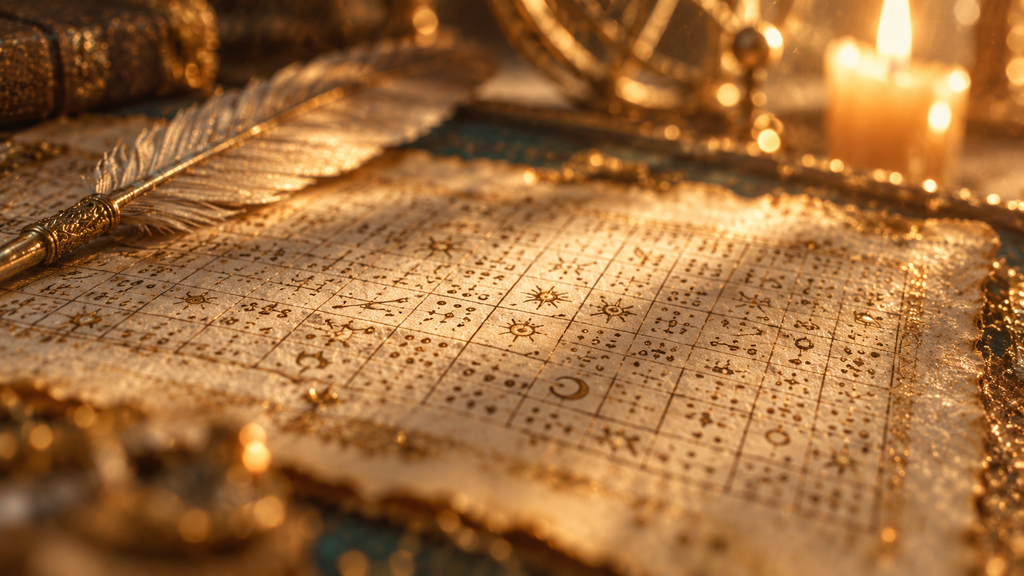
Kelley transcribed it in 1583. Much of it isn’t written as sentences on a page. Instead, the manuscript contains grids filled with letters and numbers.
It looks less like a book you’d read from beginning to end and more like a puzzle with no obvious solution.
The British Library catalog describes grids with 49 rows and 49 columns, and records the volume as part of Dee’s angelic conversations.
For Dee, those pages belonged to a sacred revelation. Their unfamiliar form was part of the mystery. The text seemed to promise knowledge, even when its meaning remained out of reach.
5. The Angelical Keys Were Meant to Be Spoken
The most recognizable Enochian texts are the 48 Angelical Keys, also called Calls.
Dee recorded them between April and July 1584 while he was in Krakow, Poland.
They belong to the same body of work as the language, but they have a different feel from the grids of Liber Loagaeth. These are structured texts meant to be spoken in magical practice.
Enochian isn’t a storehouse of everyday conversations. The surviving material is made up of revelations, symbolic tables, and ritual language.
It’s a body of texts tied to a particular spiritual project, rather than a language preserved through ordinary daily use.
6. Is Enochian a Complete Language?

There’s enough material for scholars and occultists to study its vocabulary and structure.
Linguist Donald Laycock published a dictionary of the language, while a separate academic analysis argued that Enochian is best understood as fragmentary, enciphered English.
That interpretation doesn’t settle the question of where the texts came from. It does, however, show why it’s better to be careful with sweeping claims.
The surviving texts offer a limited sample, and they don’t give us the kind of broad record we’d need to demonstrate how people spoke Enochian in ordinary life.
We can say that Dee and Kelley recorded a distinct body of words and texts they associated with angels.
Whether it came from angels, Kelley’s own mind, or some other process is a different question, and the historical record can’t answer it on its own.
7. The Enochian Used Today Has a Later History
The version of Enochian magic many people recognize today took shape centuries after Dee and Kelley.
In the late 19th century, occultists including members of the Hermetic Order of the Golden Dawn reworked Dee’s materials into a larger ceremonial system.
Later practitioners, including Aleister Crowley, carried that tradition further.
That means modern Enochian practice doesn’t simply repeat Dee’s original work. It builds on the manuscripts while adding new interpretations and methods.
Historians have traced how those later groups reshaped the material as it passed from one generation to the next.
Enochian remains compelling because its history leaves room for both belief and doubt.
The manuscripts are real, and Dee and Kelley’s efforts to communicate with angels are documented.
What we have is a record of two men who believed they had heard something extraordinary, and a set of texts that still invites people to ask what, exactly, they heard.
